Earthquakes on the Peninsula: what risk is there?
Seismic movements are not a strange phenomenon in southern Spain and there is no evidence that more are occurring now than ever
-
CAT -
CAST
BarcelonaEarthquakes continue to shake Granada. On Tuesday morning, in just under an hour, a series of seven seismic events —one of which reached a magnitude of 4.8— shook the Andalusian province. And at night there were six more, the largest at 3.4. But this Wednesday, about fifty have been experienced: the National Geographic Institute (IGN) has registered 55 seismic movements, most of low intensity. Only three were perceived by residents. It seems that Granada is experiencing a seismic swarm – several earthquakes have been concentrated in the same area and in a short period of time – since early Saturday morning there was a first tremor.
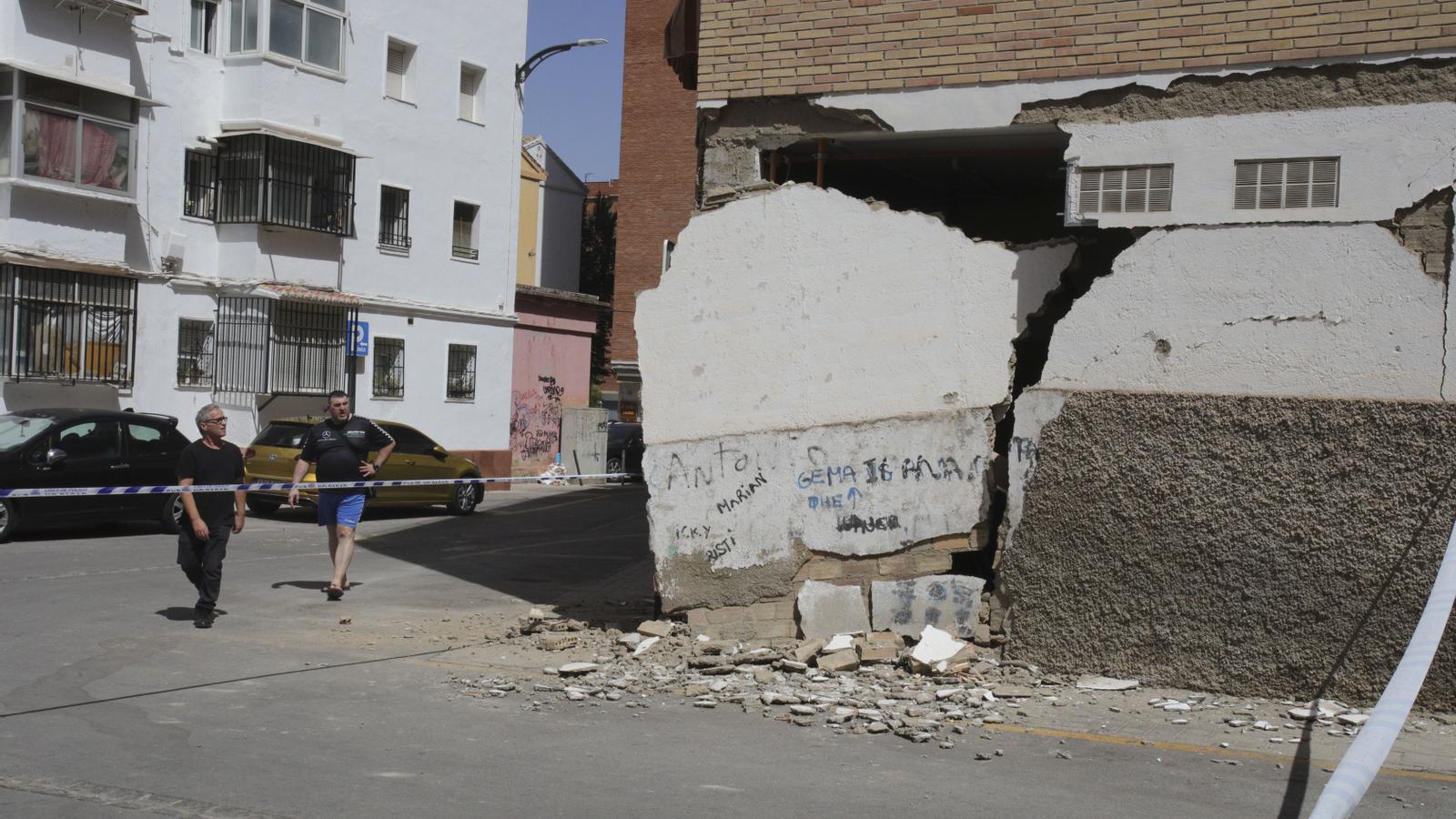
Gójar, Churriana de la Vega, Alhendín, Ogíjares... Each of the seismic events has had a different epicenter and some have been perceived in the Granadian capital. The seismic episode has left three slightly injured – including a minor – and a tense atmosphere in the population, fatigued by the constant low-intensity tremors since Saturday. The good news: apart from some material damage, only 14 out of 580 inspected buildings require urgent shoring or management measures.
The immense majority of tremors in Granada have not been perceptible and the damage is superficial. But, after the tragedies in Venezuela, Colombia, and Indonesia, this episode has raised some questions: can there be more aftershocks? Are there more earthquakes than ever and are they more devastating?
The associate professor of earth physics in the Department of Earth and Ocean Dynamics at the University of Barcelona (UB), Álvaro González, explains that seismic movements are not uncommon in southern Spain. In fact, territories like Granada, Almería, Murcia, and Alicante are categorized as seismic risk zones. "Andalusia has registered other similar episodes that often last for days or weeks, even months. Their evolution is difficult to anticipate, as they can gradually lose intensity or present new earthquakes of greater magnitude," he summarizes. In the case of Granada – which stands out on the seismic risk map – there is an area with active faults.

If you want to investigate the chart in more detail, open the high-resolution version in another tabFaced with this concentration of earthquakes, the Granada council has elevated the emergency to phase 1 to offer more resources and reinforce coordination between authorities. It has also opted to evacuate the Alhambra museum complex – which has not suffered any damage – and public buildings for non-essential services, and has also evacuated a hundred homes about 10 kilometers away, in the municipality of Las Gabias, due to the appearance of cracks. However, the impact of this series of earthquakes has been moderate. The main damage has been to facades and furniture elements. Emergency services have responded to more than half a thousand calls to the 112 number, although most medical assistance has been for anxiety crises.
Is it normal?
González explains that the low perception of seismic risk in Spain does not mean that the country is free from major earthquakes. The area with the highest hazard is concentrated in the southeast, but there are also areas of significant hazard in the Pyrenees. "The issue is, above all, their frequency," anticipates the expert. The State has suffered major destructive earthquakes, but episodes of magnitude 6 or 7 are much less common than in regions like Indonesia, Chile, or Colombia. Furthermore, they can be separated by several centuries. According to the National Geographic Institute, 30 major earthquakes have occurred in Spain since records began in 1048, and the most recent was in 2011 in the municipality of Lorca (Murcia). With a magnitude of 5.1, the tremor left nine dead.
Earthquakes occur when blocks of rock in the subsoil suddenly shift relative to each other, releasing accumulated energy all at once. In the case of Granada, one of the hypotheses being studied is that the circulation of groundwater at great depth may favor the slippage of certain fractures. But everything is very incipient. Experts also cannot know if this Tuesday's tremors are aftershocks of Saturday's early morning earthquake or if they are linked to an adjacent fault that has reactivated. The head of prevention and seismic risk at the Andalusian Institute of Geophysics, Mercedes Feriche, explains to Efe that it will be necessary to wait for the series to end – which could last for weeks or months – to determine its origin. However, experts are not alarmed and believe they should gradually lose intensity.
The low frequency of tremors may contribute to the population forgetting that a risk exists, but the seismometer network installed in the area by the National Geographic Institute and the Andalusian Institute of Geophysics also allows for the detection of hundreds of small movements that go unnoticed. This information will allow for a detailed analysis of how the swarm will evolve: whether the number of earthquakes decreases, whether their magnitudes change, or whether larger earthquakes begin to occur than those recorded so far. "Right now, the most likely scenario is that no larger earthquakes will occur. Although this possibility exists, it cannot be completely ruled out. The probability is approximately 1%," states González.
Are there more earthquakes than ever?
There is no evidence that there are generally more earthquakes now. There are periods with more activity and others quieter, and they can be temporarily concentrated in certain regions. What has changed is the capacity to detect them and the population's exposure. "And a higher number of destructive earthquakes does not necessarily imply that there are more earthquakes. The impact depends largely on where they occur, how much population is exposed, and the resistance of buildings," says González. A moderate earthquake in a densely populated area with vulnerable buildings can cause more damage than a much larger one in a remote region or with high seismic preparedness.
According to the annual report of the United States Geological Survey (USGS), in 2025 they registered 138,466 earthquakes worldwide. However, in most cases, either their magnitudes were weak – below 3 – or they occurred in locations far from urban areas. Thus, the USGS only highlights fourteen earthquakes, which caused significant human and economic losses. The most notable occurred in Myanmar and Thailand – with 1,600 deaths and 3,400 injured – in Tibet (126 deaths) and in Afghanistan (1,124 deaths and 3,251 injured). This year, the USGS has registered 17,850 earthquakes. In the same period of 2025, nearly a thousand more were counted (18,994).
