Crisis in Ceuta: the open border that only existed on social media
Meta and TikTok agree with the European Commission to verify content on new migrant entries

-
CAT -
CAST
MadridJust a few hours had passed since tens of thousands of migrants entered Ceuta, and the Spanish government was setting its sights on social networks. Pedro Sánchez's executive assured that these were the channels through which it had been amplified that the border between Morocco and the autonomous city was open and that the returns of people who entered swimming would not occur because the Supreme Court had so decreed. More than ten days later, the executive maintains the thesis: "[Social networks] They were the detonator. The vehicle that led thousands of people to Ceuta," stated the Minister of Foreign Affairs, José Manuel Albares, this Tuesday at a press conference from the autonomous city. Various investigations have detected content in these digital channels claiming success – not being expelled – if one swam from Morocco to Ceuta. Even maps with drawings representing the crossing.
Various testimonies collected by ARA from Ceuta – people who entered swimming and are still in the city in a situation, many of them, of humanitarian emergency – acknowledged that they had seen or received through Facebook, Instagram, TikTok or WhatsApp videos and text messages indicating that the Spanish border "was open." El Mourand (Marrakesh), Farah (Tetouan), and Hibbane (Comoros) explain this when asked why that Thursday, July 30, was when they decided to throw themselves into the sea and risk their lives to reach Spain.
The phenomenon does not distinguish nationalities, and speaking with one and another, the sensation of a spreading stain that had been spreading like wildfire emerges: access to almost real-time information and the capacity for instant mobilization. The number of people who entered, however, calls into question the spontaneity resulting solely from these channels. El Mourand, for example, acknowledges to ARA that he found no obstacles at the Moroccan border.
"We are fighting disinformation on social networks", said Albares, who took the opportunity to raise the tone regarding the future of all migrants who remain in Ceuta and warned that they will be returned. Since August 3rd, the profile of the Spanish embassy in Morocco on X has disseminated information in Spanish, English, French, and Arabic, denying a border opening. Also, that it is possible to cross to the Peninsula or Europe once one enters Ceuta or Melilla. This Tuesday, the embassy has launched a concise message: "Entering Ceuta or Melilla irregularly does not grant the right to stay in Spain or access the rest of Europe. All information to the contrary is FALSE".
In an interview with ARA, Jukka Savolainen, an analyst at the European Centre of Excellence for Countering Hybrid Threats (Hybrid CoE), underlined that migrants are used as a pressure weapon in so-called "hybrid wars", which are not fought with armies and weapons, but with unconventional methods, such as fake news."Someone spreads information on social networks and it is immediately transmitted to communities in countries where a large part of the people want to migrate," he said.
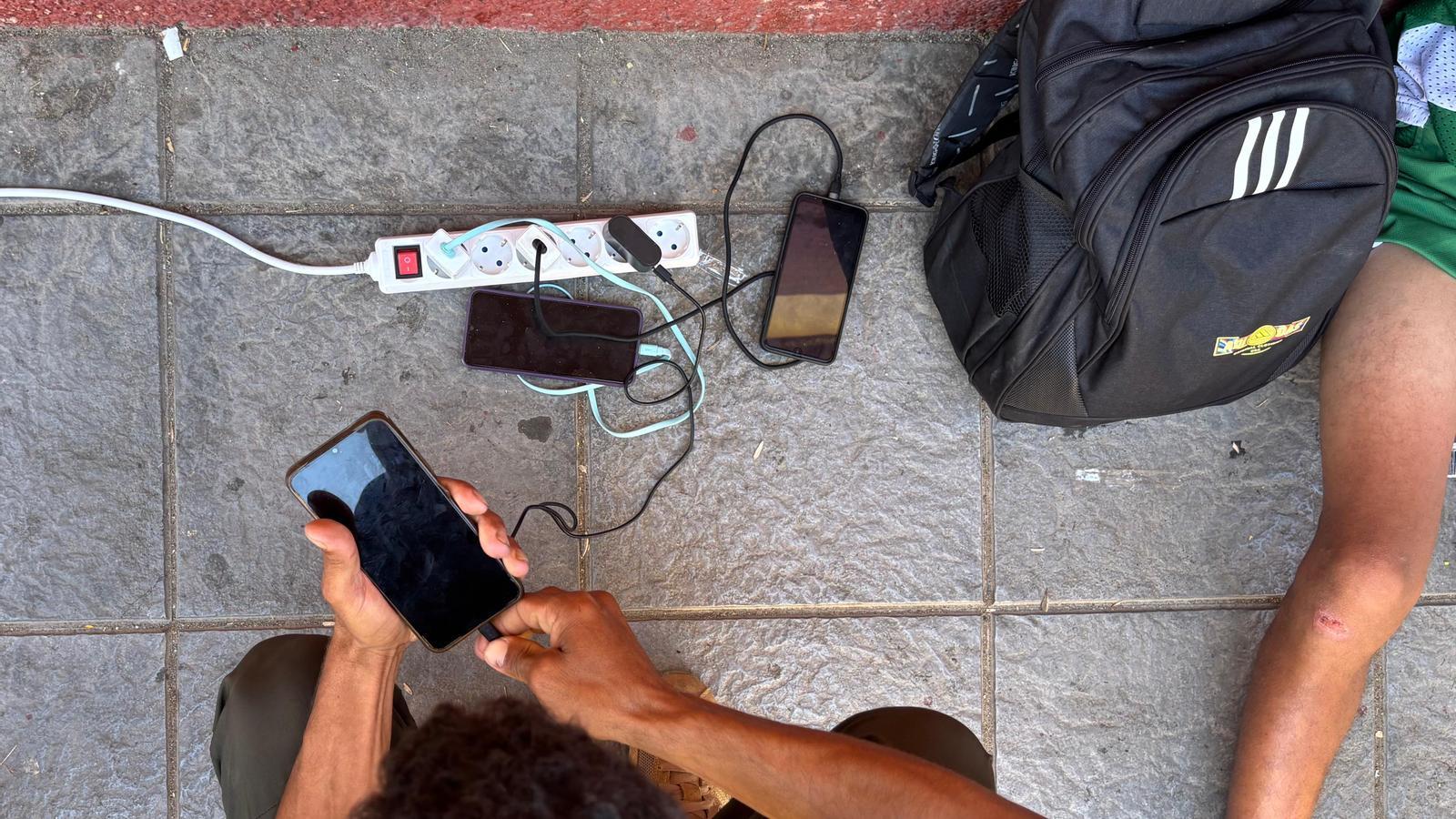
The mobile phone is an indispensable element for anyone who decides to migrate. Almost all the people in Ceuta had one with them, if they hadn't lost it at sea or it had broken. In fact, charging it was one of the priorities to be able to contact family in the country of origin and say they had arrived, but also to search for information or even use online translators – if they had wifi or a compatible card in the State – and break the language barrier.

A "new element"
The truth is that the digital space has never been alien to migration. It is the channel –often the only one– that many people use to communicate with their country of origin. Before to organize the migratory route. And social networks, in particular, have also become the channel through which they can convey how their new life is going, regardless of whether it is more or less real. This time, however, they would have appeared as a "new element", in the words of Albares, with regard to their influence on a massive entry.
Both the Spanish government and Brussels initiated a "supervision" of these dissemination channels and their impact a few days ago. In this regard, the Executive Vice-President of the European Commission, Henna Virkkunen, announced this Tuesday that Meta and TikTok have launched a verification mechanism for content on irregular entries from Morocco to Ceuta. The objective, said Virkkunen, is to detect false information that human trafficking networks may use to promote new entry attempts, and to respond quickly. Furthermore, the Ministry of Foreign Affairs has also pointed to a "joint action" with Morocco to combat their impact.
Beyond Europe
In any case, the role of social networks transcends Europe. In the case of the border between Mexico and the United States, the United Nations has put the so-called "digital coyotes" in its sights: fake profiles, advertisements, or groups that present themselves as reliable intermediaries and offer help to obtain visas, jobs, or regularization once the border is crossed. They attract migrants with the promise of an easy and less bureaucratic process, which often leads to victims of fraud or puts them in risky situations. Brussels has also pointed out that behind some of the profiles that have operated in the Ceuta crisis are "illicit transit networks".
In any case, NGOs are asking that the focus not only be on social networks or mafias, as the government has said. They recall that migration, which is a fundamental human right, is mainly related to the need and desire to leave behind the situation in the country of origin and seek a better life.
