Nobel Prize in Chemistry for the research that has solved the enigma of the asymmetries of nature
Scientists Henri Kagan and Kenso Soai take the recognition for their study on the mirror images of certain molecules
-
CAT -
CAST
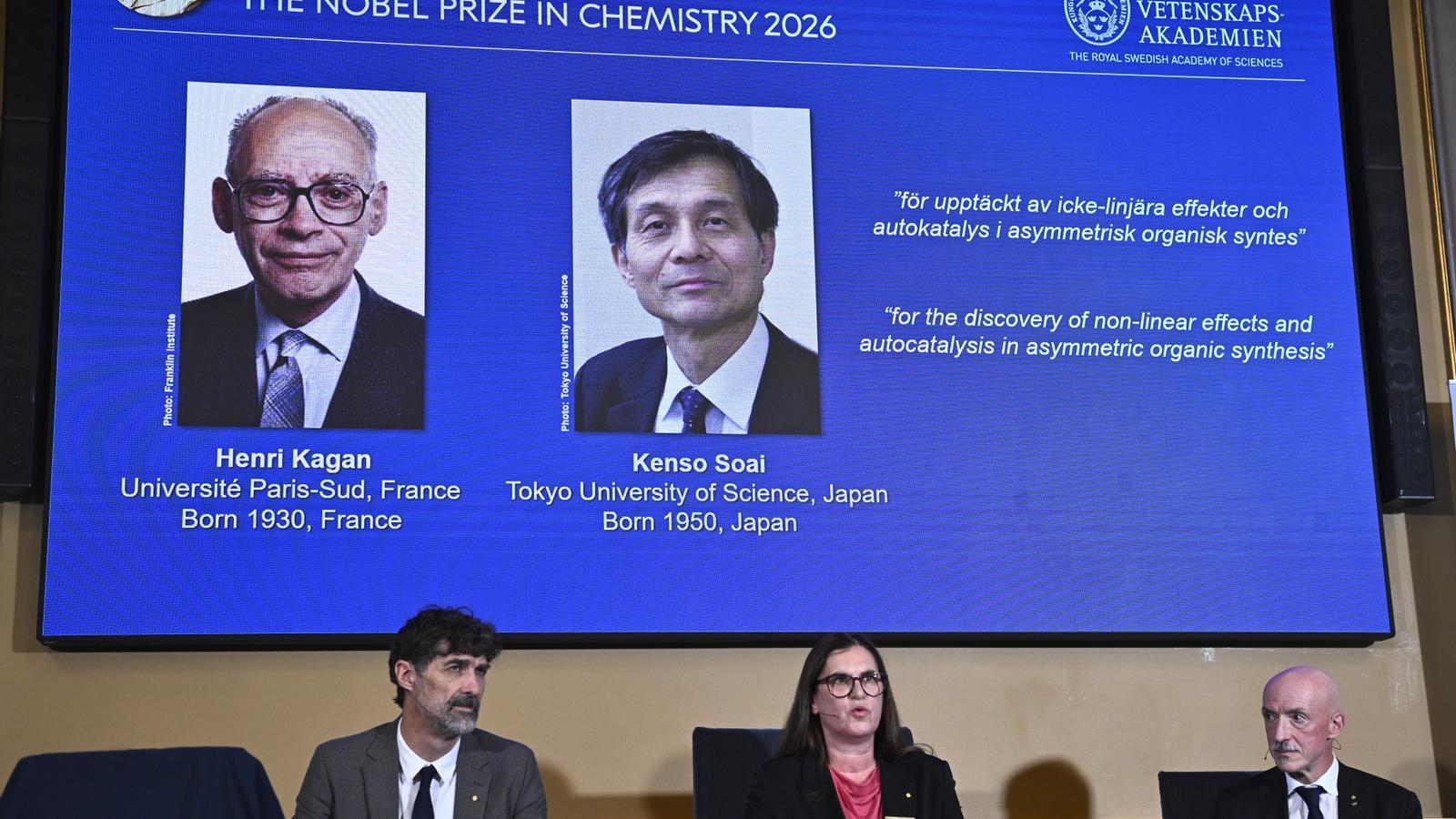
The Royal Swedish Academy of Sciences awards the 2026 Nobel Prize in Chemistry to researchers Henri Kagan, a French professor at the University of Paris-Sud, and Kenso Soai, a Japanese professor at the Tokyo University of Science, "for the discovery of non-linear effects and autocatalysis in asymmetric organic synthesis." Their research on the asymmetries of nature has won the prestigious award.
"Some molecules, like amino acids, exist as two variants that are mirror images of each other. However, living organisms only contain one of these mirror images. How such a chemical asymmetry could arise was for a long time a mystery to chemists," explains the prize committee in a statement. Researchers Kagan and Soai have succeeded in solving this enigma.
The announcement was made this Wednesday at 11:45 a.m., Catalan time. Since 1901, this award has been given 117 times and has been received by 198 people.
Last year, the prize went to the Japanese Susumu Kitagawa, from Kyoto University; the British Richard Robson, from the University of Melbourne; and the Jordanian Omar M. Yaghi, from the University of California. The three researchers were awarded for having discovered metal-organic frameworks, a new architecture in the world of chemistry in which biological concepts are mixed. Specifically, these structures allowed opening the door to applications as diverse as boosting chemical reactions, storing gases, and capturing and destroying polluting compounds.
Regarding this year's award, the prize is endowed with 12 million Swedish kronor, after the Nobel Foundation increased the amount in 2026. The award has been granted since 1901, and Chemistry was the most important science in the work of the prize's creator, Alfred Nobel.
