This is what Earth looks like from the far side of the Moon
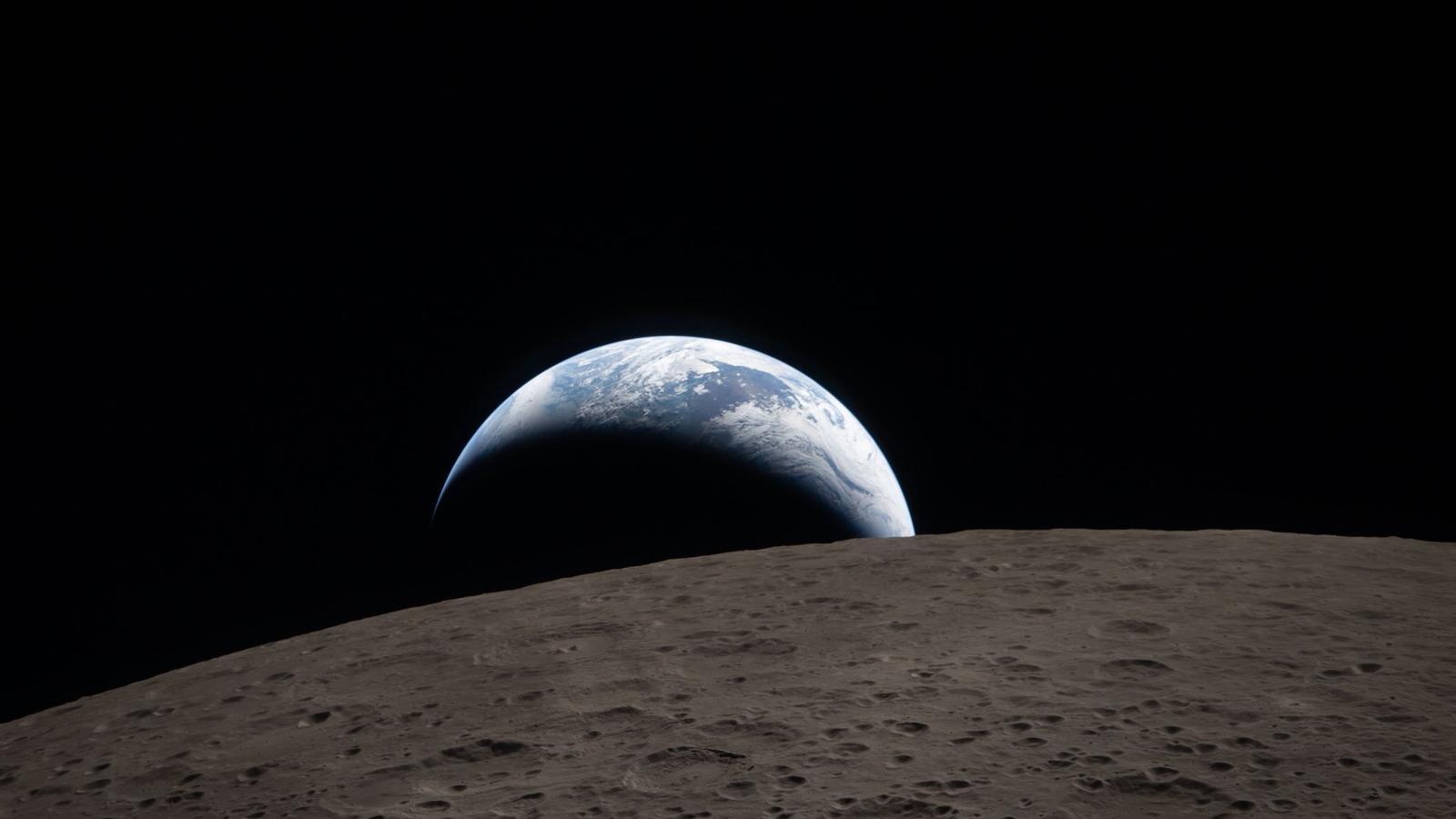
The White House distributes the first two images of Earth from the far side of the Moon and of the solar eclipse that the four astronauts have seen from space
-
CAT -
CAST
BarcelonaThe most symbolic images of the Artemis II space mission can now be admired. The White House has distributed the first two photographs in which the Earth can be seen from the far side of the Moon and another image of the total solar eclipse that the crew has experienced from space. "Humanity from the other side" ("Humanity, from the other side", in the original message), has been the text accompanying the images distributed from the official account of the presidency of the United States.
"See you on the other side," they were bid farewell from the control room before losing connection. During more than 40 minutes of absolute silence, the spacecraft has positioned itself about 6,545 kilometers away from the Moon's surface, the closest point of the mission. On its passage behind the Moon –the side that cannot be seen from Earth–, the astronauts, Rise Wiseman, Christina Koch, Victor Glover, and Jeremy Hansen, have studied the satellite's far side through photographs and direct observation through the capsule's windows. The crew has been able to inform NASA about the nuances of colors, which will help improve the scientific understanding of the Moon.

“Human eyes and brains are very sensitive to subtle changes in color, texture, and other surface features,” NASA says, so astronauts can provide details that cameras and other technologies miss. “Direct observation of the lunar surface by astronauts, along with all the scientific advances made in recent decades, could reveal new discoveries and a deeper appreciation of the lunar surface’s characteristics,” the space agency says.

The four astronauts have finished the lunar observation period, a historic day and the crucial stage of the mission, at 1:30 AM this Tuesday, and they expect to leave the Moon's sphere of influence at 7:25 PM and arrive on Earth on Friday. "It is wonderful to feel you from Earth again. In Asia, Africa and Oceania: we are looking at you. You can look up and see the Moon at these moments. We see you too," said astronaut Koch after communications were re-established.

In a call between the four members of the Artemis II mission and Donald Trump, broadcast by NASA, the President of the United States thanked the astronauts for their "bravery" and said that the American flag will return to the Moon to leave there "not just footprints," but to establish there "a permanent mission."
The ship's crew has thus surpassed the record of Apollo 13, which is the manned mission that had until now flown furthest from Earth, at 400,171 kilometers away, in the year 1970. The Orion capsule in which they are traveling had already broken this record during the Artemis I mission in the year 2022, but then it was traveling without a crew.

"We want to pay tribute to our predecessors in space exploration. And challenge the current generation and future ones so that this record is not long in being broken again," said Canadian astronaut Jeremy Hansen. After surpassing Apollo 13, the astronauts have proposed names for two lunar craters to NASA's control center. One will bear the name the crew has given to the spacecraft, Integrity, and the other will be called Carroll, in honor of Commander Reid Wiseman's wife.
"Radio silence"
The Orion spacecraft of Artemis II lost contact with Earth for about 40 minutes at 0:44 AM in Catalonia because the Moon blocked all communications. NASA had assured that they had it completely under control, as before Artemis II, more than twenty astronauts from the Apollo missions had experienced this absolute silence. The Moon has a solid mass of almost 3,500 kilometers in diameter, and prevents radio waves from the NASA control center and those from the capsule from contacting each other, so they had to wait for Orion to appear on the other side of the satellite. This silence has been unusual for the astronauts, who are in permanent contact with experts on Earth.
Return to Earth
After a few hours of observation, the astronauts will now use the Moon's gravitational force to gain momentum for the return to Earth, a journey that will last about four more days. For the first time, the astronauts are also bringing their own mobile phones to capture images, which NASA will share on social media. Additionally, the capsule has 32 cameras and different devices to capture the maximum detail.
It should be taken into account that the Moon has a hidden face due to synchronous rotation, meaning that the satellite takes the same amount of time to complete one rotation on its axis as it does to complete an orbit around the Earth. This means that it always shows the same face to our planet, so the other side is not visible from Earth. The study of this hidden region of the satellite must be done using telescopes, satellites, and lunar missions like Artemis II.
It is worth mentioning that the two faces are very different: while the visible one has large basaltic lava plains called “seas”, the hidden one mainly presents craters and mountains due to meteorite impacts. The eastern basin has been one of the main objects of study by the crew, and specifically an impact crater 930 kilometers wide in the southern hemisphere of the Moon.
