Artemis II is already on its way to the Moon
The mission will last 10 days, orbit the satellite and return to Earth to test the technology that will enable a lunar landing in 2028

-
CAT -
CAST
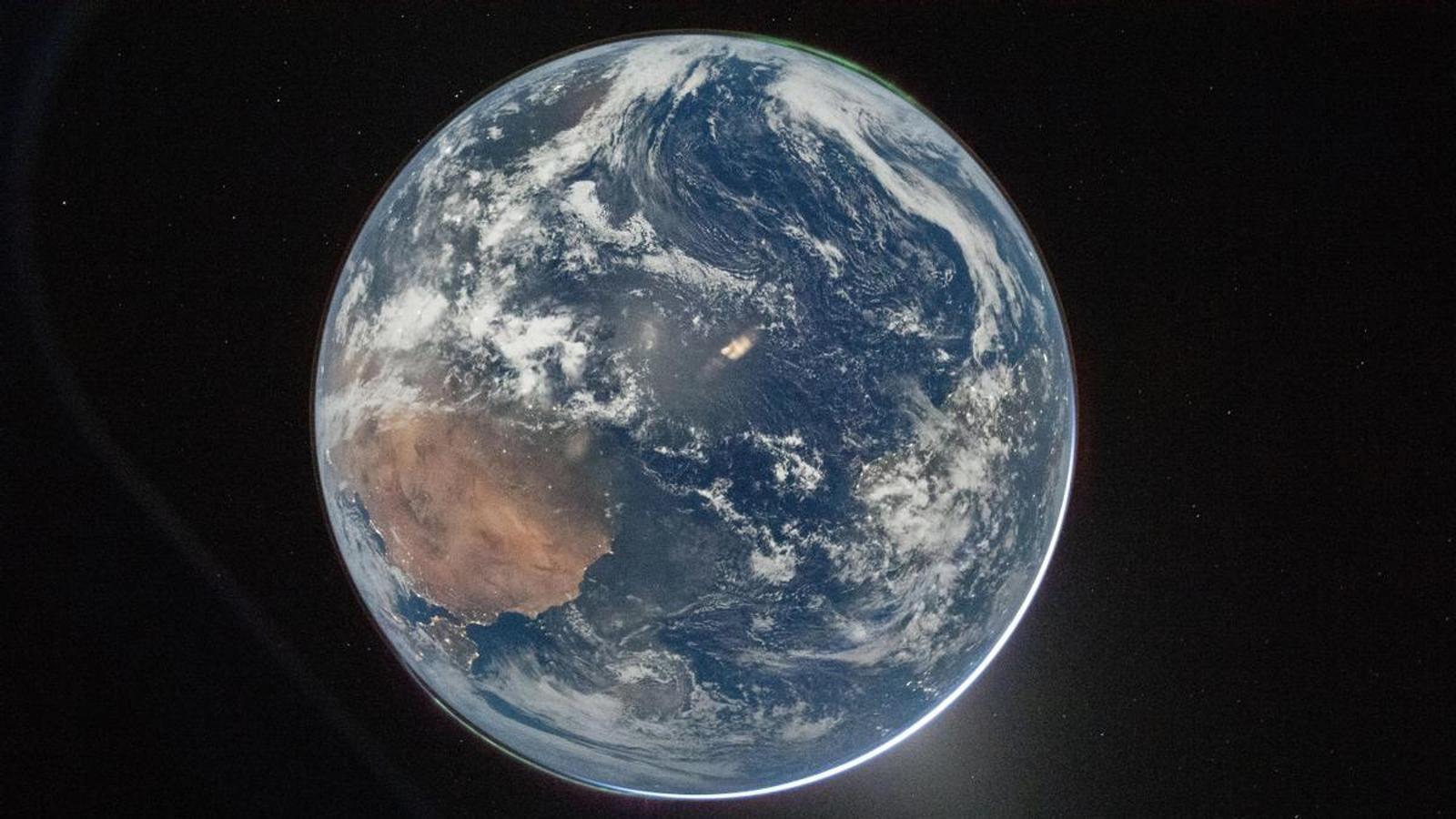
BarcelonaNASA's Artemis II mission rocket is already halfway to the Moon, after leaving Earth's orbit, and is advancing at 5,632 kilometers per hour to become the first mission to carry humans to the satellite in more than 50 years. The objective in this case is not to land on the Moon but to orbit it and return to Earth, to test the technology that should finally allow a lunar landing in 2028. The four astronauts of the mission - who are bringing their own mobile phones on board - have already sent the first spectacular images of Earth from their perspective, and they are expected to reach the Moon on Monday night. By Saturday, the spacecraft was already more than 219,000 kilometers away, closer to the Moon than to our planet.
When they arrive, the Artemis II astronauts want to make history and become the humans to fly farthest from Earth, surpassing the record currently held by the Apollo missions. It is also the first time in history that a woman and a Black man have flown to the Moon. They are specialist Christina Koch, who already holds the record for the woman who has spent the most consecutive days in space (328 days on the International Space Station), and the mission's pilot, Victor Glover. The captain of Artemis II is American Reid Wiseman, and completing the team is specialist Jeremy Hansen, the only astronaut on the mission who is not from NASA but from the Canadian space agency, and who is also the first Canadian to leave Earth's orbit.


Propelled by NASA's SLS rocket, the most powerful currently in existence, Artemis II launched at 0:35 AM on April 2nd Catalan time (6:35 PM on April 1st in the United States), only about ten minutes later than planned due to minor issues with the mission abort system. The Orion capsule detached from the boosters and eight minutes after liftoff, it left the atmosphere and successfully entered Earth's orbit. The crew, from the capsule they have named Integrity, confirmed that everything was fine and the crowd gathered at Cape Canaveral erupted in applause.
A small scare with the first space toilet
In the early hours of the flight, however, a small scare appeared: the only toilet on the ship was having problems. It is the first toilet installed on a manned spacecraft (Apollo astronauts used special bags for their needs), and it seems that it had already become blocked just at takeoff. The toilet (designed for microgravity environments and christened the Universal Waste Management System) has a funnel connected to a hose for urine and a seat for solid waste, and an automatic airflow introduces them into separate containers. Fortunately, the control room was able to resolve the incident, caused by an electronic problem, and shortly afterwards they informed the crew that they could use the toilet without any issues.
About three hours after takeoff, pilot Victor Glover took manual control of the Orion spacecraft for a while to perform some training maneuvers. It was the first time a human had manually operated this capsule in space, and Glover performed perfectly. "It's great flying with you, Houston," he told mission control after successfully completing the planned "proximity operations," which involved maneuvering the capsule around the spent upper stage of the rocket to check how the spacecraft behaves in close quarters. After the test, the Orion fired its engines to move away from the rocket stage that was already returning to Earth.
While the Apollo missions went directly to the Moon after takeoff, Artemis II first spent a whole day in Earth orbit to ensure that all life support systems were functioning. NASA reviewed all the data and, in the early hours of Thursday to Friday, April 3rd (Catalan time), gave the green light for "translunar injection," a momentary engine burn that ejects the spacecraft from Earth orbit and sends it towards the Moon, about 380,000 km away. When it arrives, from Monday, April 6th at dusk, it will orbit the satellite, flying over its far side, at a distance of between 6,500 km and 9,000 km from the lunar surface. There, they will momentarily lose contact with Earth, between 30 and 50 minutes, as the Moon will block the connection.
On this flight behind the Moon, Artemis II will aim to break the record of Apollo 13, which is the manned mission that has flown farthest from Earth: 400,171 km away in the year 1970. The Orion capsule already broke this record during the Artemis I mission in the year 2022, but it was traveling without a crew then. Artemis II aims to reach 406,773 kilometers away, less than the distance Artemis I reached but farther than Apollo 13.

After a few hours of observation, they will use the Moon's gravitational force to gain momentum back to Earth, a journey that will take about four more days.
For the first time, astronauts are also bringing their own mobile phones to capture images, which NASA will share on social media.
The Artemis II mission will last ten days in total and will serve to test the Orion spacecraft, with a capsule prepared to provide life support to the crew for 21 days, as well as other operating systems that NASA hopes will allow for another moon landing in the year 2028, the last year of Donald Trump's term. It will be then, in the Artemis IV mission, when the first humans in more than 50 years – and probably the first woman in history – are expected to set foot on the Moon. The last to do so were the astronauts of the Apollo 17 mission in 1972.
The battle with China
The President of the United States, Donald Trump, congratulated the crew of Artemis II on his Truth Social network shortly before takeoff: "We are winning, in space, on Earth, and everywhere: economically, militarily, and now, beyond the stars," he stated.
The fact that the return to the Moon's surface has been scheduled for Donald Trump's last year in office is no coincidence. The President of the United States has set NASA's objective as "to reach the Moon before China." The Asian giant plans to arrive there around 2030, albeit without as much fanfare and media noise as NASA. And the new administrator of the United States space agency, Jared Isaacman, has set to work to ensure that this geopolitical milestone occurs before Trump leaves the White House.
After Artemis II, another crew will launch on Artemis III to test the docking system of the Orion spacecraft with the lunar landers. Although this third mission was planned to be the one to descend to the Moon's surface, NASA has preferred to take more time to test a technology that is very different from what was used in the Apollo missions. A technological effort in which, moreover, private companies such as Elon Musk's SpaceX and Jeff Bezos's Blue Origin are participating, preparing lunar landers for NASA.
Isaacman presented NASA's plans for the Moon just a week ago, when he revealed that the objective of the Artemis missions is to lay the groundwork for creating a permanent colony on the Moon. After the Artemis IV landing in early 2028, another landing is expected with Artemis V at the end of the same year, to pave the way for periodic landings that will allow for the construction of a permanent lunar base on our satellite.

