Birds with shorter wings or crabs in yogurt pots: human activity forces species to evolve
Despite that anthropogenic pressure is destroying biodiversity, at the same time it also stimulates the evolutionary change of many species
-
CAT -
CAST
In 1980, a couple of North American biologists began studying the cliff swallow in Nebraska, an area where this bird nests on highway overpasses. And as time went by, they realized that their wings were getting shorter and shorter: over 30 years, they shortened by about two millimeters per decade. According to Charles and Mary Brown, authors of the study, this change would have been selected because short wings offer birds more maneuverability, more ability to turn in small spaces, and this would help Petrochelidon pyrrhonota swallows to better avoid vehicles and prevent collisions.
The case of this swallow illustrates the unsuspected paths that biological evolution can take today. When we think that species evolve, we easily visualize fossils that lived in the remote past, and images of dinosaurs, trilobites, and other distant creatures come to mind. And yet, evolution does not stop, and current living organisms are, in fact, changing right now, before our eyes, even if we don't realize it at first glance.
And what is the great driving force of biological evolution today? Biologist Menno Schilthuizen, an ecologist and researcher at the Naturalis Biodiversity Center in Leiden, the Netherlands, is clear about it: us. In his words, “human activity is currently the strongest component of all the pressures that constitute natural selection.” For this scientist, author of the books
The Urban Naturalist
and Darwin comes to Town [without translation into Catalan], “human activities, especially in urbanized areas, are causing drastic environmental changes and, therefore, stimulate wild organisms to adapt and evolve.” In fact, “the more drastic these changes are, the faster and deeper the evolutionary response will be,” he assures in an interview with the newspaper ARA Schilthuizen.

The weight of humans
The case of cities is particularly interesting. Urban systems seem like a very hostile environment for life, but they are also a great opportunity for biological evolution. The examples scientists describe are very numerous: from modifications to the legs of lizards to better grip slippery urban surfaces; to changes in plant seeds that facilitate their propagation within the tree pits of sidewalks where they live; or spiders that are adapting to make their webs near lampposts, because the light attracts the moths they feed on. In the case of these arthropods, this would be nothing peculiar if it weren't because they have a phobia of light, they are lucifugous. In this regard, curiously, an ingenious study conducted with the spider Steatoda triangulosa by researcher Tomas Czaczkes, from the University of Regensburg, Germany, shows how urban specimens are losing their fear of light, while their rural counterparts maintain their ancestral preference for darkness. The study was conducted with individuals born in the laboratory, which shows that there is a genetic component in this behavior. And genetic changes are heritable, and therefore have evolutionary value.
If spiders take advantage of light, their prey responds by doing just the opposite: studies with the moth Yponomeuta cagnagella have shown how urban individuals are attracted to light 30% less than rural ones. The artificial light we humans create is creating a new evolutionary scenario, where the interaction between different species of predators and prey changes.
Adapt or disappear
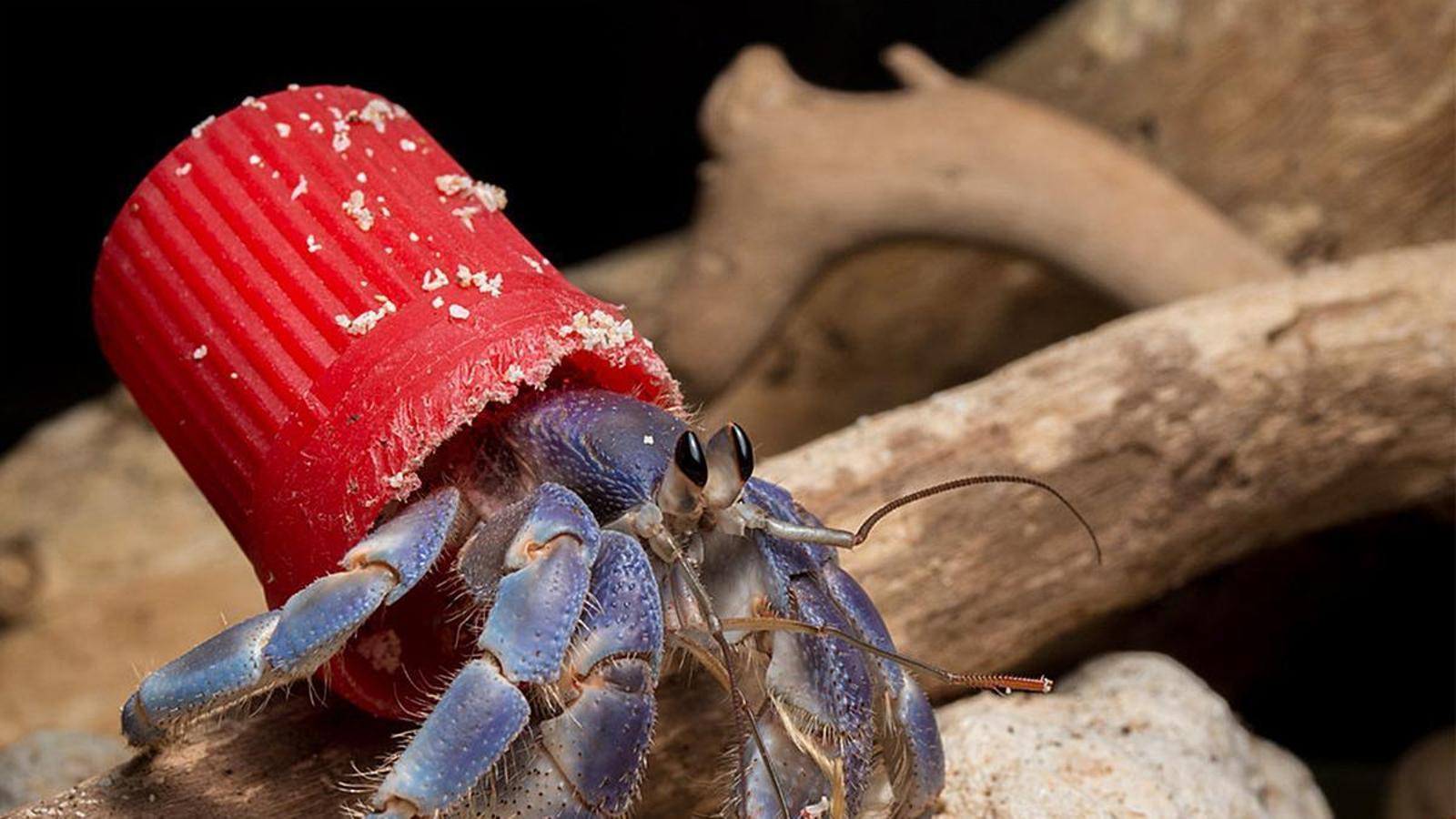
But not everything happens in urban environments. A curious example can be found in cenobitids, some terrestrial hermit crabs with a tropical distribution. Before, these animals looked for an empty snail shell where they would stuff their bodies. But for some years now, many crabs have been using small waste items: they put their abdomen inside yogurt pots, broken light bulbs, caps, or shattered pieces of bottle. This new use of heterogeneous materials by crabs raises interesting evolutionary questions: firstly, it can interfere with sexual selection, as females often prefer novelties, new phenotypes, when choosing a mate, a tendency that has also been observed in fish, birds, and other organisms. But these new and flashy "shells" do not necessarily correlate with protection attributes, and, in fact, they may be weaker. So, an association can be produced between the tendency of crabs to incorporate artificial shells and their reproductive success, which opens up unsuspected evolutionary paths in these species.
In the end, all these examples show that evolution does not stop. There is evidence of change in many species, and various authors point out that they are doing so at a rather rapid pace, adapting to urban systems, highways, waste, pollutants... Humans have modified the ecological theater, creating a new, simplified, and stressful, quite homogeneous scenario, where species struggle to adapt. However, many will not manage to do so.
“The acceleration of changes, especially in climate and land use, can leave many species out of the game”, states Jaume Terradas i Serra, emeritus professor of ecology at the Autonomous University of Barcelona (UAB), who warns that “many extinctions are occurring, mostly local but also definitive.” It is well known that biodiversity is decreasing alarmingly due to anthropogenic pressure, which can negatively affect our own species. But, despite everything, evolution works. And this is good news because, as the great ecologist Ramon Margalef said, “whatever happens to humanity, life will continue on planet Earth.”

