Trump's disarray pushes new allies towards the European Union
Canada, Norway, Iceland and the United Kingdom take steps towards Brussels in a context of international uncertainty

-
CAT -
CAST
BrusselsThe mantra says that the European Union is in crisis. Slowness in acting, critical dependencies, division, anemic economic growth, and little weight on the geopolitical board. However, facing Donald Trump's United States, Xi Jinping's China, or Vladimir Putin's Russia, the European bloc has established itself as the great power that most respects international and humanitarian law, as well as multilateralism in contrast to the law of the strongest. A stance that, in a context of building large blocs on the international stage, has led smaller or medium-sized countries to want to approach Brussels' orbit and shelter under the European Union's umbrella.The disarray caused by Trump and the decline of a Western order led by the United States are not the only reason, but they are among the main factors that have led, for example, Canada, Norway, Iceland, and the United Kingdom to make overtures towards the European bloc in recent times. "Indeed, it seems we are now the last adult in the room, the only reliable and predictable partner," summarizes Jean-Louis De Brouwer, an expert in European policies at the think tank
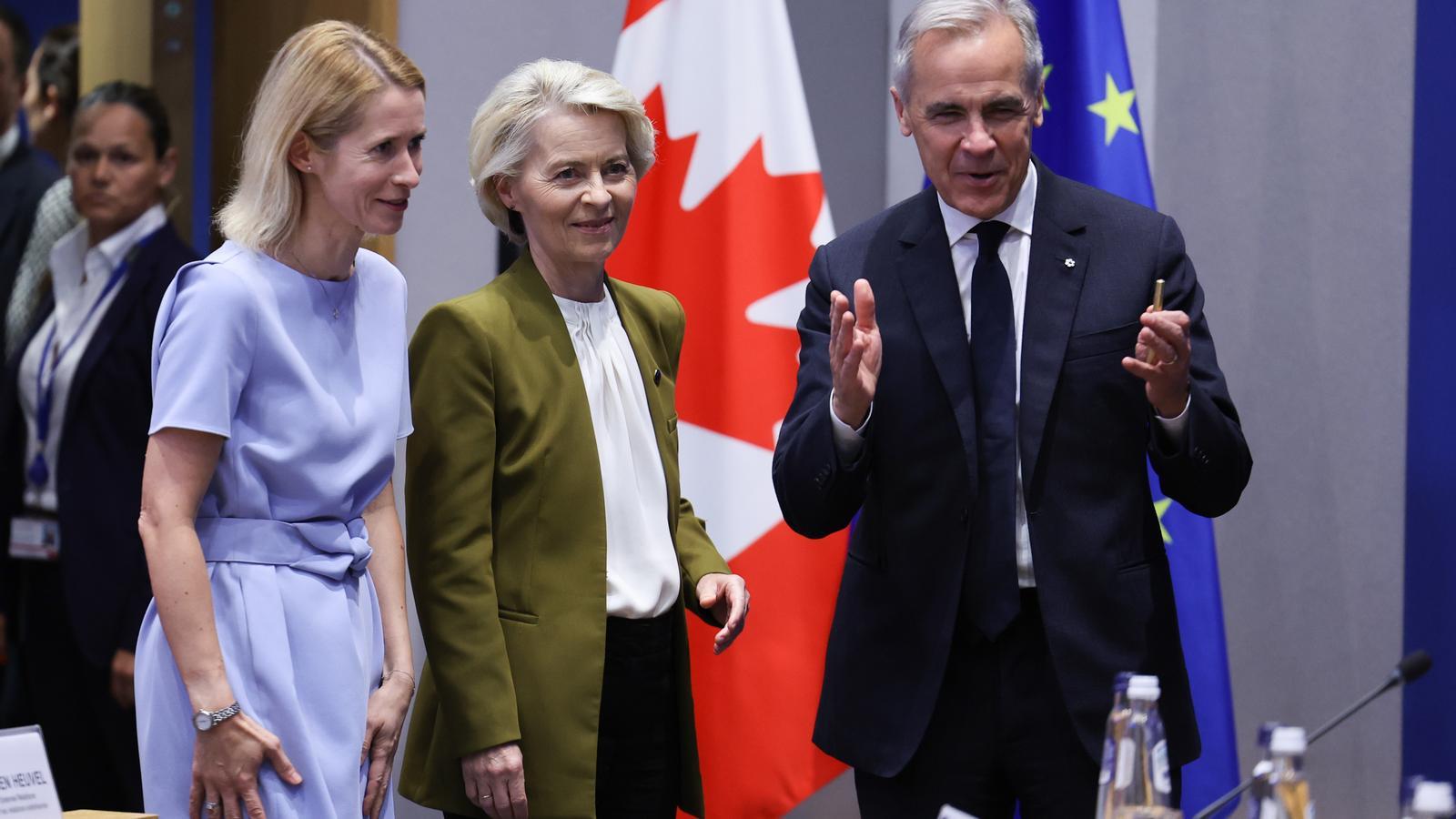
Egmont Institute, in a conversation with ARA.One of the allies drawing closer to the European bloc is Canada. And, in fact, its Prime Minister, Mark Carney, who is one of the strongest critics of the US President, was the first to, , call on "middle powers" to ally themselves to have a voice and vote on the international stage and stop being at the mercy of the Trump, Xi, or Putin of the moment. Since then, Ottawa and Brussels have not stopped getting closer.
Canada is the only non-European country to which Brussels has offered to join loans totaling 150 billion euros intended to boost rearmament and, among other things, it is the only non-European ally that attended for the first time in early May a summit of the European Political Community. It has also allied with the EU in supporting Ukraine, both humanitarianly and militarily. The head of European diplomacy herself, Kaja Kallas, summarized at the press conference of the EU Foreign Affairs Council this Tuesday that "Canada is the most European of all non-European countries".
The Canadian country, however, is not the only one approaching the European club. Norway is already part of various programs to boost the military industry and is strengthening trade ties with Brussels. And, furthermore, in the Scandinavian country the debate about potential accession to the European Union is reviving. Thus, it is following in the footsteps of Iceland, which plans to hold a referendum on whether to join the community bloc.
Although the situation is very different, the United Kingdom also seems to want to improve relations with the European Union. This week, British Prime Minister Keir Starmer attacked Brexit and promised to return the country "to the heart of Europe". Words that, for the moment, do not materialize into anything, but which are a clear declaration of intent.
promised to return the country "to the heart of Europe"The EPC analyst points out that in the case of Canada, Iceland, or Norway, Trump's influence is even more evident. Thus, Majcin explains that "in other times and other contexts" these countries "did not want to orbit closer to the European Union", butthe President of the United States has pushed them towards Brussels. In this regard, the expert recalls that Iceland in particular – due to EU fishing restrictions and quotas – and Norway – largely due to fears of regulation affecting their energy resources – have historically shown themselves to be against joining the community club, but at a time of defining large blocs and areas of influence, "they feel much more akin to the EU than to the US, Russia, or China".
A new euroscepticism
Trump has not only provoked an approach of new allies to the European Union, but has also lowered part of the internal Euroskepticism of the European bloc, which mainly comes from the far-right. Most parties and leaders of these political families have wanted to distance themselves from the President of the United States and, although they are opposed to moving towards greater European integration, they no longer speak of leaving the community bloc.

Analyst De Brouwer points out that, although this change in discourse predates Trump's return to the White House, the international context also empowers the main far-right leaders to want to be part of a large bloc and, in this way, have a voice on the geopolitical board. "Clearly, the national far-right leaders of France, Italy or, for example, Germany are readapting their international allies and their foreign policies," adds the expert.
