Hexagons, fractals, and flows: nature's patterns inspire humans
The rules that repeat in nature very often have mathematical bases
-
CAT -
CAST
Observing nature carefully allows us to discover recurring shapes and structures. This is no coincidence: it is based on rules and patterns that often have a mathematical basis. Understanding them helps scientists better comprehend how ecosystems function, how species are distributed, and how territory is organized.
Golden Ratios
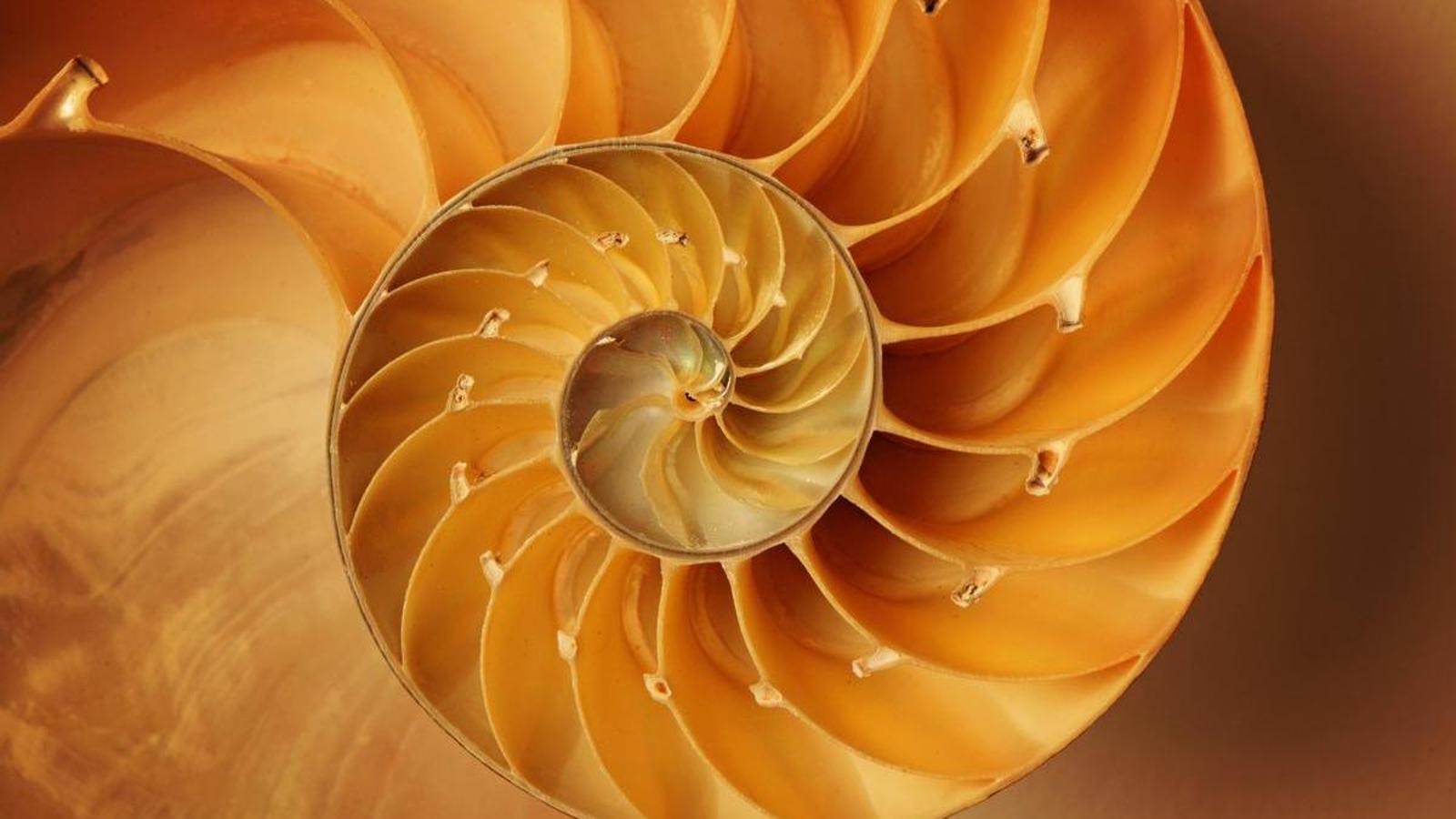
In nature, we often find the golden ratio, a mathematical pattern that appears in repetitive and strategic growth forms in nature. One example is the logarithmic spiral, present in the shells of some mollusks, elephant tusks, feline claws, or sunflower heads.

Hexagons
Honeybees build hexagonal cells because it is the most efficient way to cover a surface without leaving gaps using the minimum material. This natural pattern has inspired many applications in fields such as architecture, construction, industry, and aeronautics.

Fractals
A fractal is a structure that repeats the same pattern at different scales. In nature, fractality is not just an aesthetic curiosity, but a very intelligent way to organize apparent chaos, distribute resources efficiently, and adapt to complex environments.

Roots, fractal explorers
The soil is a medium full of irregularly distributed obstacles. Therefore, the roots of many plants adopt fractal structures. From the main root to the finest ones, they make branches at different scales to better explore the soil and absorb water and nutrients to the maximum.
Aquatic plants, however, do not follow this pattern, because they live in a more homogeneous medium.

Natural engineering to optimize flows
Trees are experts at optimizing resources and energy. Therefore, their vascular system is distributed in a highly optimized way to efficiently transport water and nutrients from the roots to every vein in the leaves. The nervous system of the human body also follows this pattern!

The body of arthropods
It is formed by an exoskeleton, a shield of chitin that protects them. At the same time, this body structure forces them to have a very small size and they cannot grow to large dimensions like vertebrates. Because they are so small, their respiratory system is formed in fractal patterns to breathe more efficiently. In the case of terrestrial ones they have a set of tracheae and in aquatic ones, gills.

Living to the rhythm of prime numbers
There are animals that have evolved mathematically to survive. Periodic cicadas, for example, emerge every 13 or 17 years, based on prime numbers. These intervals minimize coincidences with predators that have shorter, regular reproductive cycles, and make it nearly impossible for them to synchronize.

Predator-prey patterns
Turing's prey-predator model explains how, from the interaction between prey and predators, and the fact that they move differently through the territory, forms can appear in the distribution of fauna, such as patches or stripes. When there are too many predators together, they bother each other and disperse, and this creates patterns that do not always follow the factor of more prey. In ecology, simulations are carried out to observe these patterns and understand how small changes in behavior can end up shaping the landscape.

