The EU now supports Sánchez but is wary of regularization
The Twenty-seven change their tone and express their "strong solidarity" and "unity" with Spain
-
CAT -
CAST
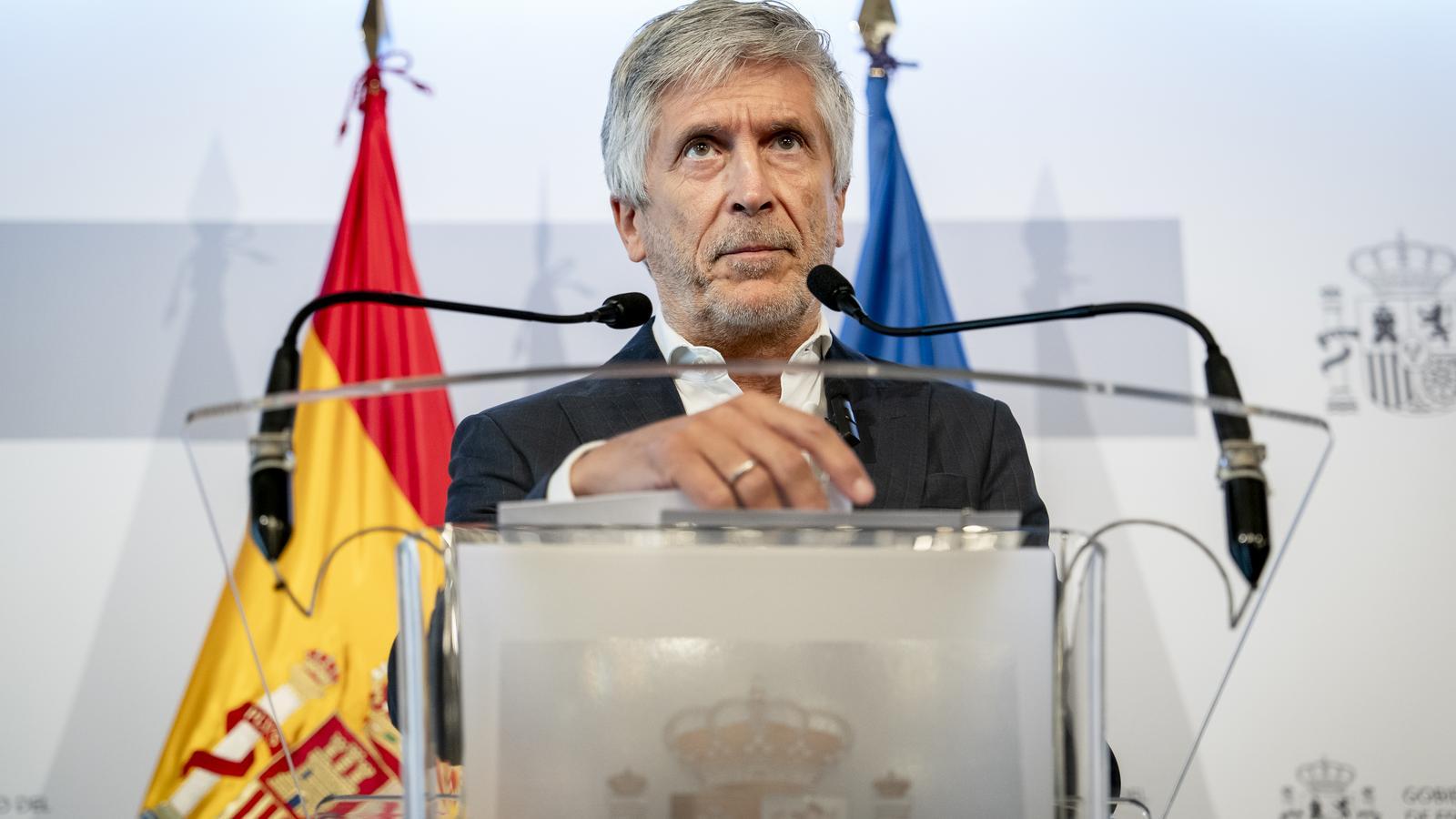
Madrid / BarcelonaAfter days of tension and division between Spain and some member states over the migratory crisis in Ceuta, the extraordinary meeting of Interior ministers held this Tuesday has served to stage a general change of stance, at least outwardly. After an initial reaction from several partners blaming Spain and its migration policies for putting EU borders at risk, the message now is that the Twenty-Seven are "united" in supporting Pedro Sánchez's government. This includes Italy, the most belligerent country, which has even temporarily tightened border controls with Spain.
During the meeting, the Spanish Interior Minister, Fernando Grande-Marlaska, informed his Italian counterpart that he "did not understand" the decision of Giorgia Meloni's government: "The Schengen area has not been at risk at any time," he stated. For Grande-Marlaska, the European response is a breath of fresh air for the Moncloa: "All interventions from all member states have been in an absolutely constructive tone [...]. Spain's extraordinary, effective, and immediate work in the face of the crisis has been recognized," he said. The Spanish minister assures that member states had conveyed their "political solidarity," an element that the Spanish government regretted from the first minute was not part of the European reaction as a whole.
But not all praise has been for Madrid. European allies, as well as Brussels, reiterated during the meeting their reservations about the extraordinary regularization process for migrants promoted by the socialist government, although Marlaska insisted that the Ceuta crisis has no link to this measure. The European Commissioner for Home Affairs and Migration, Magnus Brunner, agreed with him, assuring that he sees no "direct relationship," but stressed that the measure "is not a good signal for the rest of Europe." Some European allies had hinted in the early days that the Ceuta crisis was a response to the regularization promoted by Sánchez.
Meanwhile, the Spanish government reiterated that no entry from Ceuta to the Peninsula had occurred and that those from Morocco to Ceuta "have been stopped". The latest official figures from the Interior Ministry put the number of migrants who entered Ceuta from Morocco at 72,000 and the number of returned people at 70,000. The death toll stands at 75, according to ministry data. "It is an unbearable tragedy [...]. They are the consequence of human trafficking mafias," Marlaska blamed. The Spanish government places these networks behind the crisis, and this is the message that the European Commissioner for Home Affairs and Migration, Magnus Brunner, also repeated, who avoided pointing to the Moroccan authorities. "What we know for sure is that there has been an instrumentalization by human trafficking networks and smugglers," he said at the press conference after the meeting.
"Strong solidarity"
In the virtual meeting held this Tuesday, the interior ministers of the EU and non-EU countries that are part of the Schengen area participated, who expressed their "strong solidarity" with the Spanish government, according to the statement released at the end of the meeting, in which they also applauded the "quick and effective" response of the Spanish authorities. "The EU is united and willing to support Spain," said Jim O'Callaghan, Ireland's Minister for Justice, Interior and Migration, who chairs the EU Council this semester. "The EU's external borders are a shared responsibility and migration requires a united European response," he insisted.
The Twenty-Seven expressed their condolences for the people who died trying to cross the border between Morocco and Spain, while also celebrating that "the vast majority of people who had crossed illegally have been returned and there has been no further movement towards the Peninsula or other member states".
"Spain's responsibility is that no one enters the EU," stressed Brunner. Although Ceuta and Melilla are part of the Schengen area, they have a special regime, with an exit control, so that no one can travel from the autonomous cities to the Peninsula without identifying themselves. Furthermore, the Ministry of Foreign Affairs makes it clear on its website that being in Ceuta irregularly does not grant the right to stay in Spain, nor to travel to the Peninsula, nor to circulate in Europe.Border reinforcement
The Spanish government has already placed a pneumatic barrier on the El Tarajal jetty (Ceuta) and a line of anchored buoys as part of a containment device to slow down the arrival of migrants by swimming. It has also begun to do so in the case of Melilla, as revealed by Marlaska at a press conference.
Border control is for Europe and many member states the philosopher's stone of migratory policy, especially at a time of expansion of the right and the far-right. In summary, the statement states that the ministers have agreed on the need to continue fighting against migrant trafficking networks, strengthening returns, reinforcing EU borders, building deep partnerships with third countries, and improving foresight. In this regard, they have stressed the need to improve pre-border intelligence and social media monitoring. Regarding whether all this has also involved discussing the deportation of migrants to camps located in third countries, a proposal promoted by Italy, Marlaska said that it had not been a central point of the meeting, but that in any case Spain maintains a position of rejection.
Brunner said that the issue had been mentioned, because there are six member states that are working with non-EU countries to establish these types of centers, which he considered "legitimate." Regarding Italy's request that these facilities be financed with European funds, he said that it is a detail that still needs to be discussed.
"No report or warning from the CNI"
Marlaska has been very forceful in stating that there was "neither a report nor a warning" from State intelligence services about the possibility of this unprecedented migratory crisis occurring. After a rift opened between this ministry and the Ministry of Defense regarding information that pointed to warnings from the CNI, Marlaska denied this was the case. The minister, however, praised its functions.
"Does anyone believe that if I had known that something similar to the [crisis in Ceuta] of 2021 could happen, I would not have passed it on to those responsible?", Marlaska asked. Unlike the Minister of Defense, Margarita Robles, Marlaska avoided singling out Morocco and insisted that it is a "reliable" partner. This Monday, Robles demanded that the Alaouite country "not look the other way".
