The CNI warns that the extraordinary regularization may be a "risk" for Spain
The Spanish government believes that the work of the intelligence services must be reviewed
-
CAT -
CAST
Madrid / BarcelonaAmong the 40 documents that the Moncloa declassified on Tuesday is a CNI report on irregular immigration to Spain from July 27 that was shared both with the Spanish government delegation in Ceuta and with all competent ministries, which warns of two issues: it states, on the one hand, that the Supreme Court ruling rejecting hot returns by sea could have a "very significant" impact on irregular entries into Ceuta, although—mind you—it says it trusts that Morocco would contain the migratory pressure, and, on the other hand, that the extraordinary regularization of migrants could be a "risk" for Spain because it "will increase migratory pressure directly and indirectly".
Read the CNI reportLet's take it one step at a time. This intelligence services report provides an analysis of the irregular immigration entry points to the State up to June 30, 2026, and according to the Moncloa website, it was transmitted to the relevant authorities on July 27 at 12:03 PM. Up to this date, it is noted that the State's weak point is the route coming from Algeria, which is where the most irregular maritime entries occur, as a consequence, among others, of the increasing danger of the route passing through Libya due to the presence of criminal groups and armed gangs. On the other hand, it describes a decrease in arrivals through Mauritania, as the authorities of that country are very "involved in the control of irregular flows," and also from Gambia. These are two countries with which Pedro Sánchez has reached bilateral agreements so that they harden the interception of irregular routes.
Regarding Ceuta and Melilla, the CNI warns of the effects of the recent Supreme Court ruling: "It may have a very relevant impact on irregular entries into the autonomous cities, especially in Ceuta." However, it says that they trust in Morocco: "It is estimated that the control of the Moroccan authorities over irregular immigration will maintain a containment effect" and that the arrival figures to the Peninsula "will remain similar to those of the same period in 2025." In fact, the Western Mediterranean border is where they see the least risk. An assessment that they would correct two days later, warning of mass gatherings for Ceuta. In any case, after conducting this analysis, they add a more prospective report on the effects of the entry into force of the new European Union Pact on Migration and Asylum and its fit with Sánchez's extraordinary regularization. They say that the EU's willingness to make the expulsions of irregular migrants effective—which requires readmission by the countries of origin—could affect the diplomatic relations that Spain has with North Africa. "It would affect not only migratory control but also trade and security," it states.
The CNI report concludes that the following "risks" exist for Spain. It considers that the State's position could "remain exposed to the divergence between the spirit and the letter of the European Pact on Migration and Asylum and the ongoing process of regularizing migrants in Spain, which generates a risk." "Spain presents itself as a more receptive EU destination, which increases direct and indirect migratory pressure," it says, and points out that this weakens the government's negotiating capacity as a "recipient" of European migration management funds. It also interprets that "African partners may perceive a certain contradiction between the ongoing cooperation for the reduction of flows and the regularization."
Beyond that, and in relation to the possibilities offered by the European Pact on Migration and Asylum, they also identify another "unlikely" risk: that migration hubs are installed in third countries of the European Union to house immigrants who are subject to a return decision to their countries of origin and that this generates more "migratory pressure" for the Spanish geopolitical environment.
Sources from the Ministry of Migration, consulted for this report, downplay the report and recall that the regularization is linked to meeting very specific requirements that, moreover, had to be proven before what occurred in Ceuta. Thus, they remark that the migrants who are now at the border will not be able to benefit from it.
The Spanish government maintains that it could not anticipate the crisis
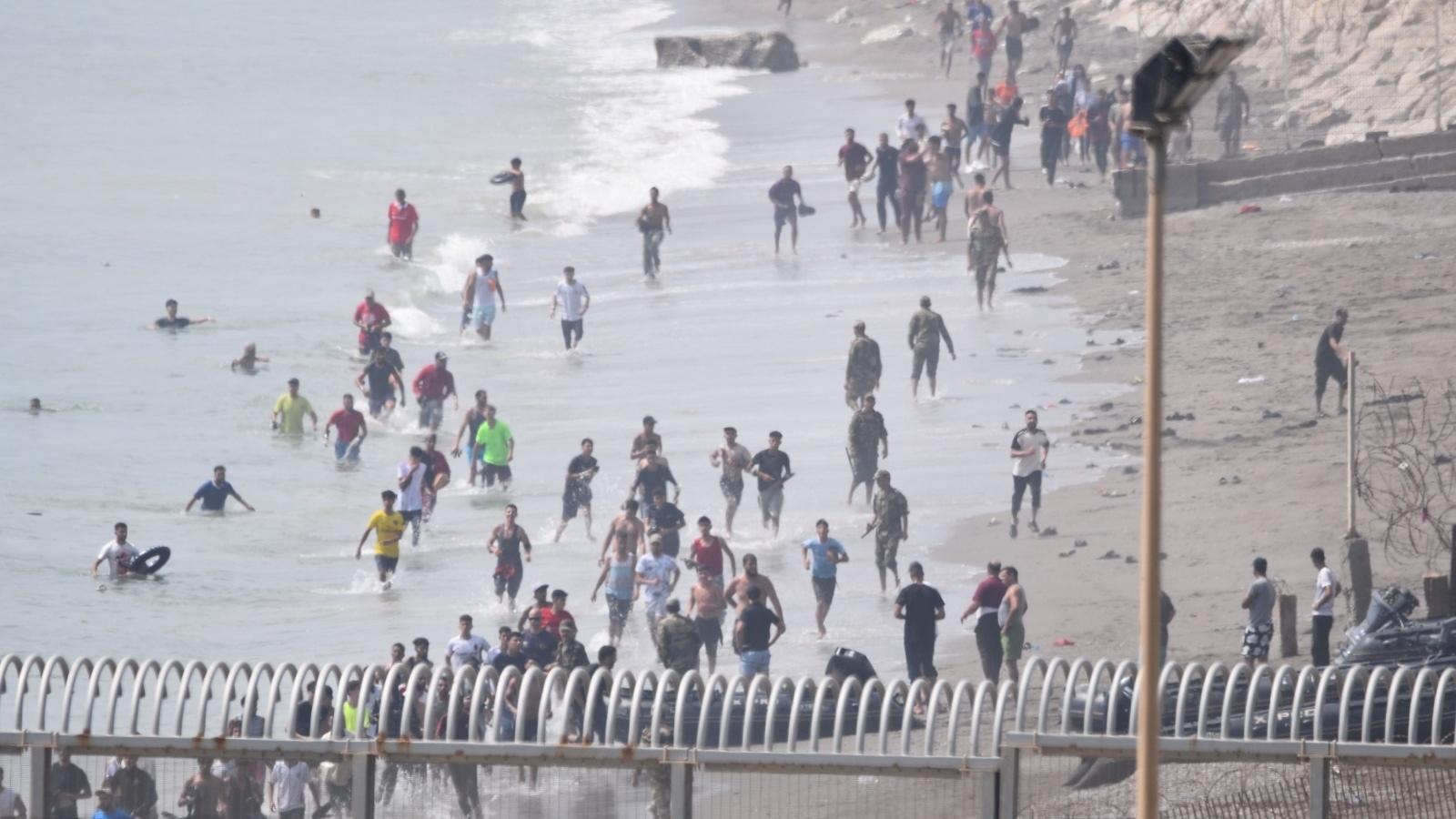
Following the declassification of the documents, this Thursday it was the turn for interpretations, and despite the CNI's warnings about mass calls to enter Ceuta, the Spanish government maintains that it could not have anticipated the crisis. Furthermore: it considers that the CNI's work should be reviewed.
The Minister of Transport and Sustainable Mobility, Óscar Puente, has assured RNE that the CNI's warnings to the Government Delegation in Ceuta were not "clear enough" nor were they issued "with enough time" to prevent the entry. Margarita Robles also spoke, who was the only one to say that the CNI had indeed issued warnings: she said that the government works "united" and that the Ceuta scenario was "unforeseeable". The government delegate in Ceuta, the socialist Miguel Ángel Pérez Triano, has assured that the CNI's message was not considered either "as an alert or an appropriate channel." The president of Castilla-La Mancha, Emiliano García-Page (and a habitual critic of the Sánchez government) does not share this: he has asked the executive to "get its act together" regarding the Ceuta crisis because, if not, "it could be the great lie of democracy since 11-M".
However, Puente has clarified that his words are not "a criticism of the CNI", although he added that from now on the "type of measures of the intelligence services to read these events better and with more anticipation" will be reviewed. Sánchez has already warned that more preparation of the intelligence and information services is necessary in the face of a hybrid attack.
