Sánchez's bilateral agreements in Africa reduce immigration by sea
Experts warn of the danger to human rights of outsourcing immigration management to third countries


-
CAT -
CAST
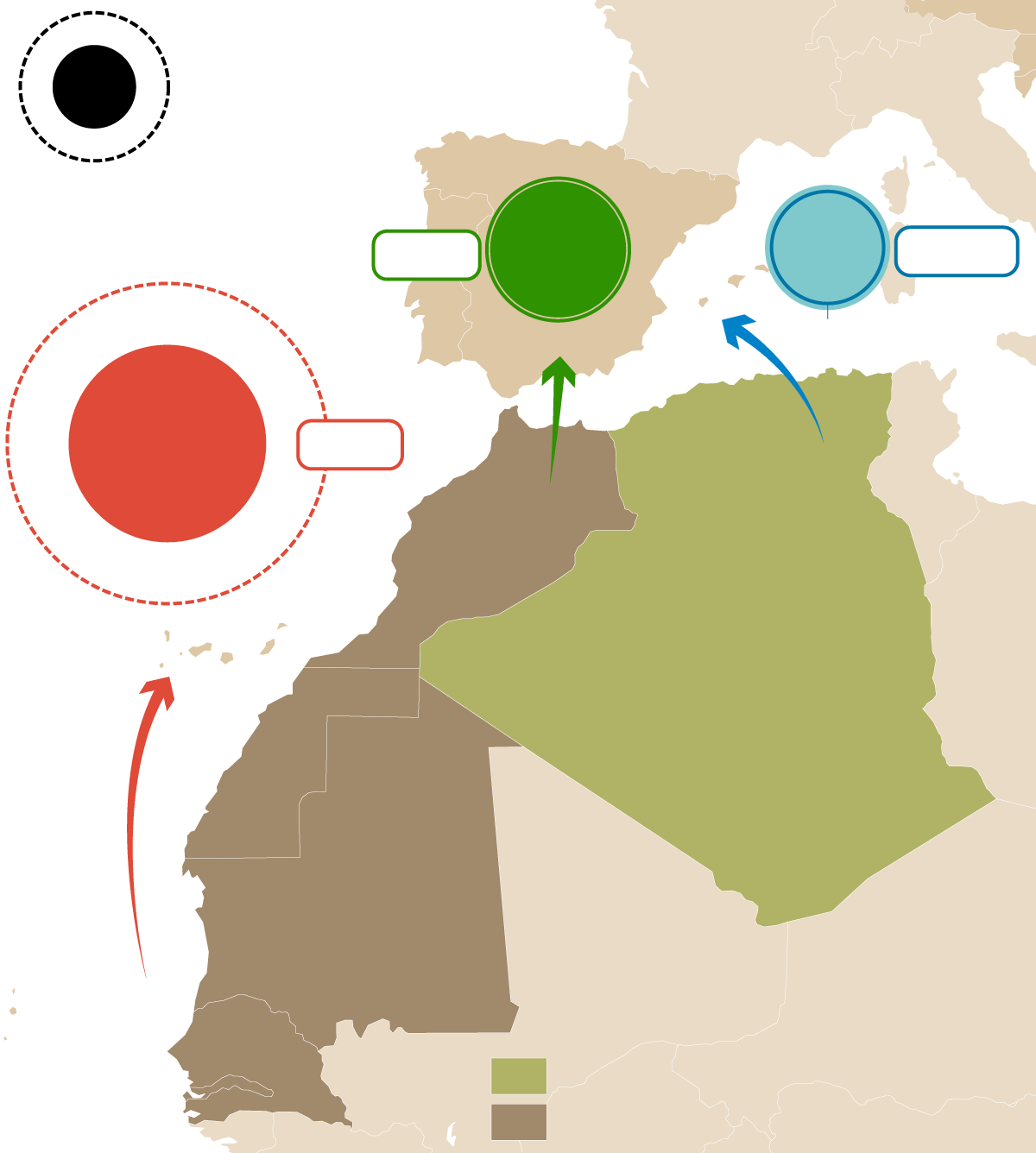
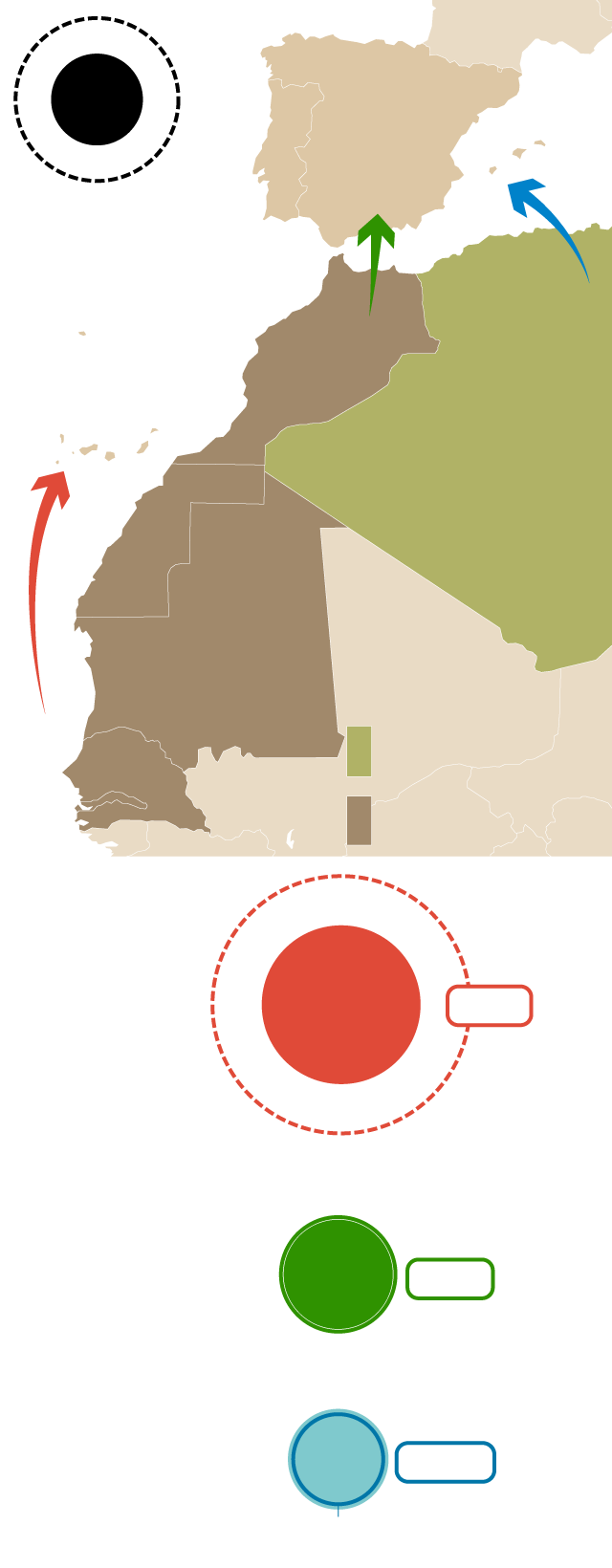
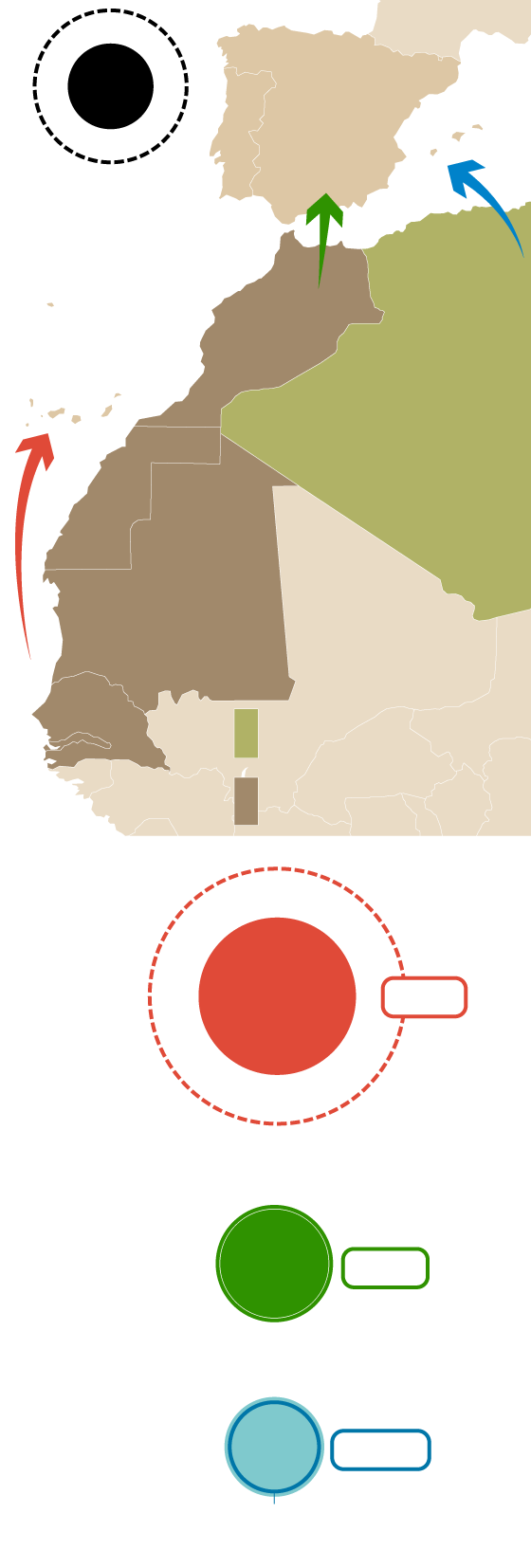
MadridPedro Sánchez embarked on a tour of West Africa in August 2024 with a stated objective: to combat irregular immigration. He held bilateral meetings with the presidents of Senegal, Gambia, and Mauritania, after having strengthened ties with Morocco. At that time, migratory pressure on the Canary Islands had increased substantially, and the Spanish government took action to address the situation. A year and a half later, the figures have changed. While there was a peak in arrivals via the Canary Islands in 2023 and 2024, the numbers began to decline from 2025 onward. However, the decrease in arrivals via the Canary Islands coincided with an increase in arrivals via the Balearic Islands.
2025
Variació
Peninsula
2024
+24,5%
7.321
-9,4%
Balears
7.787
Ruta Canàries
5.882
8.598
-62%
17.788
ALGÈRIA
MARROC
illes
Canàries
46.843
MAURITÀNIA
SENEGAL
Sense acord bilateral recent amb Espanya
GÀMBIA
Acords bilaterals recents amb Espanya
2025
Balears
Península
2024
ALGÈRIA
MARROC
Ruta Canàries
MAURITÀNIA
Sense acord bilateral
recent amb Espanya
SENEGAL
Acords bilaterals
recents amb Espanya
GÀMBIA
Ruta Canàries
17.788
-62%
46.843
Península
7.787
-9,4%
8.598
7.321
Balears
+24,5%
5.882
2025
Balears
Península
2024
ALGÈRIA
MARROC
Ruta Canàries
MAURITÀNIA
SENEGAL
Sense acord bilateral
recent amb Espanya
GÀMBIA
Acords bilaterals
recents amb Espanya
Ruta
Canàries
17.788
-62%
46.843
Península
7.787
-9,4%
8.598
7.321
Balears
+24,5%
5.882
Sources at the Ministry of Foreign Affairs assure ARA that "cooperation" with African partners has yielded "rapid and positive" results in curbing irregular migration by sea. Besides the aforementioned agreements, they also mention understandings with Ivory Coast, Nigeria, and Benin. The shift in migration trends comes after Spain signed several bilateral agreements with these countries. In fact, the Ministry of Foreign Affairs emphasizes that irregular arrivals by sea have decreased by 46.4% by 2025. In the case of the Atlantic route, the drop is 63%.
The data
Let's look at the numbers in detail. According to data from the Ministry of the Interior, there was a significant increase on the Canary Islands route between 2022 and 2023. While 15,682 people who arrived by sea were processed throughout 2022, this figure jumped by 154.5% in 2023 to 39,910 migrants. The situation worsened the following year, with 46,843 registered in 2024, a 17.4% increase. Meanwhile, the Balearic Islands also saw an increase (albeit smaller) from 2022 to 2023, at 19.1%. In 2024, however, there was a slight decrease on this route, with 6.5% fewer migrants.
Coinciding with the strengthening of Spain's ties with third countries, the data changed. In 2025, there was a 62% reduction in maritime arrivals to the Canary Islands. At the same time, there was a 24.5% increase in maritime arrivals to the Balearic Islands compared to 2024. In the first fifteen days of 2026, the numbers followed the same trend, with a 65% decrease in maritime arrivals. The Canary Islands registered the arrival of 718 people, compared to 3,223 during the same period in 2024 – a 77.7% reduction. In the Balearic Islands, the number rose from 117 to 151 (a 29.1% increase). Regarding the increase in the Balearic Islands, the Spanish Prime Minister's office downplayed its significance, arguing that there had been a "5%" increase across the entire western Mediterranean, although they stated that they were "closely monitoring the evolution of the entire phenomenon, including year-on-year fluctuations."
The opacity of the agreements
But what do these agreements with third countries entail? In the case of Mauritania, for example, a joint declaration was signed on July 16th, in which the State "values and recognizes Mauritania's strategic role as a reliable partner in migration management in the Sahel and West Africa." Or the joint declaration of Spain and Senegal in 2024: "Both countries agree that combating irregular migration requires strengthening prevention, anticipating uncontrolled migration flows, and working towards safe, orderly, and regular migration."
This trend of Spain strengthening ties with third countries is occurring throughout the European Union and is leading to a reduction in the arrival of migrants of up to 25%. However, experts warn of the danger this poses to respect for human rights and, at the same time, denounce the "opacity" of bilateral agreements, as they do not specify exactly what they are doing to close the borders.
"As Morocco controlled the borders, the departure points shifted towards southern Africa, with Mauritania, Senegal... and became more dangerous," says Blanca Garcés, a researcher at CIDOB, in a conversation with ARA. Since these countries are also collaborating with Spain, Algeria has become a departure point, and for this reason, the Balearic Islands route is increasing: "The Algerian government is not fulfilling its role as guardian." "There is a cause-and-effect relationship between bilateral agreements and the arrival of migrants," argues Garcés, who laments that in this context, people are no longer seen as subjects with rights to be protected, but rather as a kind of weapon in the hands of third countries.
Karlos Castilla, professor of international law at UPF, notes that "there isn't much public information about the scope of these bilateral agreements," which escape judicial oversight. Lorenzo Gabrielli, a researcher at GRITIM, also at UPF, describes them as "symbols," since they indicate the extent to which the relationship between countries is "structured." But he makes a point: he reminds us that most irregular immigration doesn't enter by sea, but rather with a tourist visa through the airport, so he attributes these policies to mere posturing within the framework of public debate.
According to Garcés, these bilateral agreements with third countries work in the "short term" to reduce irregular immigration, but at the same time they are very volatile and highly dependent on the current political climate between countries. He cites Morocco as an example, highlighting the migratory pressure it exerted on Spain before its change of position regarding Western Sahara, which has simultaneously cooled relations between the Spanish state and Algeria. Regarding this relationship, the Foreign Ministry maintains that they are "friends and neighbors" and asserts that despite the change of opinion on the Sahrawi issue, Spanish exports to Algeria have "tripled" in recent years, and that Algeria is also Spain's leading importer of natural gas.
On the ground
From the front line of the border, Helena Maleno, a long-time human rights activist, tells ARA that the consequence of these bilateral agreements is the "militarization of border areas," an increase in "arbitrary" detentions, and the "expulsion" of entire groups. In the case of the Balearic Islands—where she is currently located—she explains that it has become one of the busiest migration routes by 2025. She explains that although Algeria "had never used migration as a bargaining chip," a "real change" has now been detected, one that she doesn't yet know how to interpret: the Algerian state has begun to abandon its own interests.
