The entry of migrants in July grew by 1,326% compared to 2025
The Civil Guard requested a reinforcement at the border after the Supreme Court ruling due to the possible increase in entries by sea
-
CAT -
CAST
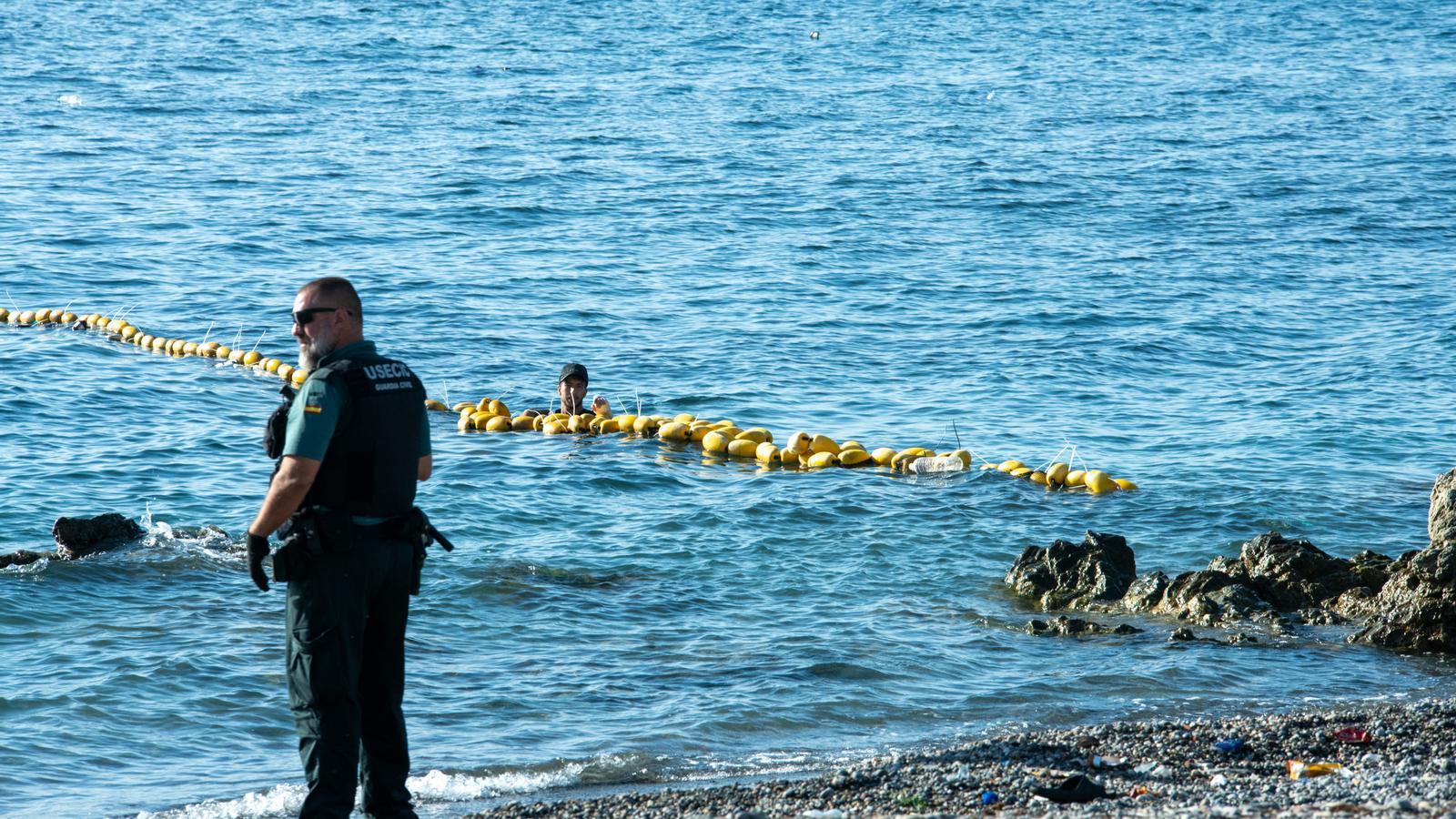
MadridOn the morning of July 30, the Spanish army was already speaking of a "migratory chaos" at the border between Morocco and Ceuta, with the State's security forces and bodies "saturated" in the face of the arrival of thousands of people. But the trickle of migrant arrivals in Ceuta from the Alawite country, mostly swimming, had been a constant throughout the month of July, far exceeding the figures from the previous year.
A report by the Intelligence Center of the Armed Forces (CIFAS) dated July 30 notes that between January and June of this 2026, the monthly average of immigrants arriving in Ceuta was 36 people. In the month of July, 1,027 immigrants arrived, following the Supreme Court ruling. "From July 1 to July 29, compared to the same period in 2025, there has been an increase of 1,326% [in migrant arrivals] (1,027 migrants compared to 72 in July 2025)," is concluded in the Civil Guard analysis.
The Spanish army itself (specifically a regiment of the land army) considers in another document from July 30th that the access attempts must be understood as a "direct consequence" of the Supreme Court ruling of June 29th, 2026, published on July 8th, as the Spanish government has pointed out in recent weeks.

The Supreme Court established that the access of migrants swimming into Spanish territory, specifically in Ceuta and Melilla, cannot be rejected at the border because there is no containment element, unlike the land border. In other words, what is popularly known as a 'hot return' or express expulsion cannot be practiced.
This implies, in the opinion of the army, a "limitation of the action of the State's security forces and bodies." The army also refers to the specific entry attempts between July 29 at 8 a.m. and July 30 at 8 a.m., just when the mass entry took place: "1,100 attempts [by migrants to enter] have occurred, of which about 500 have been intercepted by Moroccan forces," the report indicates. This containment is the argument used by the Spanish government to avoid pointing the finger at Morocco, even though the army and the Civil Guard acknowledge a certain "passivity" of the Moroccan army on the 30th.
In any case, the one who had already noted the impact of the Supreme Court ruling long before was the Ministry of the Interior. In a note dated July 8, the ministry warns that the high court's doctrine "entails relevant operational consequences for the Civil Guard in the autonomous cities." Since migrants entering Spain irregularly "cannot be subject to rejection at the border," but will instead require "individualized processing" with "all legal guarantees," this "will foreseeably increase migratory pressure on both cities [Ceuta and Melilla]."
The Interior Ministry points out that "the difference in treatment" between land and sea entry "could generate a pull factor towards entries by swimming." Furthermore, it recalls that it already poses "a high level of difficulty" for rapid detection and interception. The note even laments that the ruling "limits the immediate response capacity" to irregular entries. It also proposes reinforcing the Ceuta maritime service, the special underwater activities group, early detection technological systems, and promoting a reform of the immigration law to bypass the ruling and be able to apply border rejection by both sea and land. Some of these measures have now been carried out, following the migratory tragedy of last July 30 and 31.
Why Ceuta and not Melilla?
Although the ruling affects the so-called hot returns that Spain carries out in both autonomous cities, the Civil Guard acknowledged in a report that "geographical and meteorological conditions" favor entry through Ceuta. "The swimming distance [from Morocco] is shorter and the detection [of people] is more difficult due to the habitual presence of fog in the Strait of Gibraltar area".
In fact, in summer there is always an increase in migratory pressure at the southern border, resulting, among other things, from meteorological conditions.
