Guide to the general elections: key dates, calendar, candidates, polls and everything you need to know
Consult here who is running in each constituency, what the polls are predicting, and how to vote by mail in the November 29 elections
-
CAT -
CAST
MadridThe countdown to the general elections on November 29 continues to advance. After Pedro Sánchez announced the early election, the call decree was published in the Official State Gazette (BOE) on October 6 and activated the electoral deadlines. The electoral boards are proclaiming the candidacies for the Congress and the Senate this Monday, which will be definitively published in the BOE the following day.
The elections will decide the composition of the two chambers of the General Courts. But which parties are running in each constituency? What do the polls say? How can one vote by mail? And who has the right to participate? This is a guide with everything you need to know for 11/29.
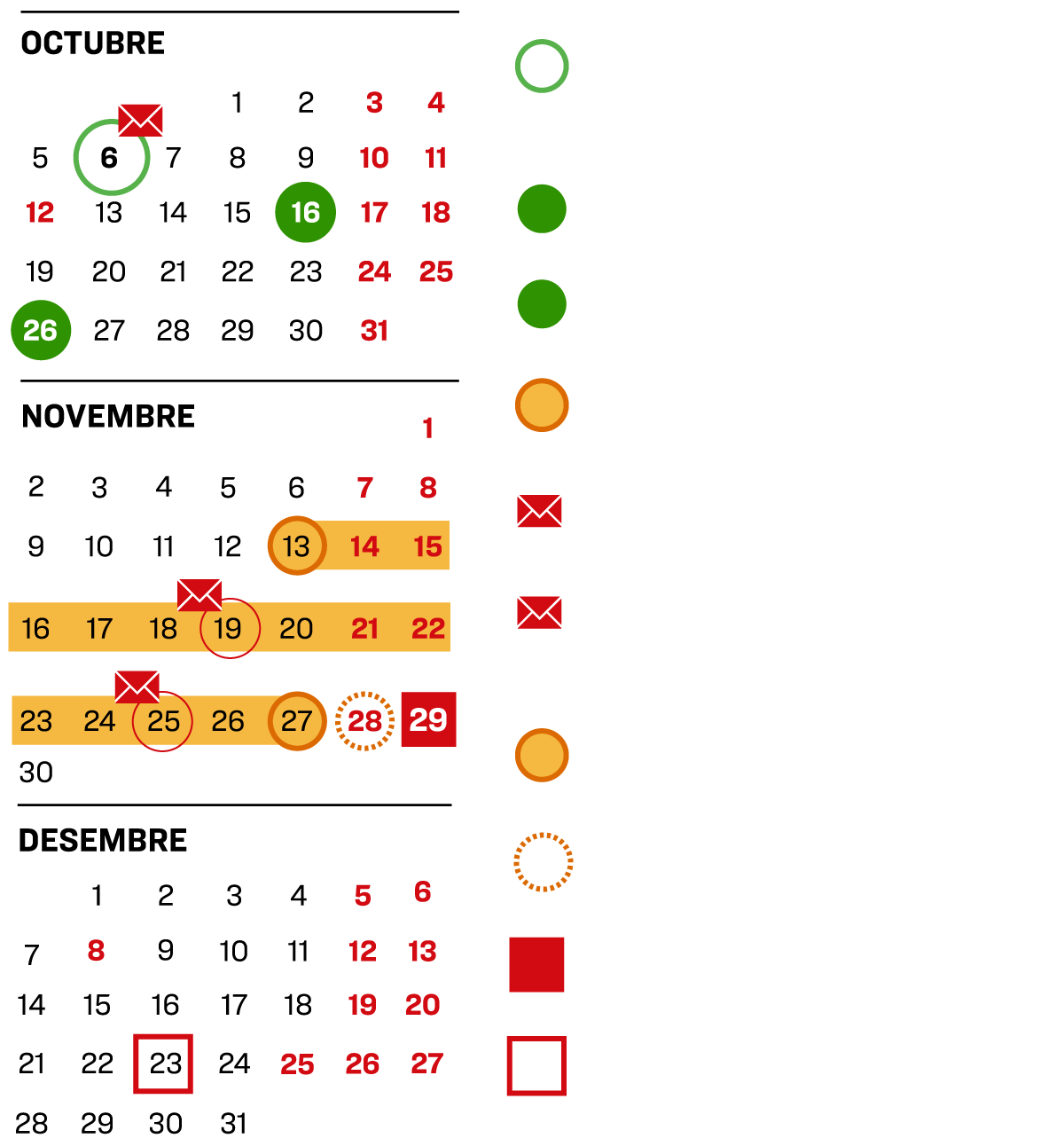
October 6th
The call is publiched in the Official State Gazette (BOE) and it is
possible to start requesting a mail-in ballot
October 16th
Deadline to register coalitions
26th of October
Deadline to present candidater-lists
November 13th
Campaign begins electoral
November 19th
Deadline to request a mail-in ballot
25th of November
Deadline to submit the ballot at a
Post Office
27th of November
End of the electoral campaign
28th of November
Reflection day
November 29th
ELECTIONS
23rd of December
Constitution of Congress of Deputies
and election of new leadership
October 6th
The call is publiched in the Official State Gazette (BOE) and it is
possible to start requesting a mail-in ballot
October 16th
Deadline to register coalitions
26th of October
Deadline to present candidater-lists
November 13th
Campaign begins electoral
November 19th
Deadline to request a mail-in ballot
25th of November
Deadline to submit the ballot at a
Post Office
27th of November
End of the electoral campaign
28th of November
Reflection day
November 29th
ELECTIONS
23rd of December
Constitution of Congress of Deputies
and election of new leadership
October 6th
The call is publiched in the Official State Gazette (BOE) and it is
possible to start requesting a mail-in ballot
October 16th
Deadline to register coalitions
26th of October
Deadline to present candidater-lists
November 13th
Campaign begins electoral
November 19th
Deadline to request a mail-in ballot
25th of November
Deadline to submit the ballot at a
Post Office
27th of November
End of the electoral campaign
28th of November
Reflection day
November 29th
ELECTIONS
23rd of December
Constitution of Congress of Deputies
and election of new leadership
Electoral calendar and key dates
The general elections will be held on Sunday, November 29, 2026. The electoral campaign will begin at 12:00 a.m. on Friday, November 13, and will end at 12:00 a.m. on Friday the 27th. The following day, Saturday the 28th, will be the day of reflection, during which no campaign acts may be held.
Polling stations will open on Sunday the 29th from 9 a.m. to 8 p.m. The publication of electoral polls will be prohibited during the five days prior to the voting, starting on November 24. The new chambers will be constituted on December 23 at 10 in the morning.
Heads of list for Barcelona on November 29
The final lists of candidates for Congress and the Senate were published in the BOE on November 3rd. In Barcelona, voters will choose between eleven lists for the 32 seats in Congress. You can consult all the candidates in our data interactive grouped by ideological blocks, from the main parties to formations like Vox, S’ha Acabat la Festa, Alhora, and the Front Obrer. Below, we explain who the main heads of the lists are.

Jordi Hereu (PSC)
Jordi Hereu (Barcelona, 1965) leads the PSC candidacy for Barcelona. Mayor of the Catalan capital between 2006 and 2011, he returned to the front line of state politics as Minister of Industry and Tourism. His candidacy represents the socialists' commitment to a profile with municipal experience and responsibilities in the Spanish government.
Miriam Nogueras (Junts)
Miriam Nogueras (Dosrius, 1980) repeats as head of the list for Junts for Barcelona. Spokesperson for the party in Congress, she is one of the party's main voices in Madrid and a leader close to Carles Puigdemont. During this legislative term, she has maintained a forceful discourse in the confrontation with the State and in the defense of Catalonia's interests.
Gabriel Rufián (ERC)
Gabriel Rufián (Santa Coloma de Gramenet, 1982) once again heads the ERC candidacy for Barcelona. Spokesperson for the republicans in Congress since 2016, he has consolidated himself as one of the most media-focused leaders in Spanish politics. His profile combines the pro-independence discourse with a prominent presence in debates about the left and state politics.
Ada Colau (Comuns - Broad Front)
Ada Colau (Barcelona, 1974) leads the Comuns - Front Ampli candidacy after having been mayor of Barcelona between 2015 and 2023. A social activist and one of the founders of the Platform for People Affected by Mortgages (PAH), she made the leap into institutional politics with Barcelona en Comú. Her candidacy represents the attempt to regroup the space of the 'comuns' and other progressive sectors.
Xavier García Albiol (PP)
Xavier García Albiol (Badalona, 1967) leads the PP candidacy for Barcelona. Mayor of Badalona and one of the best-known figures of the populars in Catalonia, he has built his political career with a discourse focused on security, immigration, and municipal management. His candidacy seeks to capitalize on the growth of the PP in Catalonia.
Electoral programs in PDF
Below you can download the electoral programs for the November 29 general elections that have been published so far:
- PSOE electoral program in PDF
- PP electoral program in PDF
- Vox electoral program in PDF
- Front Ampli electoral program in PDF
- ERC's electoral program in PDF
What do the electoral polls say?
Most private polls place the PP as the leading force, followed by the PSOE and Vox. The projections attribute an absolute majority in Congress to the sum of the PP and Vox, although there are differences in the magnitude of the lead and the distribution of seats. The barometer of the Centre for Sociological Research (CIS), on the other hand, offers a very different picture and places the PSOE almost twelve points ahead of the PP.
ARA compiles the main polls and keeps a simulation of the results by province and the possible composition of Congress updated. You can consult here what the polls say and which party would win in each constituency, as well as the evolution of seat projections.

How can you vote by mail?
Voters who cannot go in person to the polling station on November 29th can opt for postal voting. The deadline to request it ends on Thursday, November 19th, both in person at any post office or online, with an electronic ID or valid digital certificate.
In the application, you must indicate the postal address where you want to receive the electoral documentation. The Electoral Census Office will begin sending it from November 9th. Once received, you must insert the chosen ballot and the census registration certificate into the corresponding envelopes and deliver them to the post office before November 25th.
If the postal vote application is accepted, it will no longer be possible to vote in person on election day. Voters residing abroad have specific procedures and deadlines.
Who can vote in the general elections?
38,728,356 voters will be able to participate in these elections, of which 35,958,711 reside in Spain and 2,769,645 abroad, according to data from the National Statistics Institute (INE). Spanish citizens of legal age registered in the electoral census can vote, whether they reside in the country or abroad. Voters residing abroad will be able to vote without having to previously request electoral documentation.
The census could be consulted between October 12 and 19. The census cards, which indicate the polling station and the table where one must vote, will be sent between November 2 and 10.
The card is informative and it is not necessary to present it to vote. Congress is made up of 350 deputies, elected in provincial constituencies. Barcelona is allocated 32 seats, Girona 6, Tarragona 6 and Lleida 4. In the Senate, each provincial constituency elects four representatives.
Have you been chosen to be a member of an electoral table?
In the general elections of November 29th, nearly 75,000 people will have to constitute or substitute the more than 8,000 electoral tables that will be in Catalonia. The draws have been held between October 31st and November 4th, and the town halls will begin to communicate to those selected that they have been chosen to be part of them. If you are one of those chosen, you may wonder if there is any way to excuse yourself, what motives the electoral law allows, and what happens if you do not show up. Well yes, there are several causes that allow you to avoid going to an electoral table on November 29th.
Do you not know who to vote for? Consult the ARA test
If you still don't know which party to vote for, this ARA test can help you check which candidate best fits your ideas.
