El Hierro, overwhelmed by immigration: the Canaries demand the activation of Frontex
More than 9,000 people have arrived on the island from Senegal and Gambia in fifteen days, a figure that represents 84% of the arrivals to the archipelago

-
CAT -
CAST
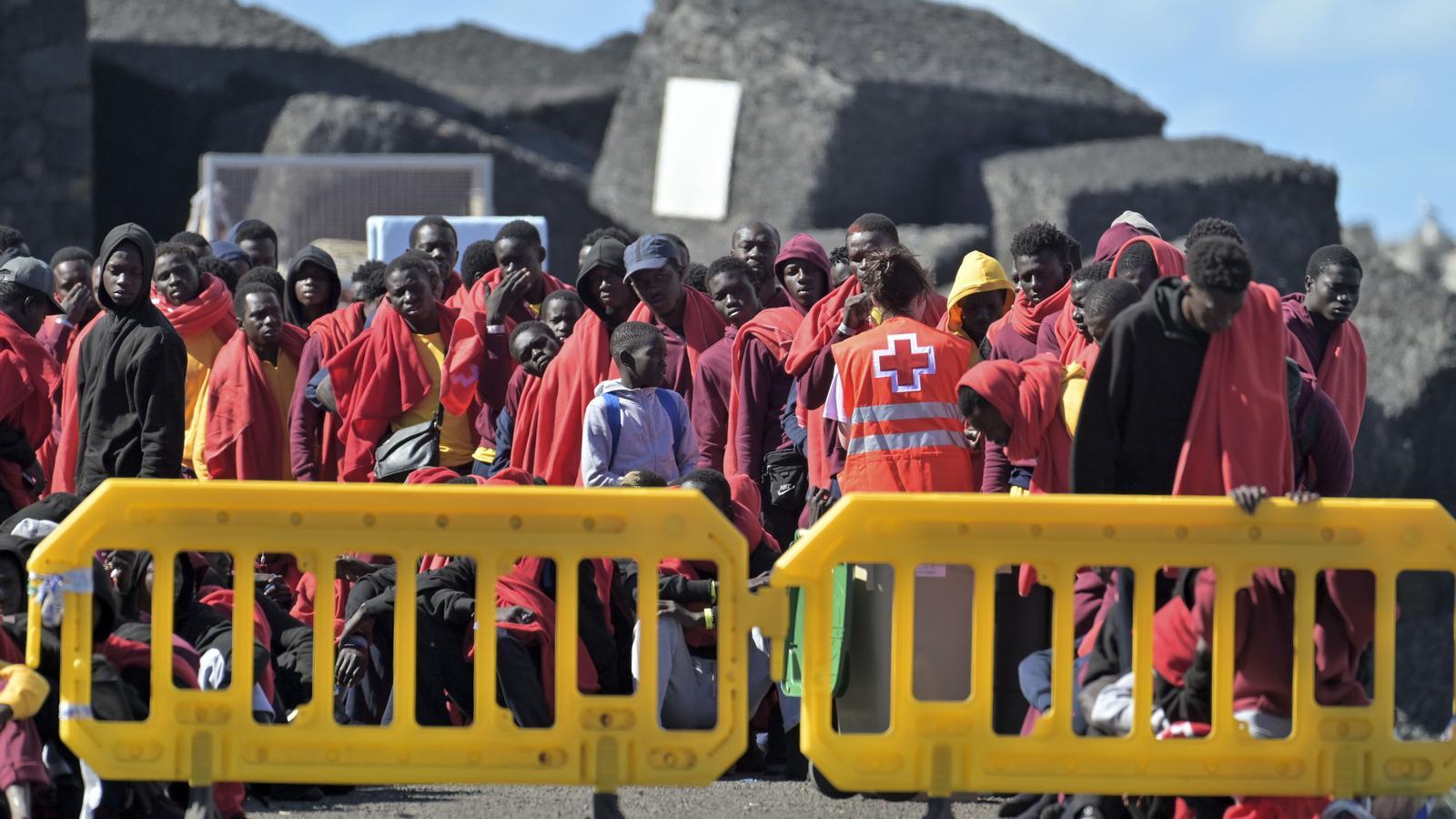
BarcelonaThe migration emergency in the Canary Islands is worsening. More than 9,000 people have landed during the first fortnight of November on El Hierro, the smallest island in the archipelago –with just over 12,000 residents–. In fact, there have already been three consecutive days in which more than a thousand people have arrived in a single day. Arrivals on El Hierro represent 84% of the migrants who have arrived in the Canary Islands in this same period, and the president of the Cabildo, Alpidio Armas, alerted on Sunday of an unsustainable situation for the island, and asked for speed from the Canarian and Spanish governmentsto attend to and transfer these people and reduce the growing pressure on the reception facilities. The island's Temporary Foreigner Attention Center (CATE) has an official capacity of 800 places, and the facilities are well over capacity.
This Monday, it was the Canarian president, Fernando Clavijo, who described this migratory spike as "unprecedented" and announced that on Tuesday, at the interministerial migration commission, he will demand that the Spanish executive request the deployment of Frontex on the coasts of Senegal and The Gambia, from where most of the boats come. It must be remembered that the Atlantic route, which connects these countries with the Canary Islands, is the migratory route with the highest mortality, as denounced by the NGO Caminando Fronteras, and at the same time it is one of the busiest due to the militarization of other migratory routes, in particular those in the Mediterranean.
The arrival of boats in El Hierro does not stop at the port of La Restinga: if Saturday saw the day with the most rescues since records of the Atlantic route began (1,580 people in just 24 hours), on Sunday another 1,467 people landed, 870 of whom had to spend the night on the docks due to a lack of space in emergency accommodation. This Monday, the first vessel to arrive in Canarian waters was carrying 134 people on board, two of whom were under 12 years old. According to the testimonies of the occupants, they had left Senegal seven days ago.
The Atlantic route to the Canary archipelago reached its peak of arrivals (40,000) in 2024 and since then had followed a downward trend that has suddenly broken in the first two weeks of November: the number of arrivals has intensified in recent days, especially from the coasts of Senegal. This year, one in five migrants who have arrived at the archipelago comes from this country in the far west of Africa. According to experts, one of the reasons behind this increase is that the Senegalese capital, Dakar, has become this November the first African city to host a Youth Olympic Games, and to guarantee the security of the event the Senegalese government has mobilized more police in the capital to the detriment of surveillance on the coasts. Added to this are the calm of the northern trade winds, which facilitates navigation at this time of year, as well as the political and economic tension suffered by Senegal, which has been aggravated by the impact of climate change: many Senegalese are driven to migrate due to European industrial fishing, which has altered their subsistence economy.
Clavijo demands the activation of Frontex
Everything suggests that the sporting event has had humanitarian repercussions thousands of kilometers from the Olympic host city, as thousands of people have taken advantage of this gap to leave the country via what is considered the most dangerous migration route in the world. Given that the journeys can last from five to eight days, it is currently unknown how many precarious boats might arrive in Spanish territory in the coming hours or days –as well as those that have been left adrift, as NGOs repeatedly denounce–. Meanwhile, the Canarian government insists that it cannot cope and that the situation, far from improving, is only getting worse. "We continue to wait for the necessary healthcare reinforcements to address the situation in El Hierro, where care services are under a great deal of pressure," said Clavijo.

The Canarian president has acknowledged that Maritime Rescue has deployed new vessels to the island, but has denounced “that the crews have to work consecutive shifts one after another”. He has also criticized that the diplomatic route announced by the Spanish government to curb departures from Gambia and Senegal “has been of no use”. However, regarding the PP's request to deploy the navy to the Canary Islands, he warned that “it would mean using [the military] as maritime rescue, because once a boat is detected, the only thing they can do is bring it to the coast”, and he insisted that the only viable path is the activation of Frontex to “prevent departures” at their origin. In this regard, he acknowledged the diplomatic effort made in Mauritania and Morocco, from where vessels “are not arriving”.
For his part, the delegate of the Spanish government in the Canary Islands, Anselmo Pestana, said that the Minister of Territorial Policy, Ángel Víctor Torres, has reported that the deployment of Frontex in Senegal and Gambia has been requested, and stressed that the executive “is doing everything possible”.
