Rufián wants to be a president like Pere Aragonès (but without Junts)
The republican candidate aspires to govern with pacts with the PSC, Comuns, CUP and “whatever remains of Podem”

-
CAT -
CAST
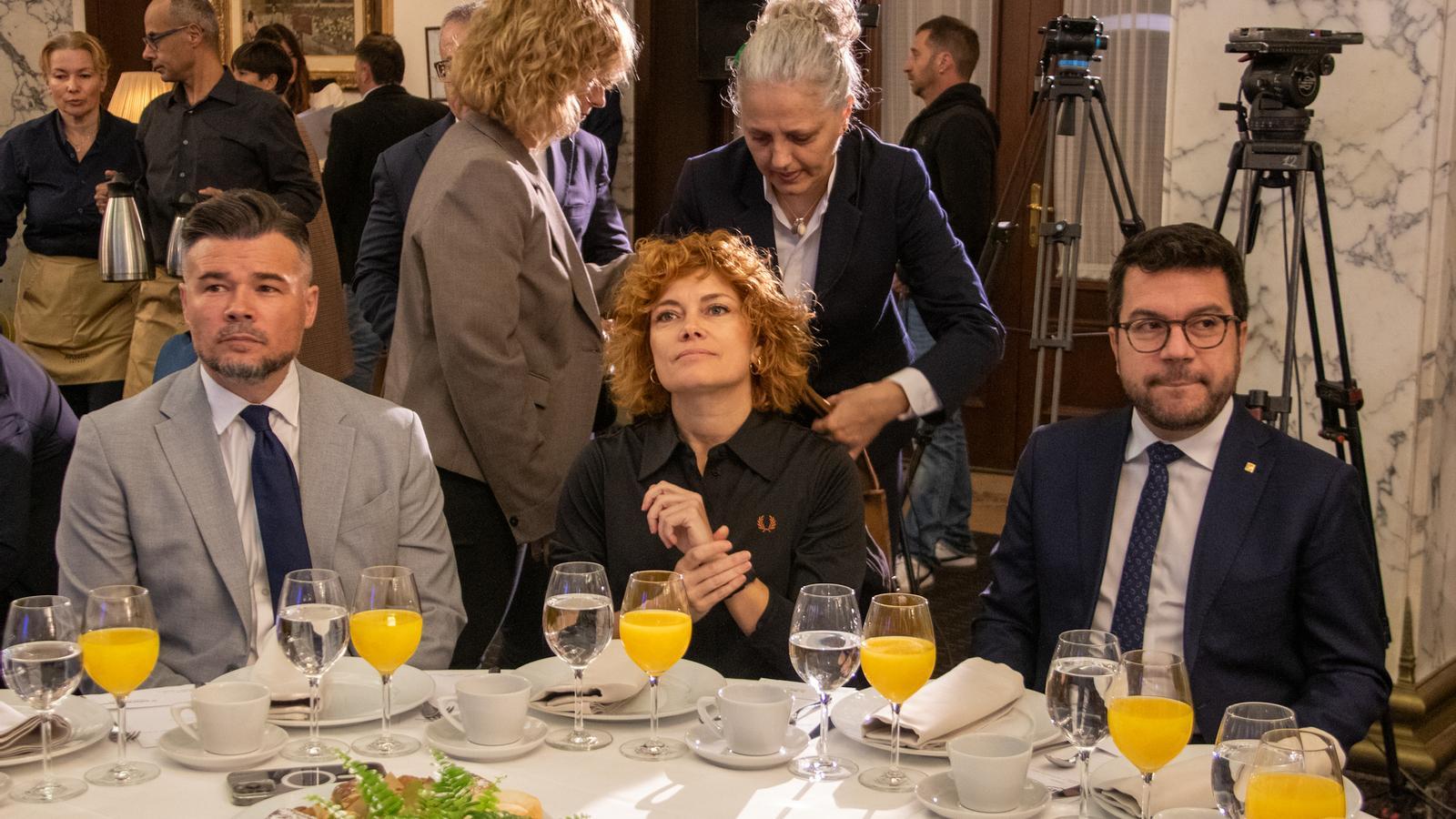
BarcelonaGabriel Rufián congratulated Pere Aragonès at 7 a.m. for his birthday. Two hours later they were due to meet at the Hotel Palace in Barcelona, where the former president of the Generalitat was presenting the republican candidate for November 29th at the Nova Economia Fòrum informative breakfast. “Pere Aragonès is my age and has already been president. And I, well, I am where I am.” The two republican leaders surely represent two very different ways of doing politics, but this Monday they showered each other with praise. Of Rufián, Aragonès highlighted his “communicative capacity,” especially in the digital sphere, where he said he “excels”; and also that he does not “shun any battle” —and signs up for “more” than those that fall to him, he added—. Rufián reciprocated the praise by defining Aragonès as a “very attentive and very capable” person and, without mincing words, he sent a dart to the ERC leadership: “A pity that ERC does not claim more that it has had a president like Pere Aragonès”.
Oriol Junqueras was not there to hear this lament, but the party's general secretary, Elisenda Alamany, was. Rufián has verbalized one of the criticisms that, behind closed doors, some party cadres reproach the current leadership with. Like Pere Aragonès, Gabriel Rufián assures that he also wants to be president of the Generalitat. Despite leading all state demographic rankings, including those that place him as one of the favorites to reach the Moncloa Palace, he says he does not want to govern Spain —although he does want to help govern it, he admits—. Rufián's aspiration, he states, is to reach the Palau de la Generalitat, but here he differs from the strategy that Pere Aragonès followed.
When and how does he want to do it? For now, he assures that he does not want to take Oriol Junqueras' place —although polls place him ahead of the ERC president as the preferred candidate to be president of the Generalitat—, but rather that he would like to govern Catalonia once Junqueras has done so. And with whom? Rufián bets on the “left-wing front” that he has been defending for months to govern the Generalitat and that there should therefore be an executive with ERC, Comuns, the CUP, and “whatever is left of Podemos.” For now, this alliance does not add up, but the republican leader bets on adding the PSC to it. “The future of Catalonia must be coalitions and left-wing spaces with the PSC,” he defended.
Spirit of “revenge”
That is to say, Rufián argues that ERC should stop looking at Junts, whom he believes should be “brought to political ostracism and the naughty corner.” In fact, he reproached the juntaires for abandoning Aragonès just over a year after signing the coalition agreement and compared it to Vox's departure from the regional executives they shared with the PP. “Vox also did it, to wear them down,” he stated. In fact, he reproached the juntaires once again for accusing ERC of voting alongside the PSOE “in exchange for nothing” after the republicans agreed to pardon all the leaders of the Procés: “What kind of political and national shame is this?”. Rufián, precisely, approaches this campaign, he said, in a spirit of “revenge”.
The republican leader will not spare the darts at Junts —nor the criticisms of the press regarding how they report on it—, he has promised. Nor will he stop asking them to resemble the PNV and avoid mirroring themselves after “Ayuso or Orriols”. Because he considers that being “those in the middle,” as Junts defends, is not an option, but rather demands a “subjugated” PSOE before a government of PP and Vox that could “make constitutional changes” with 210 seats. “People are eager to cast those in the middle out of the middle,” he stated.
In fact, Rufián took the opportunity to defend himself for speaking in Spanish in Congress in the face of criticism from Junts. And he did so by resorting to the past, when he was part of the Assembly and participated in the 2015 Diada: “Do you know who is the person who helped me the most in making the pro-independence speech in Spanish? Quim Torra, who at that time was president of Òmnium”. Rufián concluded by defending that, in an independent Catalonia, Catalan should be “the only recognized language”.
