Milk, wine and a baby bottle to say goodbye to the dead in the Menorca of 2,000 years ago
The analysis of some thirty ceramic vessels in the courtyard of a cave reveals what funeral rites were like in the Iron Age
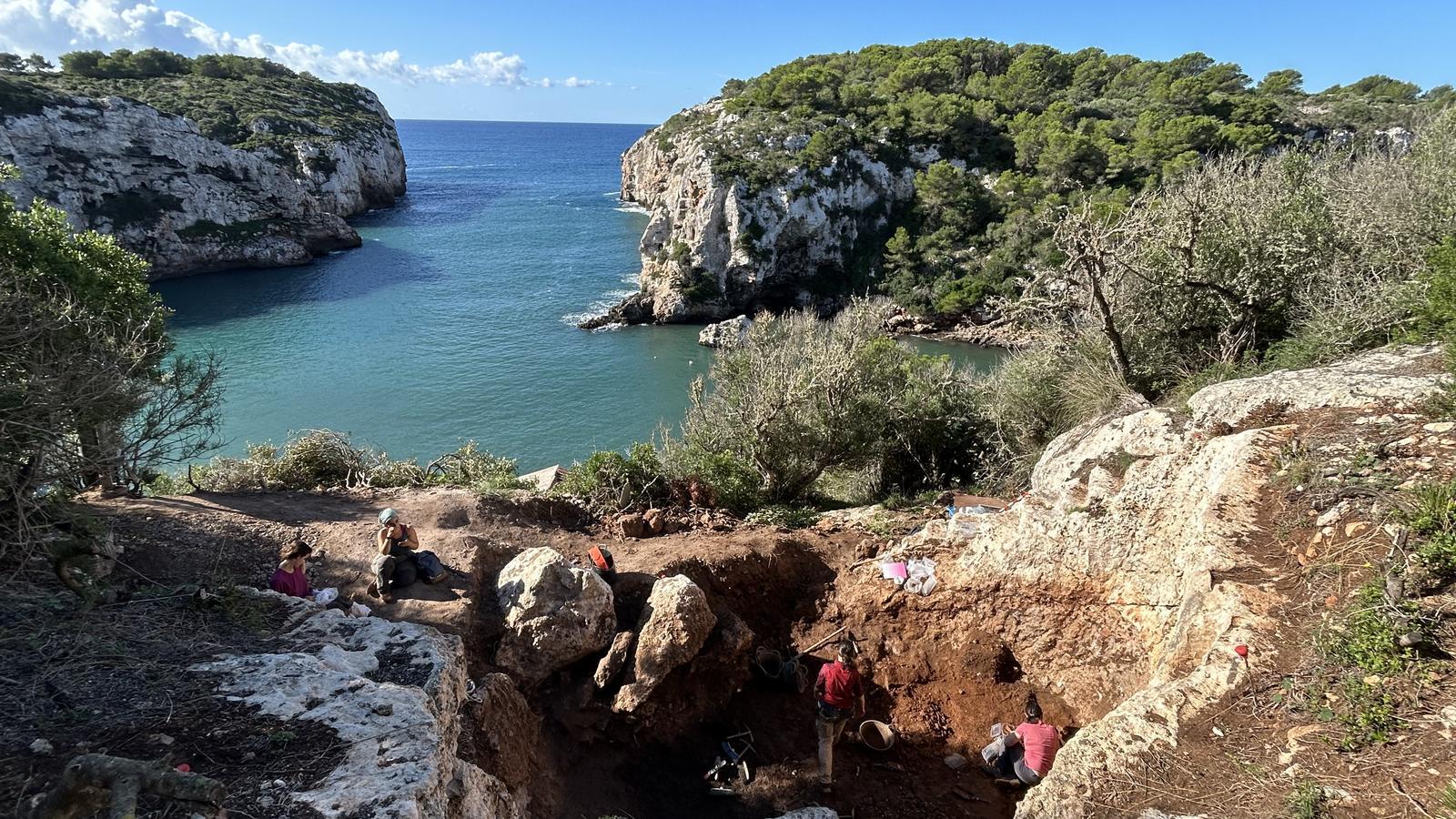
BarcelonaCales Coves is an idyllic corner of the south coast of Menorca, in the municipality of Alaior, with cliffs, pebble beaches, and transparent waters. If we close our eyes and go back more than 2,000 years, to the Second Iron Age or post-Talayotic period, there, in an external patio of the cave built expressly for this purpose, we can imagine, thanks to a new study, how the Menorcans bade farewell to their dead.
The research, published in the Journal of Archaeological Science and conducted by the Autonomous University of Barcelona (UAB), the Barcelona Supercomputing Center (BSC-CNS), and Pompeu Fabra University (UPF), has used an innovative methodology for organic residue analysis to reveal what was consumed in these rituals from 34 ceramic containers at the site.
A good part of the pieces, which were recovered in 2023 and 2024, were preserved whole and were still in their original position, a very unusual circumstance. “Until now, much attention had been paid to the interior of the burial chambers, where the deceased were interred accompanied by the objects that were meant to help them make the transition to the afterlife. In contrast, the area outside had not received as much attention as it deserved –explains Sonia Carbonell, a researcher at the BSC-CNS and co-author of the study–. Following the surveys for my doctoral thesis on post-Talayotic funerary architecture, we saw that, on the outside, before accessing the cave, there was an open-air space carved and cut expressly into the rock. It is an external patio created to perform farewell rituals”. In this external patio, it has been possible to document ceramic vessels with traces of wine and milk, and fauna —goats, sheep, and piglets— which allow us to suggest that offerings were made there.
The cave ceased to be used as a post-Talayotic funerary space in the 2nd century BC, but it was reused in later times, such as the Roman or Islamic period. The analysis of these burials has revealed a significant piece of data: unlike other ancient cultures, in which perinatal babies received different treatment and were buried in necropolises separate from adults, at Cales Coves all age groups are represented together, from perinatal individuals and infants to adults.
Milk in local vessels, wine in foreign ones
There is a clear difference in the containers according to their content: those that contained milk are indigenous, while those that were used for drinking wine are inspired by shapes from other places, although adapted to the local culture. Regarding these locally produced vessels, a thousand hypotheses had been made; that they were used to burn aromatic herbs, for example. "Organic analysis allows us to go further and refute hypotheses we had that were based only on the shape of the piece," points out Carbonell. "In this case, the vast majority contained milk and dairy products. In post-Talayotic Menorca, goat and sheep milk was a basic food source, a product very present in the daily life of these communities," he adds.
The vessels intended for wine imitate shapes linked above all to the Punic world of Ibiza. At that time, Ibiza was one of the strategic Punic control points that dominated a good part of the trade networks of the Western Mediterranean: they produced wine and oil, exported them to the Iberian Peninsula—for example, to Empúries—and redistributed products from other areas, such as pieces of Iberian production. The consumption of wine in Menorca—both in the settlements and in these funerary rituals—demonstrates close commercial ties and the presence of intermediaries in these exchange networks.
These containers copy ceramic shapes that came from other Mediterranean territories associated with wine consumption. The local population takes these imported models, adapts them, makes their own copy, and puts in them exactly the substance for which they had been intended. "Unlike milk, which was daily, wine was imported and was related to more occasional and ritual consumption, although we also have it documented within the houses of the settlements. This shows us that the community integrated products and shapes from outside, but while maintaining their own cultural codes and their identity," emphasizes Carbonell.
The work has also validated the hypothesis that another small piece with a globular body and a pouring spout, which was inside the cave, was a baby bottle. "This baby bottle speaks to us of child-rearing and care, of people who fed infants and of gestures that they also wanted to maintain in the funerary ritual," explains Margalida Coll, a researcher at the Department of Humanities at UPF and co-author of the study.
Until now, it was not known for certain what this piece was; at the Museum of Menorca, for example, it had been traditionally interpreted as an oil cruet due to its shape. But upon performing a residue analysis, they found lactic traces with the presence of fruit. These same pieces have been documented in other children's tombs in the Punic sphere, for example in Sicily and Sardinia.
In order to make containers that seemed empty at first glance speak, the team applied special methodologies. “When we started to excavate and identify these pieces in the courtyard, we collected them by wrapping them with aluminum foil and with great care, leaving the sediment inside. Afterwards, we performed a micro-excavation in the laboratory, in a totally controlled environment to avoid any contamination,” says Carbonell.

