Sánchez stands as the "spearhead" against the extreme right: "We are more necessary than ever"
The Spanish president tries to breathe encouragement into the socialist ranks in a context of crisis in Ceuta and a drop in the polls

-
CAT -
CAST
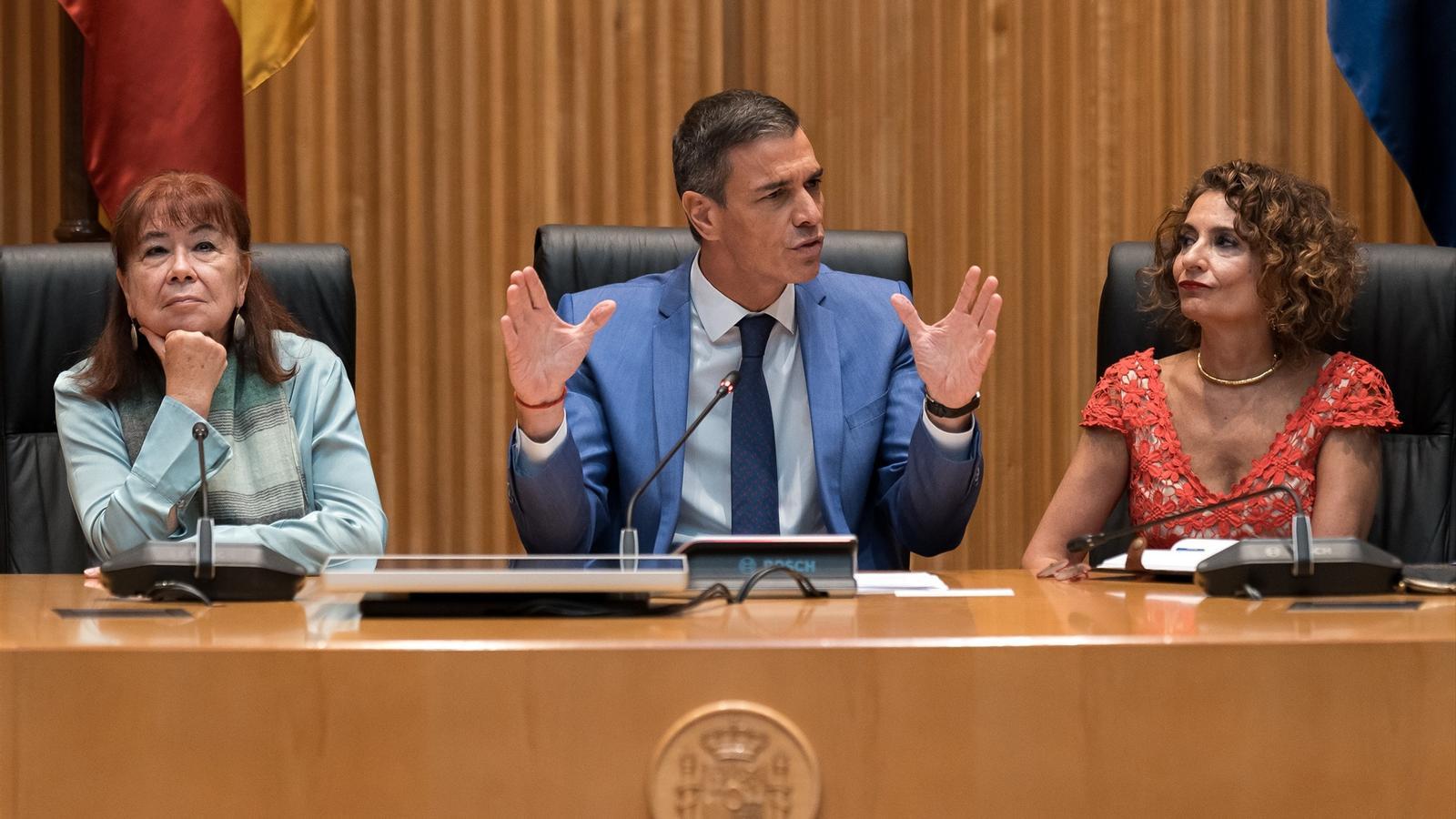
MadridThis Monday, a good number of Madrid newspapers are publishing a poll. The results are not exactly the same, but the trend is clear: the PP and Vox are surpassing the left-wing bloc by a wide margin, and the PSOE is bogged down by the Ceuta crisis and is heading for a fall. El País points out that for the first time the right and the far-right are exceeding 50% in voting intention; while in Abc and in La Razón the PP and Vox are exceeding 200 deputies, already far from the absolute majority they need to govern. In this context, and just the day after the triumph of the German far-right in a state, the Spanish president, Pedro Sánchez, has tried to boost morale among the socialist ranks. In an inter-parliamentary meeting at Congress this Monday, with the presence of deputies and senators, he reaffirmed that this term is four years long and that the project he leads as president looks towards 2030. That is to say, not only has he ratified that the elections will be next year, but he still has hope of being able to add up again to govern for four more years, despite the polls. "We have been at it for eight years, and next year, four more years," he proclaimed amidst applause from the PSOE representatives. What's more: he has proclaimed himself the "spearhead" against the rise of the far-right in Europe: "We are more necessary than ever".
For Sánchez, Spain is the example that the right and the far-right can be fought with social-democratic social and economic policies. "Yesterday's result in Saxony-Anhalt is a warning that the far-right is gaining ground in the face of the surrender of the traditional right; and also a confirmation that a government like Spain's is the spearhead to fight the reactionary movement". "It is fought with more rights and freedoms," he exclaimed.
The head of the Spanish executive has boasted of 74 legislative measures approved during this term, in the face of those who claim there is a parliamentary blockade: "We have approved the expansion of paternity leave, we have created the state public health agency, we have strengthened the national dependency system with record funding, we have approved the basic law for firefighters and forest agents to fight against climate change, the sustainable mobility law, and the decrees in response to the war in the Middle East," he cited —without mentioning the amnesty—, and called for continuing along the same path: "You have sweated your shirts and made the impossible a reality with this parliamentary arithmetic. I thank you, colleagues, for your work," he said, subsequently asking the socialist representatives to "go and achieve even more" in this final stretch.
Sánchez admitted that the upcoming calendar is difficult, but asked for "maximum commitment" from his troops now that there will be municipal, regional, and also Spanish elections next year. He asked them to roll up their sleeves to approve the laws that are in the pipeline, for which he believes it is necessary to "give it your all." He gave as examples the law penalizing conversion therapies, the law for the protection of minors on social media, the organic law on public integrity and lobbies, as well as the law to reduce ratios in schools. He also mentioned the new financing system agreed upon with Esquerra, which the council of ministers must now approve, as a necessary element to improve public services. Thus, he lamented the opposing position of the autonomous regions governed by the PP —even though those governed by the PSOE are also against it— only to attack, he said, the coalition government of the PSOE and Sumar. "They are acting against the interests of their citizens," he proclaimed, recalling that all autonomous regions improve in terms of financing with the new model.

Regarding Ceuta, Sánchez has committed to resolving the situation as soon as possible after having completed the appropriate individualized files. In fact, he has reiterated that the goal is to return all immigrants except those who have the right to asylum because they are politically persecuted. "We will emerge from the crisis through institutional unity, placing the general interest first," he promised, and he lashed out at the "destructive" opposition of the PP and Vox, who take advantage of any crisis "to spread hate." The Vice President and head of the Economy, Carlos Cuerpo, also referred to it at a breakfast hosted by Efe and RTVE: although he admitted that the solution will not be immediate, he said they are working so that "normality" arrives as quickly as possible.
The priorities of the legislative term
Looking ahead to the academic year starting this September, Pedro Sánchez mentioned the priority areas, among which is the presentation of a new budget. This is a commitment that the Spanish government made before going on vacation and that Sánchez ratified this Monday: "These will be the budgets with the highest social spending in history," he promised. He added that the great priority will be housing and called on the groups to show "responsibility" in approving them. In fact, this very morning he presented with the Minister of Housing, Isabel Rodríguez, Casa 47, the state offer of 800 available apartments at an affordable price, and took the opportunity to attack Isabel Díaz Ayuso: he defended his policies against those who "buy a penthouse worth more than 6 million euros for the president of an autonomous government," in allusion to the latest controversy affecting the Madrid leader. And the fact is that Sánchez boasted that his model involves investing in social policies and, at the same time, contributing to economic growth, which he remarked he has achieved during his eight years of government and at a much higher rate than the rest of the European Union.
As a priority, Sánchez, apart from housing, mentioned the fight against climate change, guaranteeing rights and freedoms, and shielding, for example, the right to abortion. "With PP and Vox governments in the autonomous regions, we must be the bulwark of freedoms in Spain. Either we do it or no one else will," he told the socialist parliamentarians.
Finally, the Spanish president also boasted about his foreign policy, despite the fact that with the Ceuta crisis he has been left alone and on migration policy he has no allies in Europe. "We will continue to have our own voice [...]. We defend common sense, it is not an ideological voice," he said. "We know it has a cost, but we will not give it up. We will be a brave, European, and peace-committed voice," he summarized. Sánchez made this intervention before the socialist representatives and live for the media. Subsequently, he left the meeting, so there was no debate: it was not a discussion forum but a meeting to hear the intentions of the Spanish president now that he is entering the final stretch of the legislature.
