Sánchez defends himself from the attacks of the PP and Vox: "I may be a 'dog', but I have no master"
Feijóo accuses the Spanish president of having "conditioned freedom": "If Morocco sings, you leave"
-
CAT -
CAST
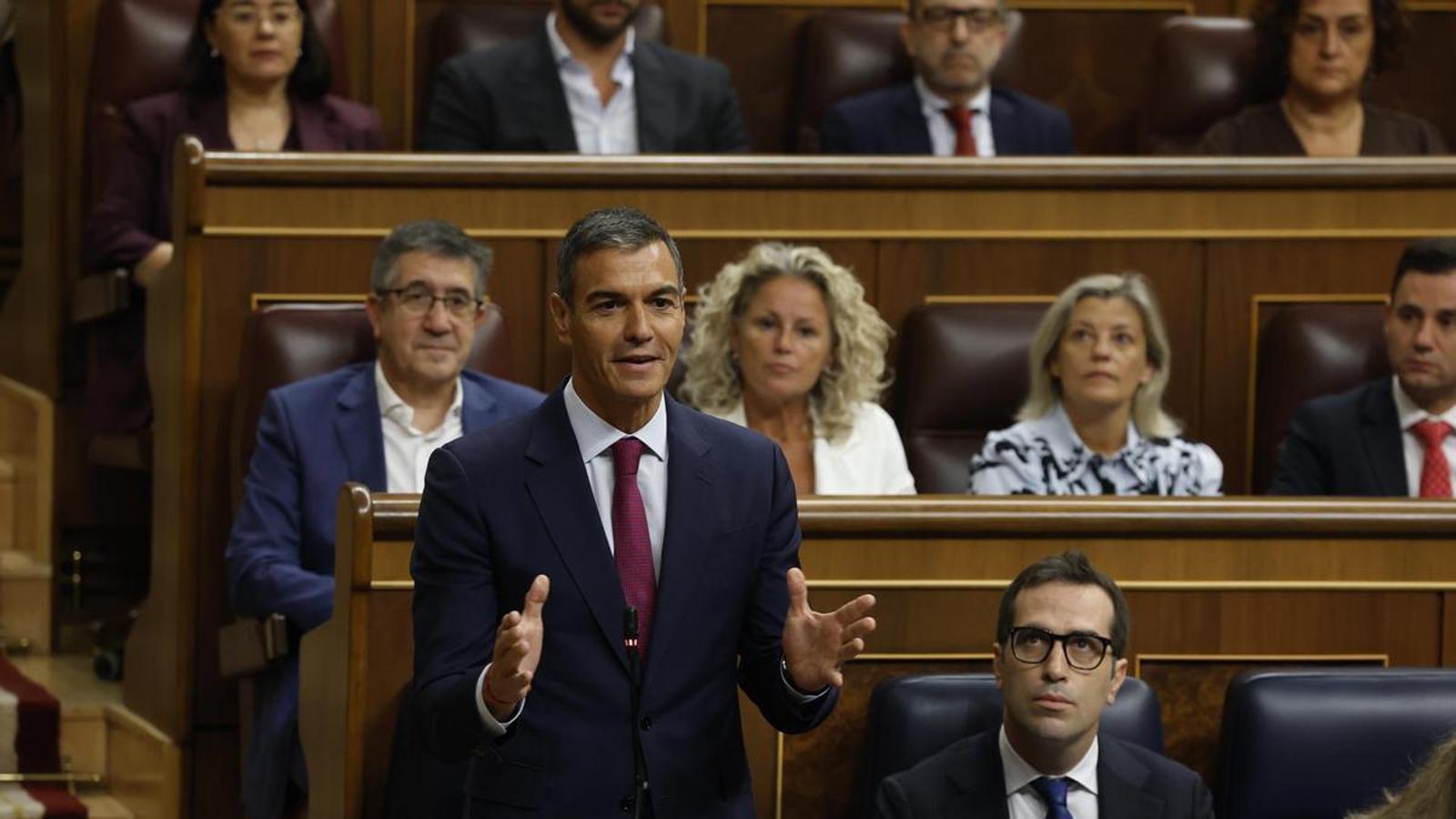
MadridA few hours before the Spanish government declassifies the reports on Ceuta, Pedro Sánchez defended himself against the attacks from the PP and Vox in Congress regarding the management of the migration crisis. "We have nothing to hide," the Spanish Prime Minister defended during the first control session after the summer break. Sánchez assured that his executive "does not accept blackmail from any party, any country, or any power." "I may be a dog, but I have no master," retorted the socialist leader, referring to the nickname Perro Sanxe, with which they tried to discredit him in the past, even though he has managed to end up making it a badge of honor.Conversely, he accused the PP and Vox of wearing a "leash" from Israel and the United States.
Both Alberto Núñez Feijóo and Santiago Abascal attacked him, warning him that the polls "will make him pay" for having "left his country unprotected." "If Morocco sings, you are out," stated the PP leader, who described the Spanish president as a political leader whose "freedom is conditioned by the fact that many people continue to remain silent." In the same vein, the president of Vox said that "Spain cannot continue to be a Moroccan protectorate."
Pedro Sánchez responded to the criticisms regarding the management in Ceuta not only in the parliamentary back-and-forth of the control session, but also in a more measured way in an interview on the program Mañaneros on TVE. "Many things can be criticized about me, but we have had a consistent and coherent foreign policy," he defended, recalling that he has stood up to the great powers during this term, such as the United States, with his refusal to spend up to 5% of GDP on defense or with the decision to veto the use of the Rota and Morón bases for the Iran war.
During the interview on Mañaneros, Sánchez defended his management in Ceuta and considered that there were only two issues to improve: a higher state of preparation against a hybrid attack and investing more in border protection, taking into account the structural inequality that exists between Morocco and Ceuta. However, he maintained that the Spanish government could not anticipate the massive entry of migrants on July 30th because there were no reports warning of it. In this way, he anticipated the content of the declassification of the documents on Ceuta, which will be made public at 5 PM.
Sánchez related that the reports reflect that a "slight uptick" in migrant arrivals was recorded in the days leading up to July 30, but "of hundreds of people" and "absolutely not of 70,000 people". "Without detracting from the professionalism of the intelligence services, a massive arrival of so many migrants was not foreseen at all," the Spanish president concluded. Thus, he challenged the PP and Vox to put solutions on the table and not "entrench the problem" in Ceuta. "Feijóo has suggested an armed solution [alluding to activating Article 8 of the Constitution] and that is an atrocity. We cannot speak of invaders, but of people seeking a better life. If the PP and Vox were actually governing and had done that, we would be talking about a major crisis," resolved Sánchez, who reaffirmed that the border security agents made the right decision in choosing not to exert violence against the migrants and letting them through.
From there, Sánchez said that it is necessary to expand the reception places in Ceuta to 6,000—now there are about 3,500—in order to carry out the triage and return economic migrants and provide coverage to those who have the right to asylum. "We do not rule anything out," he said, regarding whether they are considering moving people to the Peninsula to carry out these individualized files. What he did ask of the PP is that it help and have a "sense of state," instead of aligning itself with the extreme right, and he assured that he has nothing to hide regarding the investigation by the National Court. Moreover, he said that, despite the past of the judge leading the investigation, María Tardón, in the ranks of the PP, this is not "at odds" with her work as a magistrate. A significant difference from the tone used by Minister Óscar Puente and the Moncloa itself, which have suggested that the fact that Tardón was a PP councilor already discredits her. It was not the only self-criticism: he also admitted that the Interior report on the ideology of talk show guests, released yesterday by El Confidencial, is "unfortunate," although he downplayed its importance.
"We will win again"
Despite the difficulty of the moment, Sánchez has assured that he is "eager" to run again in the 2027 elections and, during the control session, he even predicted that he would "win" again against the right and the far right. Gabriel Rufián, spokesperson for ERC, warned Sánchez of the danger that would be posed by the right-wing bloc exceeding 200 seats, as recent polls have indicated. "How do you plan to win? —asked Rufián— The numbers don't add up for me, and my mouth is already sore from saying it so much," lamented the ERC leader in Madrid.
Ceuta has not been the only front that has opened up for Sánchez during the control session in Congress. The setback from the Supreme Court in relation to the so-called law of grandchildren has been one of the weapons brandished by the PP and Vox. Feijóo stressed that Sánchez has only been "focused on manipulating the census".
The Spanish president was harsh in his response. He accused the PP and Vox of being the direct descendants of the dictatorship and of currently trying to erode the citizenship rights of the children, grandchildren, and relatives of those who had to flee Spain during the dictatorship. Furthermore, he recalled that in the last count of the overseas vote, in 2023, the PP benefited, and as a result, the PSOE lost a deputy. "There is an underlying current, on the part of the right and the far right, of questioning the democratic regime," he warned, although he showed himself willing to put up a fight once again.

