The Supreme Court blocks the right to vote of those naturalized under the 'grandchildren law' until they prove that they are descendants of exiles
The contentious-administrative chamber of the high court has accepted the precautionary measure that Vox and Iustitia Europa requested

-
CAT -
CAST
MadridThe Supreme Court has acceded to the claims of Vox and Iustitia Europa –an extra-parliamentary party common in cases involving the PSOE– and has temporarily suspended the right to vote for people who have obtained Spanish nationality through what is known as the grandchildren's law. It is a precautionary measure that it has adopted until it issues a final judgment and while Spanish consulates do not "issue certifying documentation" of their status as descendants of exiles. This addresses those "born outside of Spain, to a father or mother, grandfather or grandmother, who were originally Spanish," who suffered exile for "political, ideological, or belief-based reasons, or for reasons of sexual orientation or identity" and who "had lost or renounced" Spanish nationality. This is the exact phrase that appears in the Democratic Memory Law.
What the Supreme Court is doing is drawing a distinction between this regulation, approved in October 2022, and an instruction published five days after the law came into force and signed by the Director General of Legal Security and Public Faith, Sofía Puente. The PP put her in the eye of the storm because she is the sister of Minister Óscar Puente. "She expanded the law without authority and has turned this process into a sieve," the Popular Party members have criticized, as they interpret that the application of the regulation has gone beyond what was initially foreseen: that the descendants of exiles recover their nationality. Two months ago, Hazte Oír filed a complaint against her for prevarication, which remains pending the Prosecutor's Office's opinion.
Sofía Puente's instruction established that to obtain nationality, the status of exile would be presumed for "all Spaniards" who left Spain between July 18, 1936 –with Francisco Franco's coup d'état– and December 31, 1955. It would only be necessary to prove the departure from Spanish territory by, for example, a passport stamp or marriage, birth, or death certificates.

The high court suspends the registration in the Electoral Census of Absent Residents (CERA) of people who have obtained Spanish nationality through the application of the Democratic Memory Law, although it allows the “processing of the corresponding file” to continue until it concludes. Regarding people who are already registered, it suspends the “electoral effects” for “subsequent electoral processes that may be called.” That is to say, they will not be able to vote. Likewise, the Supreme Court orders the Electoral Census Office to break down the people who have registered with the CERA as a result of a “direct application” of the “exile assumptions provided for” in the Democratic Memory Law and those who have benefited from the “interpretation” made by the instruction. One of the six magistrates of the Supreme Court chamber has announced that he will formulate a dissenting opinion.
From the Moncloa, Minister Félix Bolaños has “respectfully” asked the Supreme Court to resolve the substance of the matter “as soon as possible” and, especially, before the elections that will take place in 2027. PSOE sources regret that “turning” the right to vote of thousands of Spaniards into “fuel to sow electoral suspicions” is “deeply irresponsible.” And Sumar considers the Supreme Court's decision “opens the way” to a “very dangerous anti-democratic drift.”
The PP and Vox applaud the news
For their part, both the PP and Vox have rushed to welcome the news. “We were right,” Alberto Núñez Feijóo limited himself to celebrating on X. “The Spanish government intended, with total shamelessness, in a hurry and without guarantees, to alter the general elections so that Sánchez would perpetuate himself in power and it has encountered a rule of law that works,” proclaimed the number 3 of the PP, Alma Ezcurra, in a video sent to the media. “We congratulate ourselves on the judicial blow,” she added, even though the Popular Party did not turn to the courts.
For its part, Santiago Abascal's party, which has long been preparing the ground to question the result of the next Spanish elections, has boasted of having managed to “suspend the attempt to manipulate the electoral census to alter the elections.” The spokesperson for the far-right party in Congress, Pepa Millán, took the opportunity to reproach the Popular Party for taking credit: “Some limited themselves to warning about it and others have managed to stop Pedro Sánchez's goal of perpetrating a coup in the next elections,” she said in a brief statement in the lower house.
The hearing at the Supreme Court
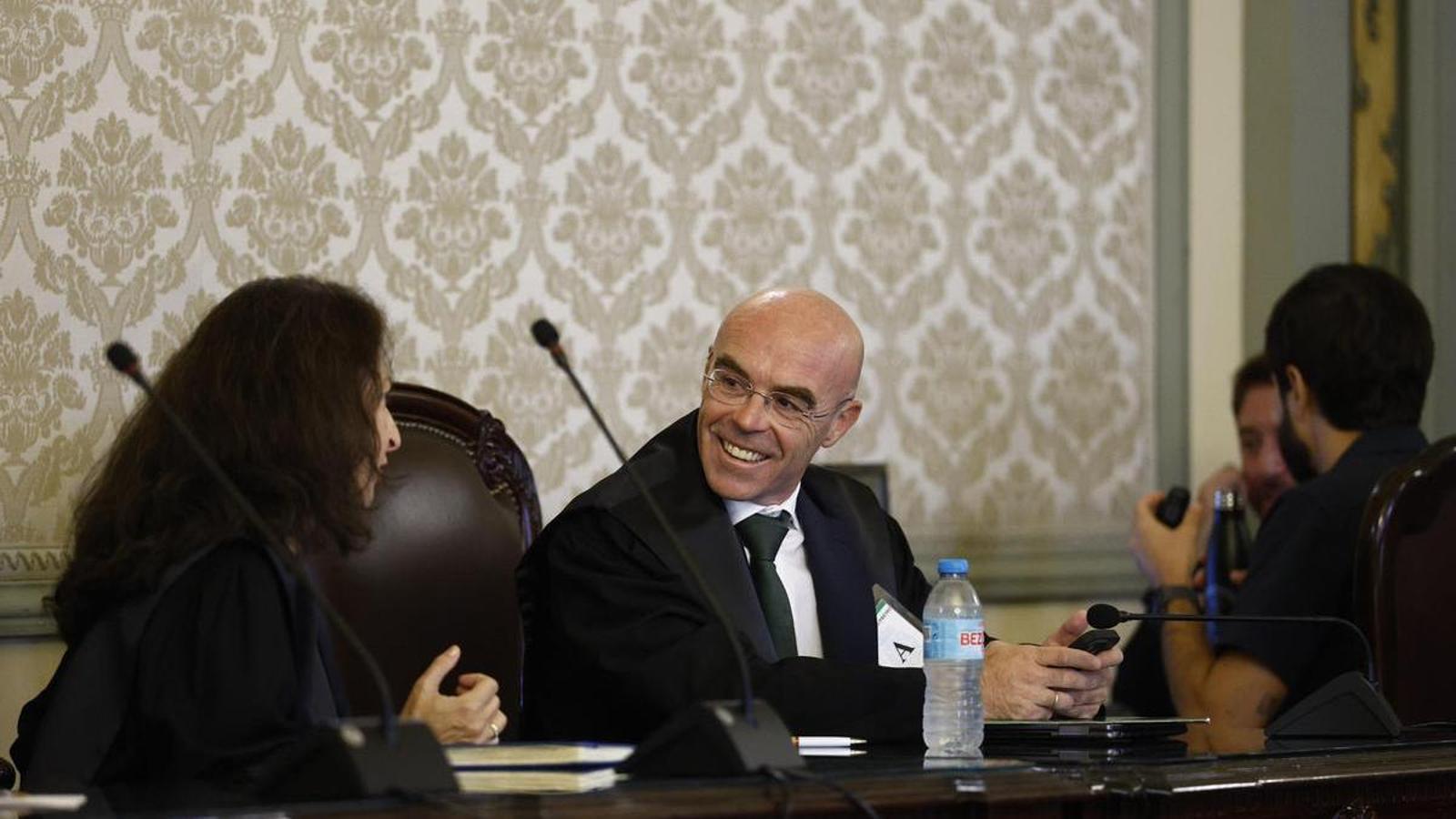
The Supreme Court's decision comes 24 hours after a hearing was held to confront the arguments of Vox and Iustitia Europa with the postulates of the Spanish government. Jorge Buxadé, legal coordinator of the far-right party, justified that the suspension of the right to vote was necessary to prevent the electoral census from continuing to “increase in an anomalous way”. For his part, Luis María Pardo, president of Iustitia Europa, argued that the “certainty of the democratic process” was “at stake” and defended that a future favorable ruling could not “reconstruct with certainty elections already held”.
In contrast, the State attorney –representing the Spanish government– accused them of basing their case on “hypothetical and eventual risks” and maintained that suspending registrations in the CERA would violate the right to active suffrage: “How could people who have acquired a nationality through firm administrative acts be deprived of rights?”, she asked.
