The statements at the National Court of the former executives of Plus Ultra, of the manager of the PSOE and of the former director of the Civil Guard mark the beginning of the new academic year
5 min
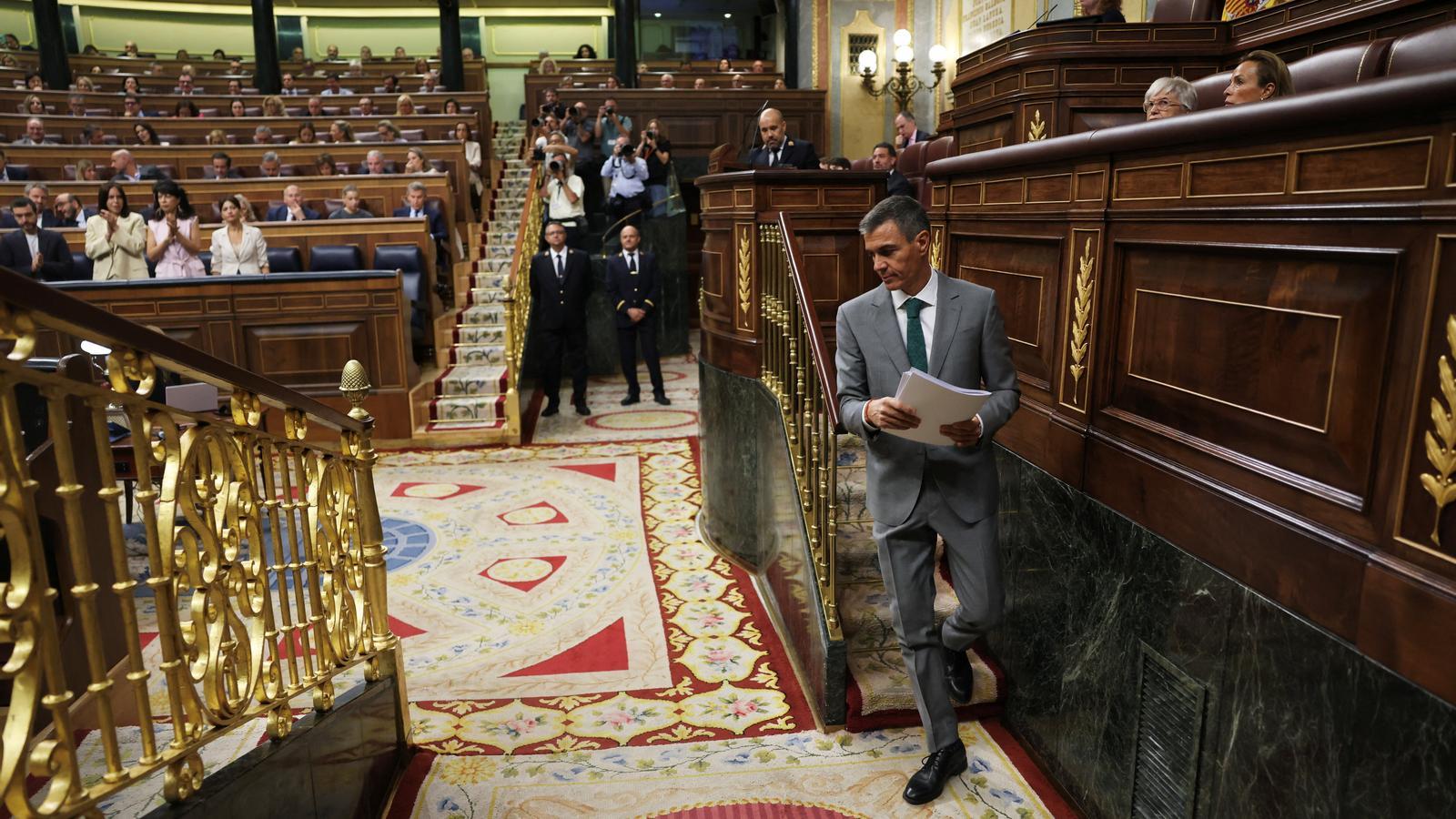
The president of the Spanish government, Pedro Sánchez, leaving the tribune of the Congress of Deputies in Madrid after intervening on the migration crisis in Ceuta.Susana Vera / Reuters
MadridAfter the holidays and a resumption of the political term marked by the Ceuta crisis, the courts return to the forefront of current events. This week, Pedro Sánchez will see two executives from Plus Ultra, the manager of the PSOE, and the former director of the Civil Guard file through the National Court in the two investigations that have gained the most momentum in recent weeks and which could shake him the most: those of the Leire Díez and José Luis Rodríguez Zapatero cases. What is expected to happen in the coming days and weeks?
Plus Ultra continues to put Zapatero against the ropes
The judicial storm resumes with two key statements: Julio Martínez Sola –on Monday– and Roberto Roselli –on Tuesday–, who resigned at the end of July as president and CEO of Plus Ultra. A month and a half ago, Julio Martínez Martínez, a friend of the former Spanish president, was summoned, who inaugurated a new stage of collaboration with the justice system: he stated in writing that Zapatero acted as a “mediator in obtaining public aid” and was “the one who marked the steps to follow” to obtain it, but before the judge he did not clarify who the former president influenced.
In parallel, Julio Martínez Sola and Roberto Roselli admitted that they resorted to Zapatero as a “desperate measure” and that they assumed the payment “of high amounts of money” for tasks that they “euphemistically” called accompaniment. The documents, to which ARA had access, also broke down how the 1% rescue commission was paid through the business network of Julio Martínez Martínez. Mind you, both acknowledged that they “never” had “reliable evidence” of Zapatero’s “concrete actions” to “favor” the rescue.
Julio Martínez Sola appearing before the Senate's Koldo case investigative commission in February 2026.Carlos Luján / Europa Press
At the end of August, judge José Luis Calama requested information from twelve banks regarding 57 accounts over six years in order to determine the “origin, traceability and final destination” of all the money. He also authorized the UDEF to “expand the information” that it considers “relevant”. The former Spanish president protested because this last blank check could lead to a “prospective investigation”, but he defended that the data will be able to “dispel” the “highly speculative” police thesis.
One of the elements that are still pending are the explanations regarding the jewels valued at 1.3 million euros that the Spanish police found in his office. Zapatero promised the judge that he needed ten days to justify them, but almost three months have passed and he still has not done so. In July, in an interview on TVE, he limited himself to saying that they were a “courtesy gift” that had “no use or destination”. The judge will also have to make a move to summon the two daughters and the secretary of Zapatero to testify, who are also under investigation.
Two new individuals under investigation in the Leire case
Also getting back to work is Santiago Pedraz, who is investigating the Leire Díez case. Three weeks ago, he received all the documentation from the Madrid courts, which had an open case in parallel. The first move will be the statement as an investigated party of Ana María Fuentes, the PSOE manager, who is summoned for Wednesday. She is under investigation for documentary forgery for allegedly "falsifying" two professional order notes with the firms of two of the accused lawyers and funneling the money to Leire Díez. That same day, one of those lawyers, Ismael Oliver, is also summoned.
The latest person to be charged was Leonardo Marcos, who was director general of the Civil Guard from June 2023 to September 2024. The former head of the Central Operational Unit (UCO) claimed that he had complained that a request from the UCO in the case of Sánchez's brother was "totally prospective and malicious" and urged for the report to be finished: "Let there be nothing," he exhorted. He is summoned to testify before the judge on Thursday. On the horizon, Santiago Pedraz will have to summon the two key people who are under suspicion: Leire Díez and Santos Cerdán.
Ana María Fuentes at a Senate appearance.A. Pérez Meca / Europa PressLeonardo Marcos presenting the 2024 Civil Guard solidarity calendar.Diego Radamés / Europa Press
One of the novelties of the last few weeks was in mid-August, with the cloning and dumping of the mobile phone of Juan Manuel Serrano, who was chief of staff for Pedro Sánchez at the PSOE and president of Correus. He was charged two months ago after the Civil Guard considered that he had a “relevant and preeminent participation” in the alleged plot.
Will the PSOE be charged as a legal entity?
One of the unknowns that has been hovering over judicial news for some time and that will gain more prominence in the coming weeks is whether the PSOE will end up being charged as a legal entity. There are two cases that threaten Ferraz. The first is the one regarding the cash payments to José Luis Ábalos and Koldo García, which was opened in the month of December. It is a secret piece in which the documentation provided by the PSOE regarding cash payments made between 2017 and 2024 is being X-rayed. This is where the PP believes the party could be charged with irregular financing. It would be in the event that money from illegal commissions ended up in Ferraz's coffers. The party's internal audit ruled it out, but found “surprising” expenses by Ábalos.
The second is the Leire case. Judge Santiago Pedraz has long maintained that Santos Cerdán, who was number 3 in the PSOE, placed the party's structure “at the disposal” of the alleged plot that wanted to “destabilize” the judicial cases of Sánchez's inner circle and that instigated the PSOE to pay third parties to get the money to Leire Díez. In two recent documents accessed by ARA, the judge and the Prosecutor's Office point out that the PSOE's organization secretariat had “presumably on the payroll” a “parallel structure” that acted “under the baton” of Leire Díez. A month ago, precisely, the magistrate requested information from twelve banks to track these payments and put under the magnifying glass six bank accounts of the PSOE.
The latest movements of Peinado
The other judicial battering ram against Pedro Sánchez is the investigation into his wife. Begoña Gómez, who has recently changed lawyers, has submitted her defense brief once again requesting acquittal for the crimes of influence peddling and embezzlement. Hazte Oír, which leads the popular accusations, is requesting thirteen years in prison for her. It is expected that in the coming days Judge Juan Carlos Peinado, who will retire on September 27, will call a new preliminary hearing before sending the two investigated women to the defendants' bench.
Awaiting the Kitchen (and Pujol) verdict
In parallel, and far from the judicial storm besieging the socialists, the PSOE –and, to a lesser extent, the PP– is awaiting the verdict of the Kitchen case. The leadership of Mariano Rajoy's Ministry of the Interior was on trial for four months at the National Court, but the length of the trial and the media saturation meant it had less media presence than expected. The Prosecutor's Office is requesting fifteen years in prison for Jorge Fernández Díaz.