A "philocommunist" and three resounding absences: the complicated relationship between Illa and Sánchez Llibre
The president of the Generalitat and the one of Foment continue distanced, despite the good harmony of the past and the attempts of reconciliation

-
CAT -
CAST
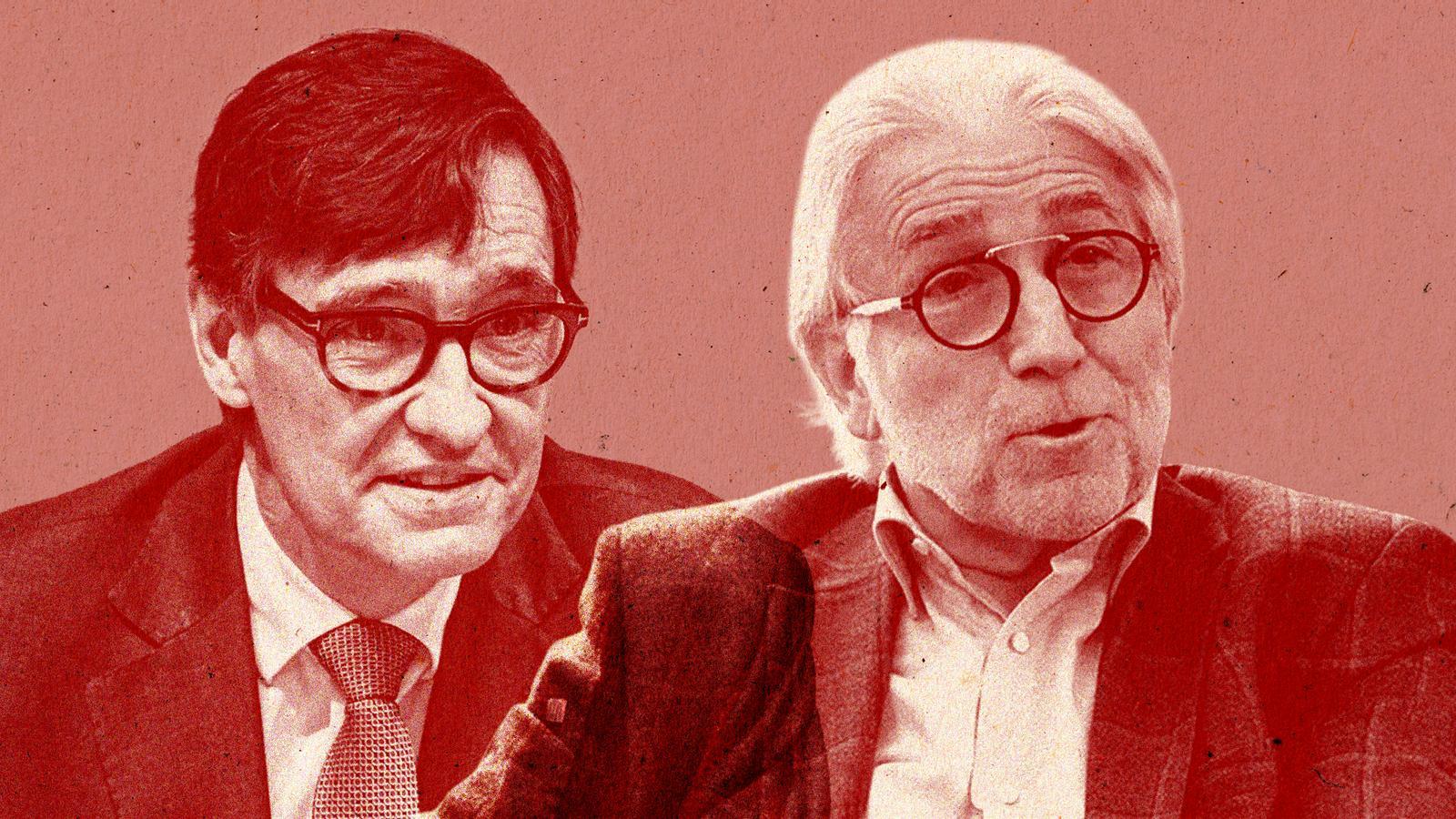
BarcelonaSalvador Illa was supposed to turn the page on the 'Procés', restore stability in Catalonia, and promote major infrastructure projects, such as the expansion of El Prat airport, the Fourth Beltway, and the Hard Rock complex. Or that was the hope of Foment del Treball and, for this reason, they maintained a frankly good relationship with the President of the Generalitat, especially when he was in the opposition. The honeymoon, however, lasted a short time. The leader of the PSC, who depends on the support of Esquerra and the Comuns, has pushed forward measures regarding tax, financing, and housing that have displeased, and very much so, the business association presided over by Josep Sánchez Llibre. The relationship between the two leaders has broken down and, as sources knowledgeable about the matter confirm to ARA, attempts at reconciliation have failed. Three agenda changes by the Government—by President Illa himself, by Minister Òscar Ordeig, and by Minister Ramon Espadaler—in the last two weeks confirm this, although the Palau denies that it is a pattern and that there is an order to the members of the executive to belittle Foment's events.
The most notable absence was that of the President of the Generalitat. Unlike in previous years, Illa finally did not attend the gala for the presentation of the Medals of Honor for Excellence, which the business association organizes every year at the Teatre Nacional de Catalunya (TNC), on October 26th, despite the fact that it had even been announced through institutional channels that he would go. The reason they argue at the Palau is that at the same time, he had the presentation of the PSC candidates for the Spanish elections in Lleida. That said, the Minister of Economy and Finance, Alícia Romero, and the Minister of Business and Labor, Miquel Sàmper, did attend.
At Foment's offices, the message was understood at the first sign, but they confirmed it later with similar gestures from two other ministers. The head of the Department of Agriculture, Livestock, Fisheries and Food, Òscar Ordeig, canceled his attendance at the business association's event Agricultural enterprise, biodiversity and territory last Tuesday. From that department, they attribute it to agenda reasons and respond that they sent representation. Finally, that of a former party colleague—Unió Democràtica de Catalunya—of Sánchez Llibre, the head of Justice and Democratic Quality, Ramon Espadaler. They also affirm that, due to agenda reasons, he finally declined the invitation to the event Religious phenomenon and metropolis this Friday, which was organized by the business entity.
History of a distancing
The absences of Illa, Ordeig, and Espadaler are the latest clues of the distancing between Illa and Sánchez Llibre, but the story goes back a long way. It is not an issue that is due solely to the fact that we are in an electoral pre-campaign. The first time the president of Foment proclaimed that the "complicity" they had shared was over was when the socialist executive agreed with Comuns to increase the property transfer tax (ITP) –the tax paid when acquiring a second-hand property– for large holders and for homes costing more than 900,000 euros. Beyond the measure, the employers' association criticized in March of last year that the Government did not consult with the sector or the main economic players in the country. A complaint that the business organization repeated on several occasions later on.
The definitive distancing came almost a year later, on February 20th, with the new financing model agreed between the executive, the Ministry of Finance and Esquerra. The employers' association issued a particularly forceful statement against the agreement –before meeting with the Government to discuss it and without going through the employers' association's board– and labeled it "clearly insufficient". Illa personally called Sánchez Llibre that same day to convey his dissatisfaction. The conversation was tense.
Shortly after, the president of the employers' association returned to the matter. This time against the agreement between the PSC and the Comuns to prohibit speculative purchasing of housing. He described it as a "philo-communist measure" and asserted that it "violated fundamental rights of the Catalans, such as the right to private property". Finally, and after a non-binding report from the Council of Statutory Guarantees that ruled that the law contravened several articles of the Statute and the Constitution, the Government backed down and now everything points to the regulations ending up as a dead letter.
However, even though the law is going nowhere, the word philo-communist still resonates at the Palau. Consider it a bizarre remark that is hard to forget and, in fact, they have not forgotten it. Although they assert that they have no problem with the employers' association, they admit that with Sánchez Llibre it is another matter. Thus, the latest overtures from the president of Foment, who when he was re-elected president last spring advocated for "deepening the relationship with the Government of the Generalitat" and building "a space for deep dialogue," have not borne fruit either. The fact that the country is in an electoral pre-campaign has not helped, and in recent days the leader of the PSC has raised his tone –aside from the PP and Vox– against Junts and the interests that he himself calls those of "big money" and "the elite." All in all, even though the bond between the two leaders is not what it used to be –their fondness for Espanyol had united them–, sources in the know assure that Illa and Sánchez Llibre keep the channels of communication open and interact with cordiality out of a mere question of respect and institutional sense.
The dream socioconvergent
While Foment was moving away from the PSC, it was getting closer to Junts. For some time now, the employers' association has stopped viewing it as an unpredictable party and has found in it a key political ally, especially at the state level. Sánchez Llibre, who was a deputy for CiU, maintains a very good relationship with Junts leaders and visits Carles Puigdemont in Waterloo periodically, almost every quarter. Some of the gestures he has most appreciated from Junts, together with the PP and Vox, is that they blocked in Congress the extraordinary tax on energy companies and, among others, the reduction of the working day.
In fact, the Catalan employers' association does not feel so far from the PSC and the President of the Generalitat, but regrets that –just like Pedro Sánchez in Madrid– it gets closer to and depends on the formations to its left. For this reason, Sánchez Llibre is openly pressuring for the PSC to leave behind the alliance it forms with Esquerra and Comuns, and to reach an understanding with Junts. That is to say, for what is popularly known as sociovergència to become a reality.
