Madrid celebrates October 12: a military parade marked by November 29, shouts against Sánchez and the trip of the kings to Ceuta
The Supreme Court has to decide in the next hours about the 'clean law', which affects the census of the elections

-
CAT -
CAST
MadridOn bus 14 in Madrid, which was traveling along the Paseo del Prado and Recoletos this Sunday evening, a young boy was insistently asking his mother if they could get up early today to go see the military parade. He asked her after seeing that all the chairs, barriers, and platforms were already in place. "We are not going, I don't like military parades," said the mother, and the boy tactically turned to his father to see if he could reverse the decision. It is not known if he succeeded, but this Monday, October 12, Hispanic Day, there are indeed many families in the center of Madrid to be spectators of the Spanish national holiday, presided over by the monarchs.
The ritual is as follows, the same as every year: arrival of the monarchy, military honors, and performance by the air force. Afterwards, it is the turn of the army, with the legion's goat. In total, about 4,400 members of the armed forces, security forces, and other civil institutions are participating.
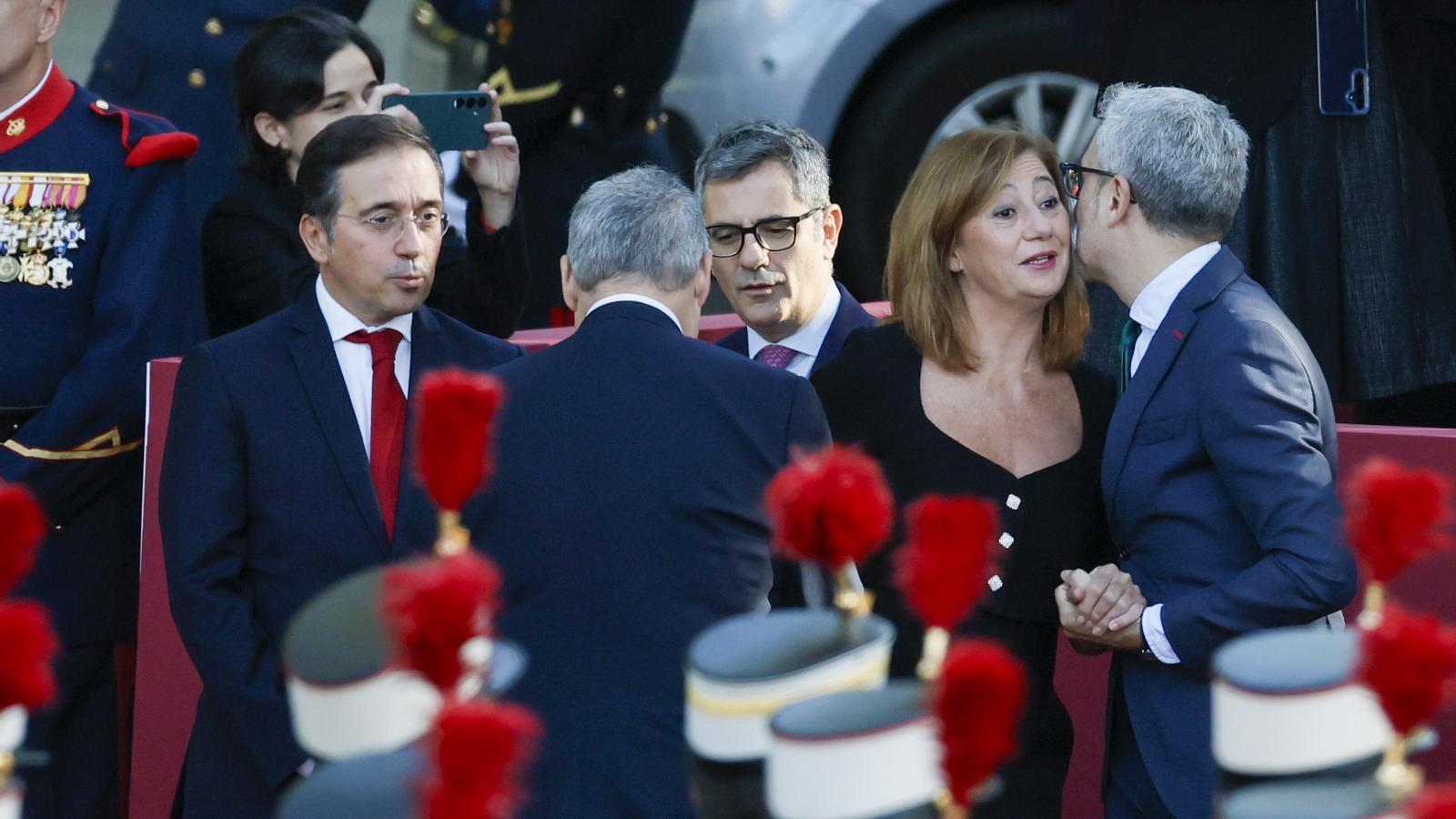
However, beyond the protocol, this Monday all media attention is pointed at the authorities' tribune, with King Felipe VI; the President of the Spanish Government, Pedro Sánchez; and the leader of the opposition and head of the PP, Alberto Núñez Feijóo. When Sánchez arrived, there was no shortage of shouts from the right-wing demonstrations: "Pedro Sánchez, son of a bitch".
The moment is of high political voltage: this October 12 is the day before the monarchs' visit to Ceuta – in democracy, the Spanish monarchy has only stepped foot in the autonomous cities once, and that was twenty years ago – and it is already in the electoral pre-campaign for the early elections called by Pedro Sánchez for November 29. For this reason, it will be interesting to see the body language of the attendees, who is speaking with whom, and also the information that might circulate at the Royal Palace of Madrid, where after the parade all the powers of the State will meet for the hand-kissing ceremony to the monarchy. A total of one thousand guests are expected.
"It is the celebration of all Spaniards", states a commentator, even though neither the pro-independence and nationalist forces nor the most left-wing parties will be there, nor will the leader of Vox, Santiago Abascal, who avoids attending institutional events with Sánchez. The President of the Generalitat, Salvador Illa, is there, as is the President of Ceuta, Juan Jesús Vivas, when the crisis following the massive entry of migrants on July 30th is still not resolved. In fact, all regional presidents are present except for those who have excused themselves: the Andalusian, Juanma Moreno Bonilla; the Navarrese, María Chivite; and the Basque, Imanol Pradales.

The Supreme Court's decision
Hovering over the day is a decision by the Supreme Court relevant to the November 29 elections: it must decide on the vote of those newly naturalized following the grandchildren law. The court is expected to decide whether to maintain the precautionary suspension of their right to vote, as Iustitia Europa, one of the entities that requested the extraordinary measures, demands that the application of this veto to the election census be guaranteed. The fact is that the electoral body for November 29 is broader, as it closed on August 1 – before the Supreme Court's precautionary measures regarding the grandchildren law.
In recent days, all parties have spoken out: both the Prosecutor's Office and the State Attorney's Office are in favor of lifting the measures and allowing all naturalized citizens to vote, by whatever means they accessed Spanish citizenship, since it is "materially impossible" to differentiate them; while Iustitia Europa demands that if this is the case, the elections should be paralyzed until the question of the census is clarified.
It should be remembered that the so-called grandchildren law is an additional provision to the Democratic Memory Law, approved in 2022, which established that descendants of exiles could access nationality. In any case, a subsequent order that developed the legislation extended this assumption to descendants of Spaniards who left Spain after the Civil War in 1978, without specifying that it was for ideological reasons. According to the Ministry of Foreign Affairs, 1.2 million applications were received, 571,761 have been approved, and 333,696 new registrations have been recorded in the foreign census, according to Europa Press. These figures were key for the Supreme Court to justify the precautionary measures, as they represent 408,262 more people registered than in the 2023 general elections.
This Sunday, Pedro Sánchez demanded that the Supreme Court put an end to the "trampling of rights" that depriving these Spaniards of the right to vote would mean, as requested by the PP and Vox. This decision may arrive in the coming hours, while the President of the Supreme Court, Isabel Perelló, coincides with all the authorities at the October 12 parade.
