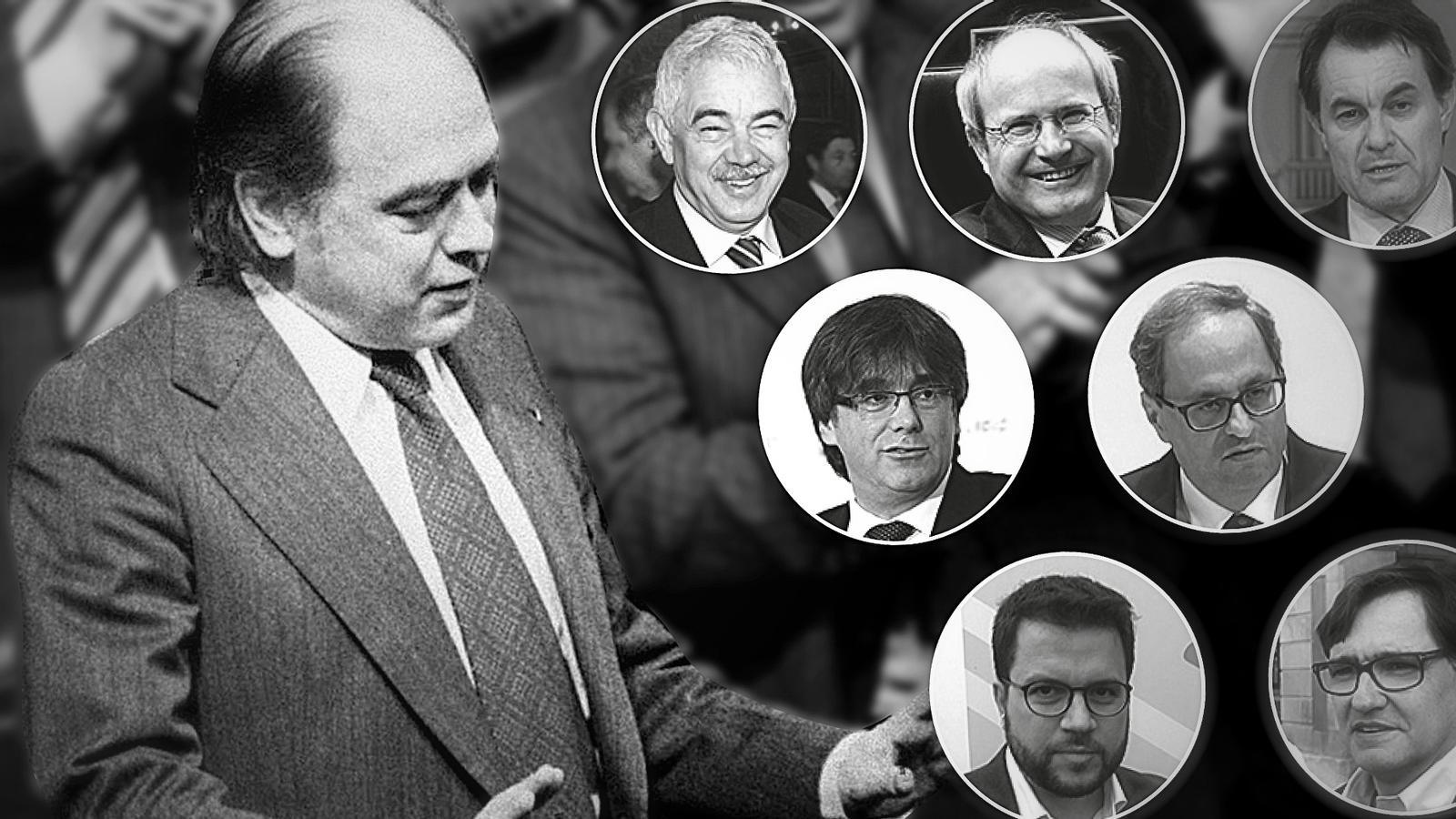
Jordi Pujol and the 7 presidents who add up to 23 years in Palau
The stability of Pujol's governments contrasts with the situation of uncertainty in Catalonia in recent decades

-
CAT -
CAST
Barcelona"In this new phase, we do not think a Catalan unity government is convenient. We must consolidate the institutions and accustom the country to the presidency of the Generalitat, but the time has come to govern". He probably did not imagine he would do so for 23 consecutive years, but the day after the 1980 elections, a triumphant Jordi Pujol was already beginning to envision that his main mission should be the creation of autonomous Catalonia. This year marks 46 years since Pujol was invested president, and it so happens that he has now been out of government for as many years as he spent at the head of the Generalitat.

Josep Tarradellas handed over the baton to the first Catalan president elected since 1940, the 126th in historical count. Especially Pujol's early years were those of great works. The Catalan health model was defined, the Catalan school –with the complicity of socialists and communists–, the status of the Catalan language, TV3 and Catalunya Ràdio were created, the structures of the welfare state were promoted, the Mossos d'Esquadra began to be recovered... Everything was to be done and Pujol set himself the priority of doing it following the spirit of "Catalunya, un sol poble" (Catalonia, one single people), and proposed a kind of national reconstruction project after forty years of Francoism.

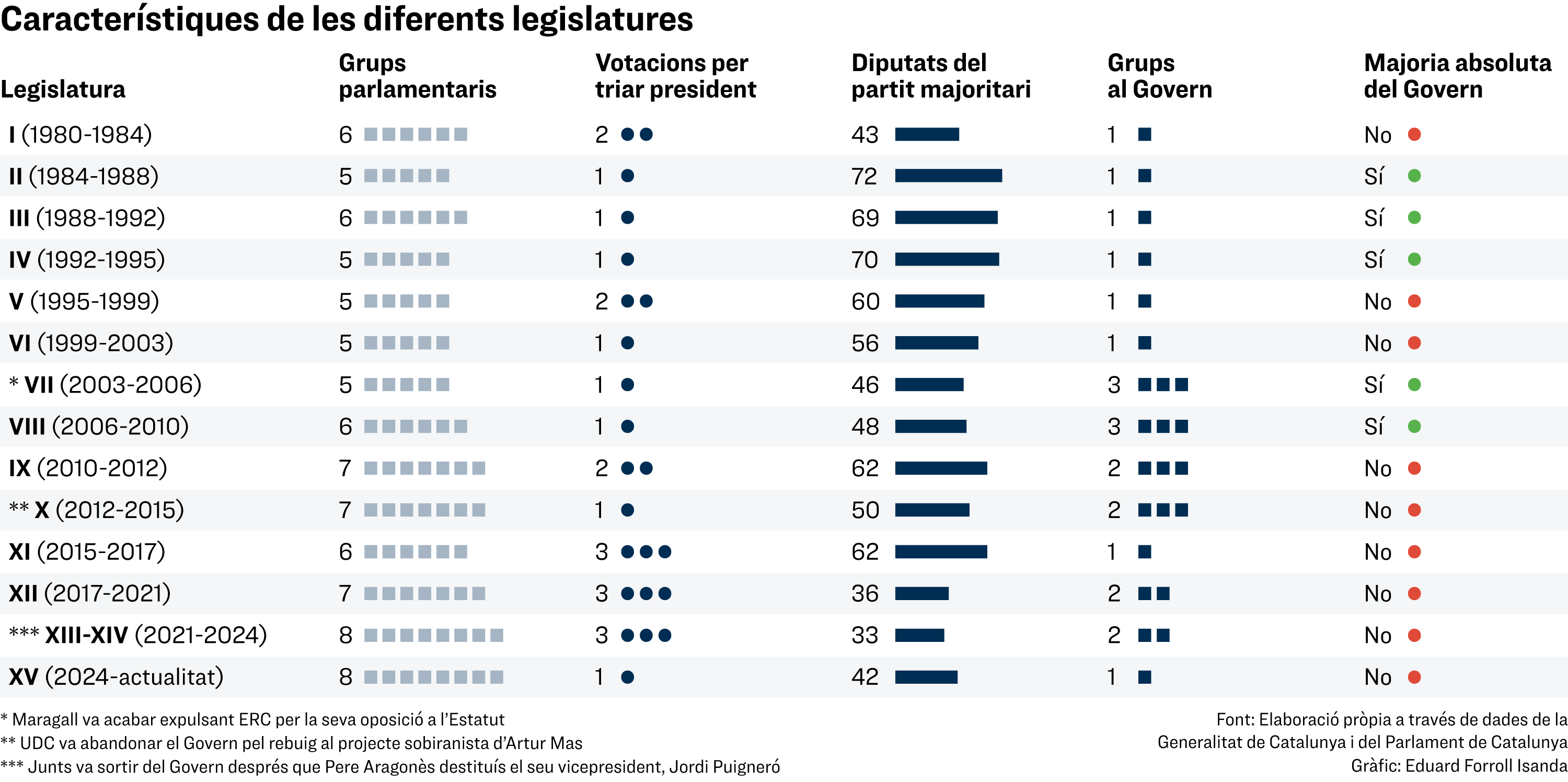
Three absolute majorities (1984, 1988, and 1992) gave him the legitimacy to persist in his idea of a country – despite the setback of the judicial investigation into the Banca Catalana case –, but from 1995 onwards CiU began to show signs of wear. In total, 23 years in the Generalitat, with ample majorities or solid parliamentary agreements – with ERC in 1980 and with the PP, both in Catalonia and in Madrid, in the last stage – which define a period of fundamental political stability. In the following 23 years, Catalonia has had seven presidents, practically all serving only one term, which has often ended prematurely and, especially in recent years, without the capacity to pass important laws and major projects. How can this be explained?
"There is a general trend in Western and European democracies towards fragmentation and volatility. More parties and more vote changes from one election to another," comments Jordi Muñoz, a political science professor at the University of Barcelona. Disengagement from parties and the loss of trust in institutions and democracy are a key factor that explains, according to him, vote volatility. Also, the still unresolved effects of the economic crisis that began in 2008. "It is a perfect recipe for instability," he stresses.

- If you want to investigate the infographic in more detail, open the high-resolution version in another tab.
A Dragon Khan who did not lose votes
The tripartite government that replaced Pujol in the presidency is often remembered by its detractors as the "Dragon Khan", for the supposed political instability that having three parties in the Generalitat represented. In conversation with ARA, the 128th Catalan president, José Montilla, strongly disagrees: "There was no coalition culture. We were asked for a level of uniformity that was unrealistic and any detail was made a big fuss about. But the government I presided over for four years did not lose any vote in the Parliament and always approved the budgets when due." Before Montilla, it was Pasqual Maragall who brought about the first political alternation in Catalonia. "That was very important for democracy," recalls Montilla, convinced that during Pujolism "the country had ended up being confused with the party and President Pujol." The rollout of the Estatut, with the large number of laws and new institutions that were created, and social policies and those in the neighborhoods ("teachers, doctors, and mossos") are what Montilla considers to define that stage.
Artur Mas also does not believe that his presidency (divided into two short legislatures) can be described as unstable. "I arrived in 2010 with 62 deputies and, later, we achieved 50," he highlights, and he claims the stability pacts he reached, first with the PP and then with Esquerra. "When there is more and more fragmentation, a lack of political skill and leadership leads to weak governments that do not have majorities to build practically anything," he points out, referring to the governments that have come after his. The 2008 crisis worsened from 2010 onwards and public spending cuts were the hallmark of Mas's first years in the Generalitat. "The austerity imposed by the Germans left no room for maneuver. The only room for maneuver was to cut as best as possible without touching the core of public services," states the 129th president.
Furthermore, Mariano Rajoy's absolute PP majority in Madrid offered little hope of negotiation with the State to increase self-government – the fiscal pact –, despite the rise of the sovereignist procés, which was consolidated during his second term starting in 2012. "We tried to channel the Procés, which had emerged from the citizenry, and I think we succeeded in the early years (the 9-N was held in 2014), although later some opened the floodgates and everything overflowed," he reflects. President Pujol's declaration confessing he had money in Andorra –the trial against his family is now being held– was also a missile in the waterline of the Generalitat and Convergència, recalls Mas, and shortly afterwards the party – also judicially pursued for corruption – ended up disappearing.
Rise and fall of the Procés
Mas was unexpectedly succeeded by Carles Puigdemont, due to the CUP's veto of his investiture. Puigdemont's was the legislature of the independence referendum of 1-O. "It was a short legislature, but profound and committed, both in day-to-day management – the country functioned very well – and in the national project, based on the unity of political forces and mobilized civil society," explains to el ARA the 130th president, who still lives in exile in Belgium, pursued by Spanish justice. Puigdemont is convinced that the instability that Catalan politics has been experiencing for years originates from the "dependence on an increasingly centralist and suffocating Spanish state," with its "sewers" and parties, all of them "aligned to prevent the economic, social, cultural, linguistic, and political progress of Catalonia."
A diagnosis that the 131st president shares, in part. "Autonomy is collapsing. We cannot aspire to survive as an autonomy of Spain, and this change of mentality breaks the "pax pujoliana," expresses Quim Torra in conversation with el ARA. He, however, is one of the thousands of citizens "disappointed and angry" about how the Procés has ended. "I ran for elections aiming for independence and it didn't happen; therefore, I failed as president," he concludes. He finished his presidency prematurely, disqualified for having maintained a banner in support of political prisoners on the facade of the Generalitat. The repression of the independence movement was one of the factors that led his government to act "reactively and not proactively." In the final phase of his presidency, the global pandemic changed the order of priorities: "Despite the enormous difficulty and the problems that arose, I am reasonably satisfied with the management we carried out."
Pere Aragonès first assumed the presidency of the Generalitat on an interim basis with Torra's disqualification and, after sweating an agreement with Junts that cost him having to present himself three times for investiture, finally became the 132nd president of Catalonia. "In my time, the Generalitat became fully involved in political negotiation with the State to resolve the political conflict," he highlights. From there came the dialogue table and the agreements for the pardons of political prisoners, as well as dossiers such as those of the new financing model and the transfer of Rodalies. Aragonès highlights the free early childhood education for 2-year-olds as one of the measures to symbolize his executive's social commitment, which, after a year in office, saw it lose a key partner for stability, as Junts left the Government in response to the dismissal of Vice President Jordi Puigneró. Aragonès was the first president of an operational Generalitat from ERC since Lluís Companys.
Now it is the PSC's turn again. Salvador Illa is the third socialist president of the Generalitat and the first non-independentist since 2010. "I try to ensure that the Generalitat is at the service of all Catalans, after a period in which there may have been perceptions that this was not the case," he states in conversation with ARA. Collaboration with the Spanish government to achieve Catalonia's "leadership" in the State and "excellence in public services" are his commitments. "We have to reconnect with what had been lost," he insists. Illa has set himself a 10-year project, but he has started it with a government far from an absolute majority and with many problems finding stable partners.