The whole system must be rethought and address what the school must respond to today
Educational experts pose to ARA the weak points of education after the rejection by teachers of the agreement with the Government

-
CAT -
CAST
Barcelona"We don't build with bricks. The raw material with which we work and obtain academic results is very variable. 30 years ago this material was quite stable; ten years ago it was stable enough, but now nothing is stable." This is how Jordi Satorra, president of the directors' association Axia and a teacher for 24 years, defines the emergency situation of the Catalan education system.
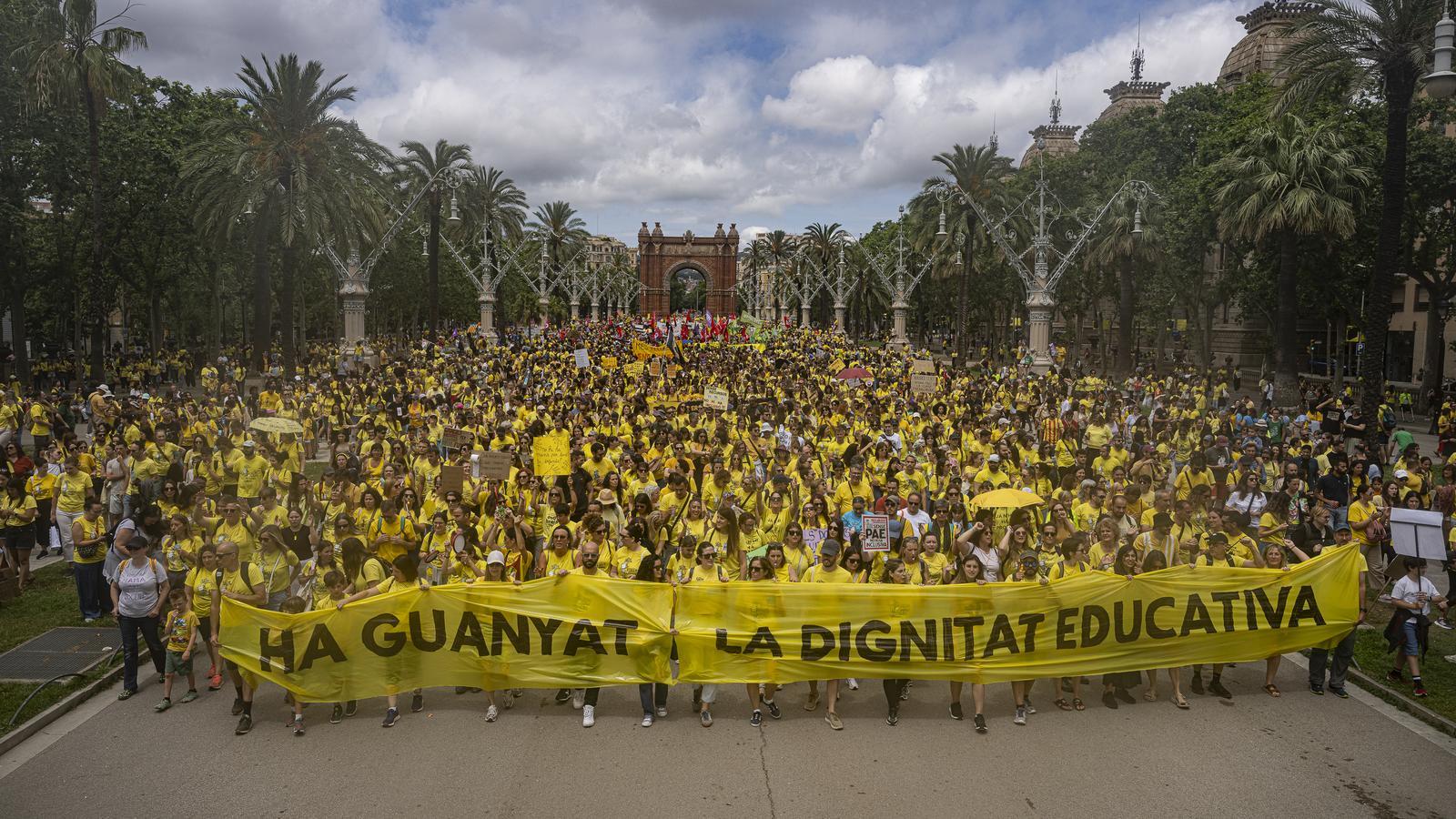
Following the no from teachers on the agreement with Education and the continuous mobilization in the streets, ARA has asked four experts linked to teaching to ground the discontent to detect the weak points of Catalan schools. All four agree that it is necessary to stop to calmly "rethink" the way of functioning of a system that has become obsolete in the face of the drastic change that society has undergone in the last decade, with an explosion of needs in classrooms and a growing frustration among teachers due to the lack of staff and horizon.
"School is society's trench. We have in school what society suffers and has strained the system," describes Montse Jiménez, a secondary school teacher at the Vedruna Catalunya Educació Foundation. A member of the PISA expert committee – to whom the previous government commissioned a document of measures that has not translated into substantial changes in schools – Jiménez explains that, unlike twenty years ago, we now have 100% of the population schooled, but "we cannot guarantee opportunities for everyone because the system is not prepared to respond to this complexity." According to Jiménez, this ends up "confronting" excellence with equity, causing a sense of failure in teachers. "We want to succeed, but it is very frustrating when you see that you are not getting there and that the system cannot respond to this reality," warns the teacher, who points out that the problem goes beyond school. "We need to sit down with Health, with Social Welfare and with the town councils to see what needs to be done for school projects to move forward".

Discomfort and disorientation
Regarding how the teaching staff's discontent has not been sufficiently addressed, the teacher, pedagogue, and philosopher Gregorio Luri also speaks. "For a very, very long time, we have been talking about teaching staff's disillusionment and discontent. Just by visiting schools, you notice this dissatisfaction. What is not understood is what the [Education] inspectors are doing to not see it," he criticizes. Luri also says that the problem now is that "a lot of shortcomings have accumulated that cannot be resolved at a negotiation table."
All this complexity –one in four students is at risk of poverty, educational needs have skyrocketed, there are children who do not understand the language, the rise of social media has overwhelmed teachers, there are growing psycho-emotional problems in students...– ends up directly impacting the day-to-day at schools. "Classroom management takes up a huge amount of space, and if there's a classroom management problem, you can't make them learn. If you are trying to maintain order all the time, nothing is learned there. The level drops because classes cannot be taught," warns ICREA researcher and specialist in public educational policies Caterina Calsamiglia.
In this regard, Satorra, Luri, and Calsamiglia point out that, given the evident disorientation, clear references and criteria are needed. "Especially in secondary school, but also in primary school, the methodological north has been lost. Tradition and innovation have been presented as black or white, when everything is a matter of shades of grey. We must talk about everything and not implement without control because this generates a lot of discontent," laments Satorra.
Luri proposes creating "a white paper on education in which the school situation is accurately recorded, from teacher training, the relationship between teachers and families, to minimum results." In contrast, Casalmiglia talks about having new figures who are references: "People who are responsible for thinking, in each situation, of different ways to solve very specific problems and support teachers in aspects that go beyond classroom management capacity."
A new radiography far from "a one-size-fits-all"
The four experts also agree that the Catalan school system needs to be re-analyzed. "The entire system must be rethought, clearly addressing what the school should respond to today. But it cannot be done in a dossier: paper can take anything. It must be done with consensus, not with measures and patches, and focusing on two key aspects: stability and money," explains Jiménez.
For their part, Satorra explains that school principals have already requested "an external audit" of the needs of the public education system and, especially, of the role of inclusive education. "This new radiography is essential because, otherwise, we are groping in the dark," insists Luri.
Obviously, everyone also brings to the table the need for more resources, but with surgical distribution. "We must avoid a one-size-fits-all approach because that no longer works. We must look at each school, each educational project, and each area. A high-complexity center is not the same as a rural school. Let's put resources where they belong," insists Giménez. He also points out that this distinction must be applied to training: "There are centers that need a type of training that others do not need, and, moreover, the autonomy of the center must be respected." In fact, Luri also says that the "first" thing he would do would be to "strengthen teacher training."
Ceasefire?
And now what? Faced with the evident tension in schools and institutes, the four experts consider that "calm" is needed and advocate for opening a "long" dialogue. "It is a complex problem that we will not resolve in a twenty-hour negotiation and in a strike context," acknowledges Casalmiglia. The ICREA researcher says that all voices must be taken into account, including that of the unions, but that it would be advisable, for example, to "form a commission and spend four months negotiating and analyzing to present a new proposal to be put to a vote." "A new diagnosis is needed, but we should all sit down at a table and with a bit of calm," says Satorra, who adds that directors should also be key interlocutors in resolving the unrest.
On the other hand, Jiménez states that "what is happening to the system" has already been detected and that the solution involves "a holistic view." "There are medium and long-term measures, but there are things we can already apply and what is needed is a consensus on educational policies. We must take a step forward and, as in other countries, reach an educational pact that provides stability," he insists. Furthermore, the secondary school teacher also points to hope as a key point. "We must be able to rebuild and restore trust through dialogue and try to do so from a hopeful perspective. If we educators have no hope, we might as well give up," she concludes.
