Why does Pedro Sánchez feel more comfortable with the Pope than with the Episcopal Conference?
Democratic memory continues to be a taboo in the relationship with the Church, which maintains a "situation of primacy" in the State
-
CAT -
CAST
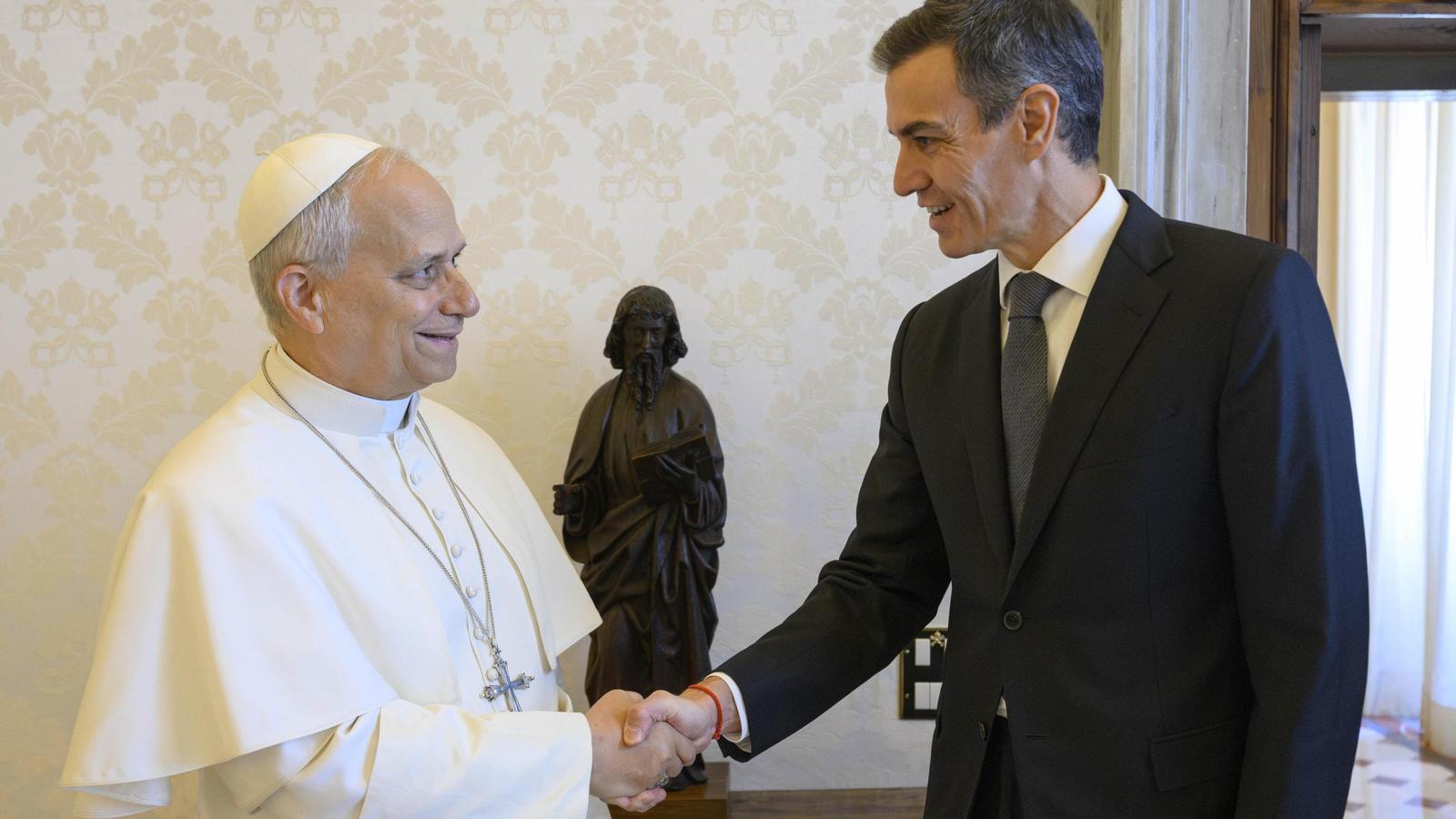
MadridThe arrival of Francis at the Holy See marked a paradigm shift in relations with Spanish political parties. While the Catholic Church in Spain still bears the imprint of the repressive role it played during Francoism, the previous pope's demeanor allowed fresh air into the institution, which in the last decade has shown greater alignment with left-wing parties. The Argentine pope's commitment to a Church more focused on vulnerable groups to the detriment of doctrinal matters – precisely those that separate them from progressive sectors – which his successor, Leo XIV, continues, has led Pedro Sánchez's government to establish the Vatican as an international ally against the rise of the global far-right.
This was evidenced by the Spanish Prime Minister during his visit to Rome last week, from where he praised the new pontiff as a "moral compass in the fight against injustice" after his clashes with Donald Trump. With Leo XIV at the opposite pole to the President of the United States and the Church distancing itself from Vox over the migratory issue, the Pope's visit, which begins this Saturday in Spain, has a particularly positive interpretation for the Spanish government. An alignment of the socialists with the Vatican that contrasts with the era of José Luis Rodríguez Zapatero at Moncloa. The former president promoted controversial laws for Catholicism – such as abortion and same-sex marriage – during the pontificate of Benedict XVI, who represented the most conservative soul of the Church. In contrast, the predecessor of Francis I connected much better with the former Popular Party executive leader, Mariano Rajoy.
Thus, the Pope's personality and the color of the government in power are "two fundamental factors" for understanding relations between Spain and the Vatican, although since the arrival of democracy, the general trend in all stages has been "stability and diplomatic relations that have always been cordial." This is confirmed in a conversation with ARA by the researcher specializing in religion and professor at the International University of La Rioja (UNIR) Manuel Sánchez-Moreno, who also emphasizes that contemporary ties with the Vatican cannot be detached "from Spain's historical past," such as "the legacy of national-Catholicism." A Francoist ideological pillar that has conditioned the Catholic Church in the State to still have a "situation of primacy" and "a certain status of privilege" which, internationally, is only comparable to the situation in Italy.
A framework from 1979
A few months after the Spanish Constitution was approved, the then Spanish president, Adolfo Suárez, closed four agreements with the Vatican that updated the 1953 Concordat, signed in full dictatorship. The framework between Spain and the Holy See established at the beginning of 1979 was continuist, in line with the character of the Transition, and it is what remains in force. Revising it is "one of the main pending challenges that both right-wing and progressive governments have because it is truly a democratic deficit and an incoherence in a state that declares itself as non-confessional", maintains Sánchez-Moreno. Why? In these agreements, the State undertakes to collaborate in the "adequate economic support" of the Catholic Church – it is where it assigns it a percentage of IRPF collection – and guarantees that the teaching of the Catholic religion is included in the study plans.
The unaltered tensions
During Sánchez's term, up to five new agreements with the Church have been signed that question some elements of this status. The one on property registrations and that on compensation for victims of pedophilia have generated particular tension. This last matter has been one of the "main battle horses" in which the Spanish government has found even more predisposition in the Vatican than in the Spanish Episcopal Conference – still with more conservative ticks than those of a Holy See renewed by Francis–. However, while the Vatican has opened up to deal with these controversial matters internally, the UNIR professor points out that democratic memory is still "the biggest taboo subject" pending.
Memorialist entities, as well as left-wing parties like Podem, have demanded that Leo XIV take advantage of his visit to condemn the Franco dictatorship and to order that the archives of the Church and religious congregations linked, among others, to the theft of babies be opened. Other irreconcilable tensions, although now in the background due to the prominence of other social issues, are related to the euthanasia law or the trans law.
