The Pope visits "the roughest people in the neighborhood"
The visit of Leo XIV to a Caritas center puts the situation of people at risk of exclusion in the spotlight
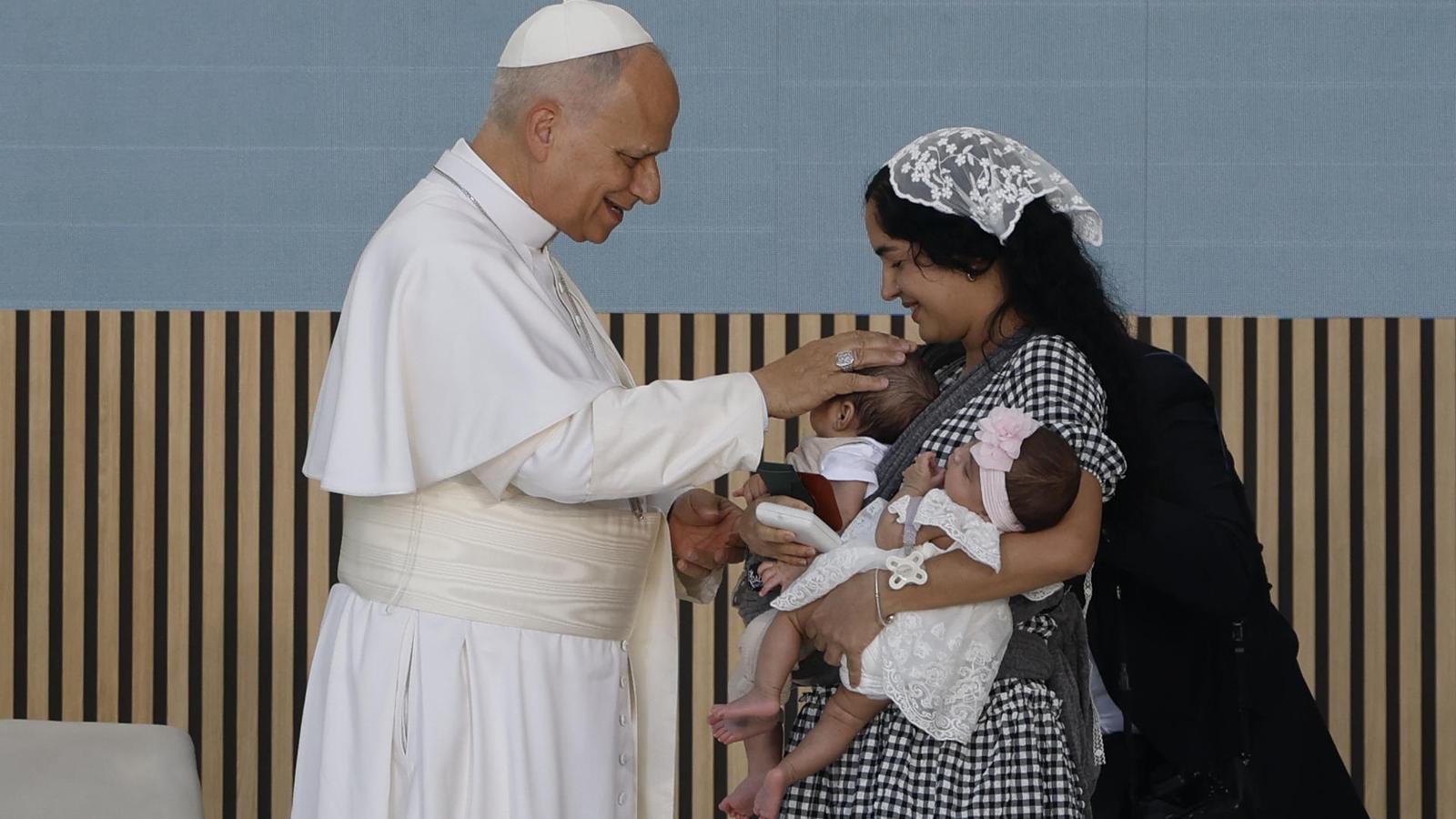
MadridOlha Kosova is a journalist who is also a user of the Càritas Madrid reception center visited by Leo XIV.The Pope's image suddenly appears on the television screen. Applause and shouts of joy fill the room. The dining room, the usual setting for our daily conversations and gatherings, becomes for a few minutes one of the spaces included in the Pope's visit to Madrid. When the pontiff enters the room and begins to greet those present, many approach to try to see him up close. Some cannot hold back tears.
Despite a complicated day-to-day life, this week the atmosphere at the reception center for homeless people managed by Cáritas Diocesana de Madrid (Cedia) has been one of expectation, almost of celebration: the Pope's visit has even infected those who do not believe in him.
Cedia is a small world in itself. Sometimes it resembles a children's camp, albeit for adults with real problems and, often, with deeply tragic stories. The visit of Leo XIV becomes an occasion to look again at that other world that coexists with ours and that we often prefer not to see: that of homeless people.
In a room, a woman of about 50 years of age raises her gaze towards a small window, the only source of light. Her eyes are full of tears. In silence, she prays and asks for protection for her son. Years ago, the young man – after watching videos on TikTok about an idealized life in Europe, very popular in Algeria – and in an attempt to defy his father, left everything to travel to Spain. Reality turned out to be very different: a minors' center, loneliness, and the gap between expectations and reality pushed him into a deep depression.
This was not the future Keltum had imagined for her son. Some time before, and despite her family's opposition, she herself enrolled, at the age of 37, in a French philology degree because she believed that education opened doors. She also tried to open them for her son: English and French classes, jujitsu, constant support, the promise of a better life. "He is the meaning of my life," she says. I look at her and think about the lives that have come to Cedia.
Despite the stigmas – alcoholism, bad decisions, supposed individual responsibility – the reality is more complex. Years of patience and a failed divorce can be enough for a car to become a home, while the remnants of a previous life end up in a storage unit on the outskirts of the city. Lack of affection in childhood, abuse, dropping out of school, a family argument. Sometimes the breaking point comes when there is no job and no possibility of paying rent. A misunderstood loan, lack of training, and depression can lead to years of wandering life between cheap hostels.
A chain of arrangements
We say "from Madrid to heaven" because for many it is a city of opportunities. Afternoons at the Teatro Real, exhibitions, galleries, concerts, infinite plans... But falling is just as easy. Unscrupulous businessmen, illnesses, addictions, breakups, loneliness, mental health problems... The street world in Madrid is closer than it seems.
The waiter who smiles at you politely on one of the most expensive terraces in the city might sleep in a rented clothing container in Vallecas for 100 euros a month, and his perfectly ironed shirt is the result of a chain of improvised arrangements. Neighborhood laundromats. Hours of ironing at friends' houses.
The construction worker who comes to your house might be living in a borrowed van, while a friend gives him leftovers from a restaurant so he can eat. The Glovo delivery person might return, after an exhausting day, to Cedia because he has nowhere else to go. Or your daughter's potential suitor, a polyglot and educated man, who talks about urgent commitments, perhaps only calculates the time to return before 9 p.m. to the shelter.
Many of these stories happen with almost no trace. The street does not trust strangers, is ashamed of shelters, and sometimes distrusts institutions. In the end, the only thing they have in common is indifference: not suffering enough to be seen in time.
In 2016, British director Ken Loach premiered I, Daniel Blake, Palme d'Or at Cannes, a film in which a carpenter suffering a heart attack gets trapped in a system of aid that he cannot understand or navigate. The film portrays how bureaucracy turns people into files. Social services, saturated, sometimes cannot provide them with a response. Meanwhile, life is suspended in a bureaucratic limbo.
However, if the protagonist had arrived at Cedia, the outcome would not necessarily have to be the same. Even before getting a place, he would have already been provided with a list of soup kitchens. They would help him draft a resume, he would receive financial support for clothes, a phone, and uncovered medications, and accompaniment for job searching.
"It's not easy to recognize a homeless person"
In Cedia there is also a horizontal support network, made of minimal gestures. "Since you're not carrying anything? You should always have something on account", one of the residents, a bricklayer, tells me. He rummages in his wallet and pulls out 10 euros. He offers them to me insistently, although I refuse them. "We've made you a list... the golden milk helps to relieve joint pain", explains another colleague as she reads the ingredients: cinnamon and turmeric.
My colleagues wash my clothes when it's not my turn, help me with tasks at the center, carry my backpack, share tips for surviving in a city that has suddenly become alien, a city where loneliness is felt differently. "Line 6 is good for sleeping during the day because it doesn't stop", "at the Pacífico metro library they don't look much", "in Retiro you can sleep on the grass if it's dry", "Gran Vía was the safest place for me to sleep on the street".
The external stigmatization is also joked about here. "Don't worry, I won't steal your phone", says one of the companions, laughing. "Be careful", warns a woman to my companion as she gets off the metro, pointing to the phone sticking out of her bag. "This area isn't very good". "Don't worry, we're the shadiest people in the neighborhood", I reply. We laugh at the stereotypes.
In this small world, everyone knows that it's not easy to recognize a homeless person at a glance. In any case, Cedia is just an intermediate stage, a "support stone", as one of its slogans reads. Afterwards, everything will depend on the person. Or on destiny. Some manage to start over; others, inevitably, return to the street.
