"It is not a reason for resignation": this is how Moncloa reads the Ábalos case ruling
The president appears this Wednesday in Congress and will emphasize the differences between the PSOE and the PP when reacting to corruption cases

-
CAT -
CAST
MadridThe sentence of 24 years in prison for José Luis Ábalos, the harshest sentence for a former minister, has not changed Moncloa's script by even a millimeter. Although it is the first to affect Pedro Sánchez's government, from the executive they consider that the case was already discounted and that they distanced themselves at the opportune moment from the former head of Transport and a totem of the PSOE. "Before he was formally indicted, we asked him for his deputy's seat, and he ended up in the mixed group," they state from the Spanish government. Specifically, it was the federal executive committee of the PSOE on February 26, 2024: they gave him 24 hours to do so and assume political responsibility for the Koldo case, even though at that time there was no formal indictment of the former minister yet. Now, this in vigilando responsibility does not apply in Sánchez's case, for having trusted him, and Moncloa considers that he has already paid the political price for this case: by distancing himself and undertaking anti-corruption plans still in the process of implementation, also as a result of Santos Cerdán's case.
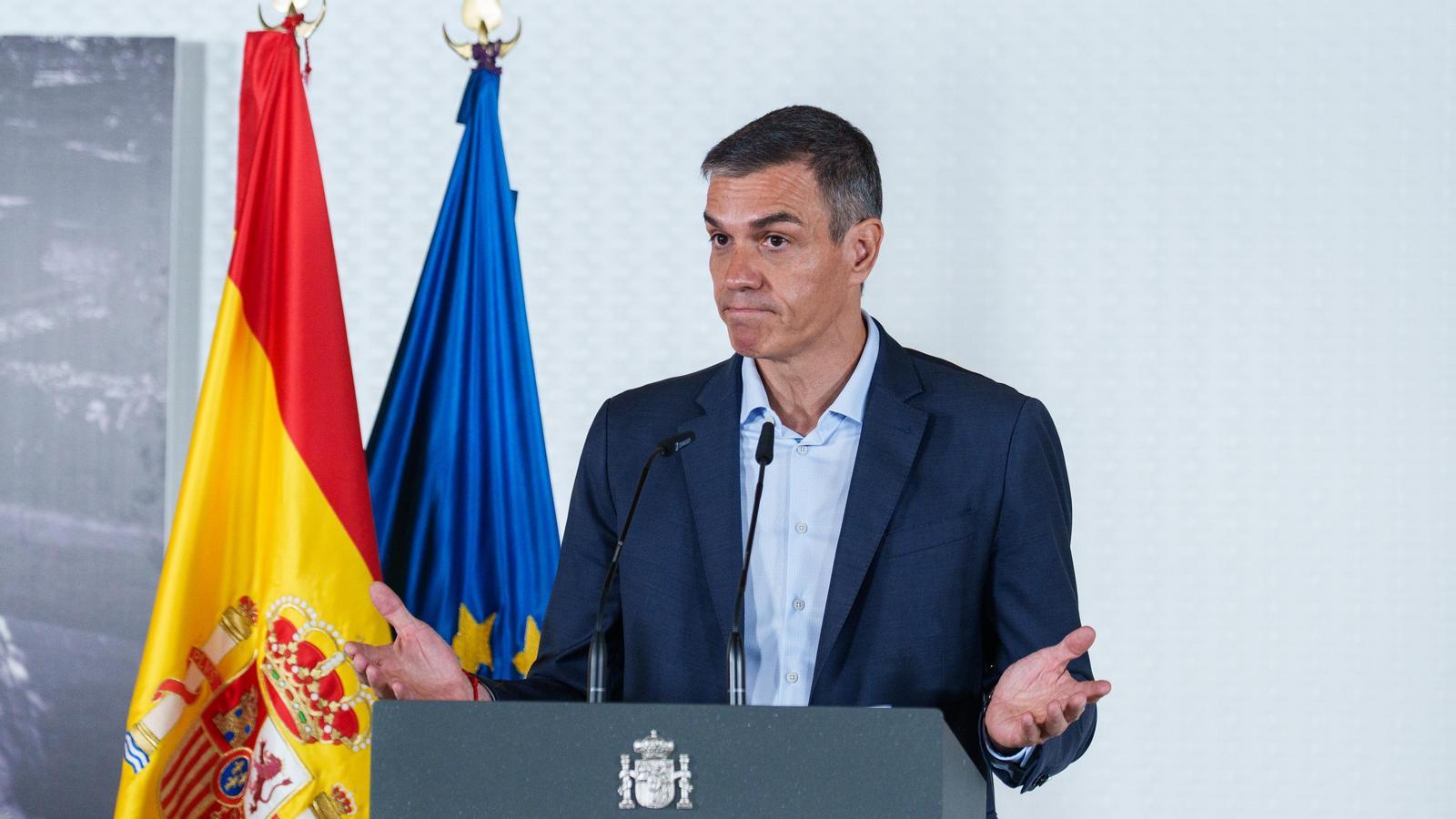
This is what the Spanish president, Pedro Sánchez, will defend this Wednesday in Congress, appearing in plenary to give explanations about the cases of alleged corruption affecting his party. Not only about the Ábalos case, but also about that of Leire Díez and Santos Cerdán, from whom he also distances himself. Moncloa reduces corruption to this "circumscribed group of no more than ten people" and not to a network extended throughout the government. A "one-off" case, they emphasize. For this reason, they argue that it would be disproportionate for Sánchez to resign, as requested by the leader of the PP, Alberto Núñez Feijóo. "Let him act in his own house first," they reply from Moncloa, pointing to the case of the boyfriend of the president of the Community of Madrid, Isabel Díaz Ayuso. "Whoever does it pays for it: whether it's Ábalos or Ayuso," said the Minister of Digital Transformation, Óscar López, at the press conference after the cabinet meeting. "The values of transparency and merit are what sustain the government," added Elma Saiz. In fact, Sánchez will emphasize this in his appearance, in contrast with the PP when addressing corruption cases.
From the official PSOE line, they maintain the same position, as they consider that what makes the difference is not having cases or not – they present it almost as an inevitable thing – but rather how one acts when they appear. And, in this sense, they highlight the battery of measures that they also implemented in the party a year ago following the outbreak of the Cerdán case.
Not everyone within the party, however, sees it the same way, as former PSOE deputy Eduardo Madina showed his concern this morning on the Ser radio talk show. "The last thing that worries me about the sentence is Víctor Aldama," he replied to the PSOE's complaint about having been left unharmed, despite being a briber. "The major issue is that the politician with the most power after the president of the government and the PSOE, has been sentenced to 24 years in prison," said Madina. For former president Felipe González, the sentence "is well done".
Precisely this Tuesday night, on Cuatro, Aldama encouraged Ábalos and others involved in the Plus Ultra case or in the PSOE's cash payments, still secret, to speak. This one on Telecinco has directly said that Zapatero and Sánchez will end up in prison. La Moncloa has not wanted to comment on Aldama being released, but Patxi López from Congress has: in the opinion of the PSOE spokesperson, the sentence is disproportionate and the businessman should be in prison.
The cases of Zapatero and Begoña Gómez
For Moncloa, however, not all cases have merit. There are two more categories beyond Ábalos, Cerdán, and Leire Díez: that of Zapatero and that of Begoña Gómez. In the case of the former Spanish president, Sánchez maintains his confidence, although there are voices from within the PSOE who have asked for the figure of former presidents to be regulated now and Sumar has put it on the table.
This is a different degree of defense than Moncloa's defense of Begoña Gómez, in which they explicitly see a political cause for being the president's wife. A similar position to the one they maintain with brother David Sánchez, who is awaiting the decision of the Badajoz Court. Precisely Peinado has summoned Gómez this Wednesday afternoon to confiscate her passport, while the Spanish government only hopes that the Provincial Court of Madrid will stop her.
What is an unknown is, in view of this panorama, what Pedro Sánchez will put on the table. "To those who ask why we want to continue, it is for this, to improve people's lives," said the Spanish president yesterday after announcing the largest in dependency in recent times, a message that he will probably repeat this Wednesday to the partners who ask him to fill the legislature with content. That is to say, to continue "despite the stones in the road".
So far, the Spanish president has responded to the cases of Ábalos and Cerdán with anti-corruption plans that have not yet been implemented, and his circle avoids revealing the content of the appearance. "We hope he works his magic," says a PSOE deputy. The PP, however, does venture: they believe he will announce another battery of measures, but without "credibility". At this point, Feijóo will remind him that "theft is already typified and will recommend that he follow the principle of not committing crimes so that justice stops pursuing his government, his party, and his circle".
