The PP will abide by the distribution of minors, while Vox opposes it
The popular demand from the Spanish government that the process be "fair" and "planned"
-
CAT -
CAST
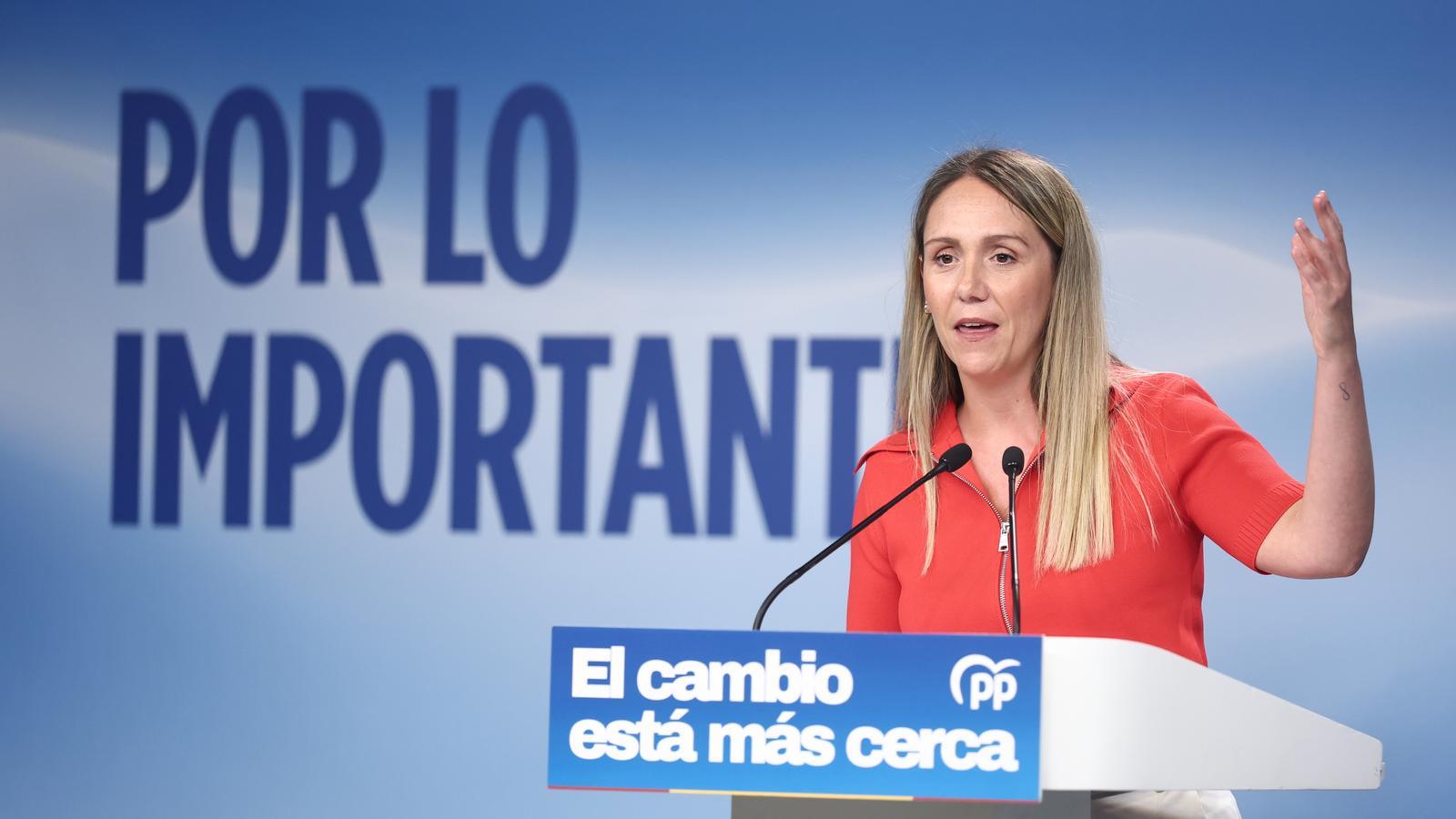
BarcelonaThe Spanish government plans to activate Article 35 of the immigration law, which describes mandatory and solidarity-based reception by the rest of the autonomous communities when an "extraordinary migratory contingency" is declared. Ceuta finds itself in this situation and, therefore, this will be the next step the Spanish government will take to face the crisis the city has been experiencing since the massive arrival of migrants last week. Until now, the PP had left its position on this distribution up in the air, but this Wednesday the deputy secretary for Sectorial Coordination of the PP, Alma Ezcurra, confirmed that the autonomous communities governed by her party will comply with the law. They will thus participate in the distribution of the approximately 1,100 unaccompanied migrant minors – according to data released by the president of Ceuta – who have arrived in the autonomous city, although she has requested that the process be "fair" and "planned." She said this in an interview with Onda Cero, one day after Vox – a governing partner of the Popular Party in four communities – openly refused to take in these minors.
The vice-president of the Junta de Extremadura, Óscar Fernández Calle, assured this Wednesday at a press conference that they will oppose it "by land, sea, and air" and that the party will use "all political, administrative, and judicial means at its disposal." In the same vein, the Andalusian leader of Vox, Manuel Gavira, stated that Andalusia will also oppose the distribution because that is what they had agreed upon with the Popular Party. Precisely, two years ago, the far-right party withdrew from all regional governments because it rejected the distribution made by the Spanish government after a massive arrival of migrants in the Canary Islands. The Spanish executive had warned the PP this same Wednesday that it had to "comply with the law," because the alternative was the courts, said the first vice-president of the state government, Carlos Cuerpo, who linked the Popular Party's reluctance to the desire to avoid a new clash with Vox in the shared regional governments. In parallel, the PP has intensified parliamentary pressure: the Popular Party spokesperson in the Senate, Alicia García, has requested that the chamber be convened in August to demand appearances from the ministers of Foreign Affairs, Defense, and Interior – Albares, Robles, and Marlaska – and has requested the same in Congress.
Despite accepting the distribution, Ezcurra has argued that the solution requires applying the mechanisms provided by law, such as the family reunification of minors or their return to the social services of their countries of origin, and has asked the State to assume "the responsibility for its actions". The popular leader also recalled that in the previous distribution the Spanish government excluded Catalonia and the Basque Country for political reasons, and has demanded that on this occasion the criterion be fair. The deputy secretary of the PP has also distanced herself from the tone of the leader of Vox, Santiago Abascal, who on social networks had described the migrant minors as "illegal and invaders" following the announcement of a grant of 25 million euros from the Spanish government to assist them in Ceuta. Ezcurra has said that her party does not share nor will share this type of language.
Following the same line as what the PP already pointed out on Tuesday, Isabel Díaz Ayuso has defended that migrant minors should return to their countries of origin –"each nation must take responsibility for its children", she said– and has described as "incomprehensible" the spectacle of seeing the Ministries of Defense, Interior, and Foreign Affairs publicly confronting each other in the midst of the crisis, in reference to the cross-accusations about whether the CNI warned the Interior Ministry of the possible massive arrival of migrants. Ayuso, moreover, has once again pointed at Pedro Sánchez, reproaching him for being "on vacation" while a "human crisis" is unfolding in Ceuta, and has lamented that Spain has turned its back on Western allies like the United States just as "authentic problems" arise.
The president of Ceuta provides new data
The announcement by the Popular Party comes amid a migratory crisis in Ceuta that the local executive describes as "unsustainable". In fact, the president of Ceuta, also a Popular Party member, Juan Jesús Vivas, provided new data this Wednesday that worsens the portrait of the crisis: he estimates that there are still around 6,000 irregular migrants on the streets of the autonomous city since last Thursday, when the massive entry from the border with Morocco occurred – he estimates that around 80,000 people entered, a figure higher than that previously provided by the Ministry of the Interior. In an interview with TVE, Vivas denounced that the State still does not have exact figures – beyond those of the Ministry of the Interior – and attributed this lack to a notable shortage of resources in managing the crisis.
Vivas lashed out at the Spanish government for not yet having identified the people present in the city or opened expulsion proceedings. Regarding minors, he stated that 1,100 are now being attended to in centers – compared to the 750 that were there before the massive entry – a figure that, according to his calculation, represents 2,600% above the capacity of the facilities. The Ceuta president also questioned Morocco's collaboration in border control.
Junts says no again
Junts, on the other hand, has once again rejected that Catalonia be part of the distribution of minors. In a statement released this Wednesday, the party reaffirmed what the Junts leader in Congress, Miriam Nogueras, tweeted on Tuesday on X. The group recalls that the criteria set last year in Royal Decree-Law 2/2025, which established the distribution of minors arriving in the Canary Islands with an exclusion clause for Catalonia as historical compensation, remain in effect. According to Junts, the Principality already hosts far above its capacity while other territories avoid their responsibilities.
Nogueras has once again called for the urgent approval of the law that her party has promoted to transfer immigration powers to the Generalitat. The party leader in Madrid has also lashed out at the rest of the Catalan forces and the president of the Generalitat, Salvador Illa, for their "submission and inaction" in the face of the State, and has stated that the veto on Catalonia must be maintained until the Generalitat has full sovereignty over migratory flows, security, border control, integration, and resources.
On the other hand, from ERC, its president, Oriol Junqueras, has admitted that Catalonia will "surely" have to "continue" making efforts to welcome unaccompanied minors, but has also urged "everyone to assume responsibilities, starting with the states".
