A face to face that will not go down in history
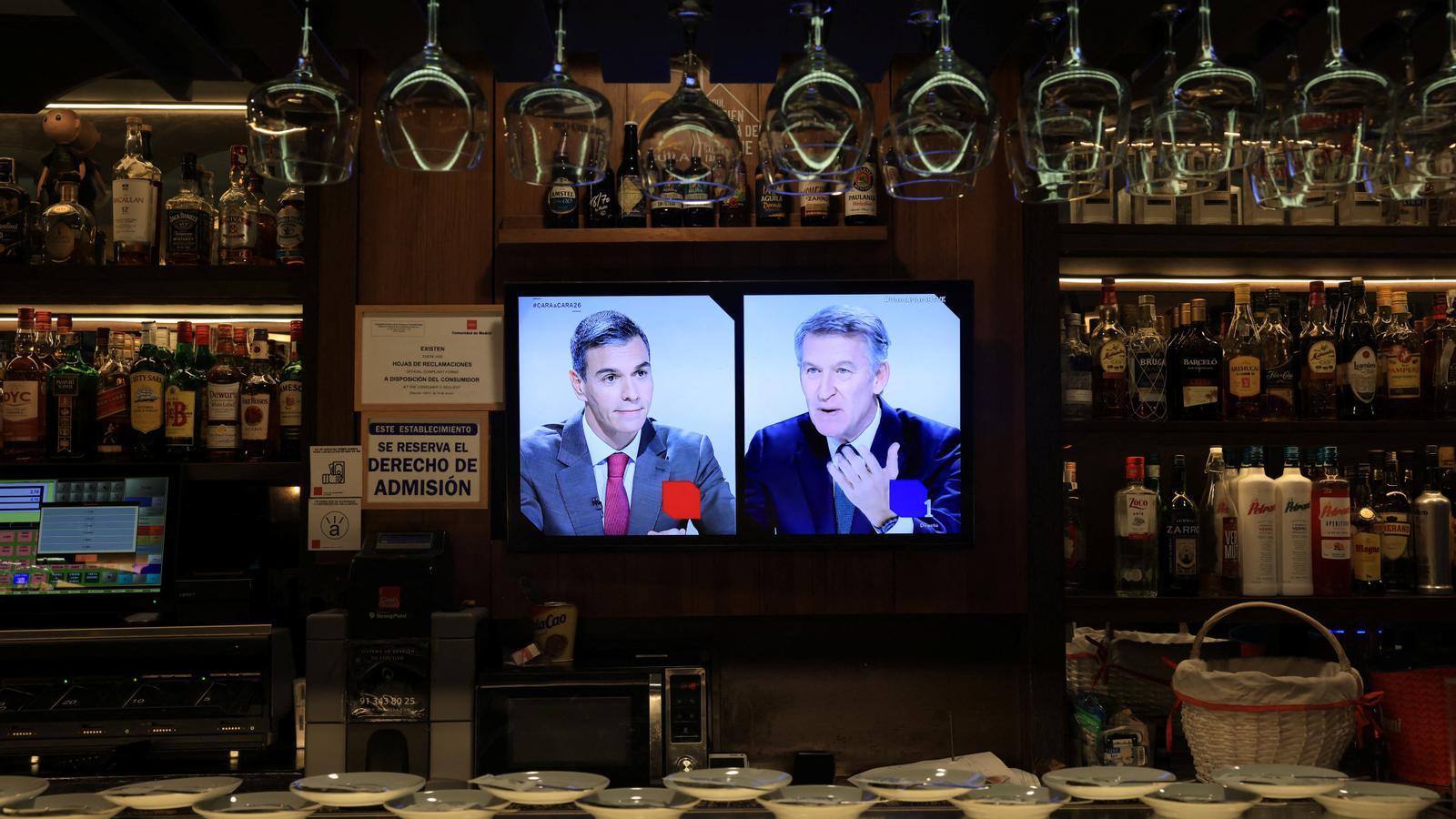
Sánchez's magenta tie against Feijóo's green tie. Two hundred and fifty centimeters of distance between the candidates in a face-to-face debate that started too late. It is agonizing to have them appear on set half an hour before starting just to greet each other and keep them waiting in front of one another without any specific objective. The wait leads to an absurd over-interpretation by journalists regarding the tension and the exchange of glances. The magnificent zenithal shot offered an indiscreet view of the papers the protagonists had on the table. The journalist María Casado announced the rigid structure of the face-to-face debate, which limited the spectacle. The moderator opted for a role of almost absolute invisibility in the development of the program. In a campaign where Broncano, Wild, Motos, and Griso have been more prominent than the candidates, it is appreciated.
Just as the debate started, Puigdemont took five seconds to be mentioned. And he was cited up to three times. Catalonia did not exist in the discussion. Feijóo pronounced the word prostitutes four times and brothel once.
Regarding the format of the face-to-face, the program mainly featured the arrangement of the candidates. Because more than a dialectical exercise, these debates have become a dialogue of the deaf, especially in the first stretch. There were even interventions where the two leaders preferred to address the camera to appeal to the audience rather than look at each other. The confrontation was highly disappointing in its lack of brilliance. Especially because the exercise allowed for a dependence on papers that nullified any spontaneous exchange. A true face-to-face should prohibit so much documentation to test the candidates' argumentation capacity. The challenge would be much more vibrant for the viewers. Feijóo opted for a reading of the papers and a more aggressive speech based on two strategies: a cocky sarcasm when questioning his opponent and rhetorical questions, seeking a more intense head-to-head.
The split screen
Pedro Sánchez opted for a more explanatory attitude and completely avoided conflict or stooping to the same level. Especially in the first part, he had a duller tone, which contrasted with the belligerence of the Popular Party candidate. Faced with Feijóo's constant interruptions, Sánchez insistently asked to be allowed to speak and conveyed a certain sense of victimhood.
The director contributed to a certain inequality with the split screen, because the close-up of Sánchez, passive, listening to Feijóo, was held longer than the other way around. Since the Popular Party candidate tried not to hold his gaze when his opponent was speaking, he conveyed disdain without having to try.
At the end of the debate, the PP team ran to congratulate Feijóo, while Sánchez was left alone next to the presenter, in a dim area, waiting for his own team. Perhaps the most symptomatic image of a head-to-head that will not go down in television history.
