Feijóo now proposes to withdraw nationality from Spaniards of foreign origin who commit serious crimes
The PP prepares a law to withdraw the passport in case of murders, sexual assaults, terrorism or organized crime
-
CAT -
CAST
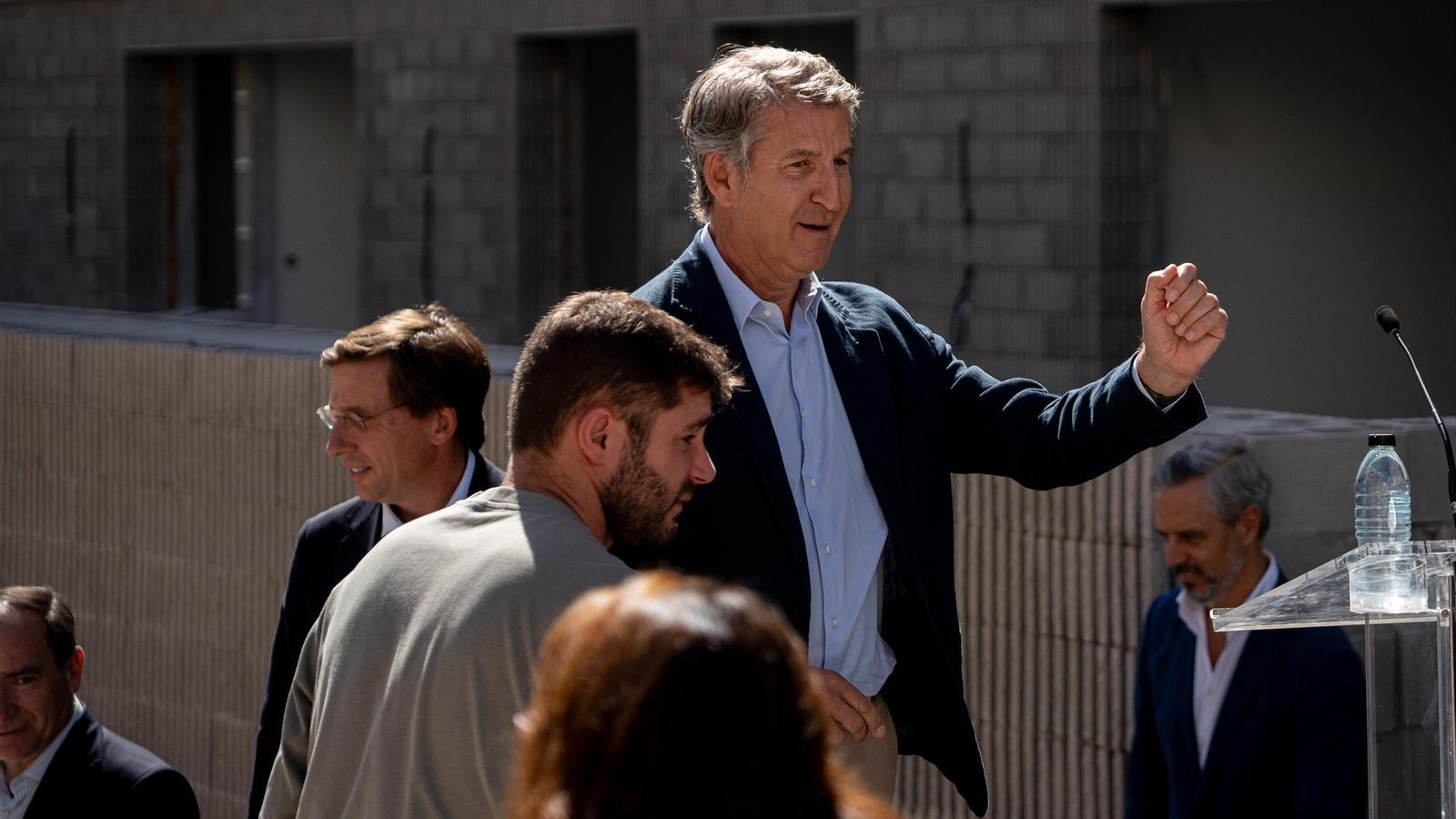
Madrid / Barcelona"Giving away Spanish passports? [...] That is over" and "The passport must be earned". The phrases were spoken this July by Alberto Núñez Feijóo during his assessment of the year as leader of the opposition. Amid the controversy over the amnesty lawof the Spanish government, and immersed in a competition with Vox over the toughness of the rhetoric on immigration, the president of the PP was already proposing a tightening of the conditions for accessing Spanish nationality. Just two months later, and in the midst of a crisis in Ceuta, the Popular Party goes a step further: they are now proposing to withdraw nationality from Spaniards of foreign origin who commit serious crimes.
As reported this Tuesday by El Mundo and confirmed to ARA by party sources, the PP is preparing a legislative initiative that would open the door to withdrawing the status of Spanish citizens from people born abroad who commit crimes such as murder, sexual assault, terrorism, or organized crime, and also those who accumulate a specific criminal record. The rule would be approved in the event that Feijóo reaches the Moncloa, so it remains an electoral proposal, and the details are not yet finalized.
"Nationality is not an administrative procedure, it is an honor," argued Feijóo himself at a press conference a few hours after the proposal was published. The PP leader defended that "nationality is an act of trust" when it is granted to a citizen who was born abroad and that "this trust must be maintained." "If the pact of trust is broken [with criminal conduct], it will be withdrawn," he stated. According to Feijóo, the modification of the current framework on which the PP is working "draws from the legal systems of the most serious countries in the European Union" and contrasts with the "frivolity" with which he considers the current Spanish government "grants naturalizations".
In contrast, the Spanish government has lashed out at Feijóo's "chaotic" approach and attributed it to the fact that he does not seem to believe the polls that give him a wide victory and that is why he is embracing Vox's rhetoric. At the moment, as detailed on the Ministry of Justice website, the grounds for losing nationality in the event of having been born outside the Spanish state are three: using for three years the nationality that was renounced to acquire the Spanish one; voluntarily entering the "service of arms" or holding a political office in another country against the prohibition of the Spanish government, and committing falsehood, concealment, or fraud in the acquisition of nationality.

The PP's proposal would not only serve to expand these assumptions. In line with the declarations of the last few months by the conservatives, it would also toughen the requirements to acquire the passport with a higher level examination of language and constitutional values. All of this adds to the series of proposals launched without major details in recent months by the conservatives in a matter in which it competes with the far right.
Vox exerts more pressure
"We are glad that the PP is joining our principles," reacted the Vox spokesperson in Congress, Pepa Millán, although she warned that it is not enough and demanded that the Popular Party block in the Senate the regulation that grants Spanish nationality to those born before 1977 in Western Sahara. In a press conference at the lower house, Millán remarked that the PP must be "coherent" and "not give even half a milligram of air" to the Spanish government if it wants to provide "true opposition". According to the far-right party, the granting of nationality to the Sahrawis is comparable to the grandchildren law and "opens the door to electoral fraud". The Popular Party abstained in last week's vote in Congress, where it went through.
In this endless race towards the radicalism of immigration principles, Vox is also pressuring the PP with several initiatives presented in this week's plenary session, coinciding with the crisis in Ceuta. One of them proposes reforming the national defense law to include the fight against illegal immigration among the missions of the Spanish army. The PP has opted to vote in favor despite not agreeing with the entirety of the text, which is not moving forward due to the opposition of the plurinational majority.
Vox has also proposed in Congress to reject the distribution of immigrant minors to the Peninsula, while on the other side of the political board, the Spanish government is pressuring the PP and the Ceuta president, Juan Jesús Vivas. In this sense, they pose a question to him: why does he not request the transfer of minors to other places on the Peninsula? The Minister of Territorial Policy, Ángel Víctor Torres, has put the number of unaccompanied minors at 2,084 who are currently registered, but has admitted that there are between 700 and 1,000 who are still wandering the streets of Ceuta, reports Núria Orriols Guiu.
In this sense, he recalled that the corresponding files must be completed (they have 10 done) and if there cannot be a family reunification, it will be necessary to decide whether they stay in Ceuta or are sent to other communities. All this on the day that Felipe VI has spoken for the first time about the crisis to thank the "civility" of the Ceuta population in the face of a situation of "extraordinary complexity". What the Royal Household has not yet clarified is when the King will visit Ceuta, as announced by Pedro Sánchez.
