'Forgive me my body': in defense of women
Queralt Riera signs at the Teatre Akadèmia a recommendable show about sexist aggressions
-
CAT -
CAST
- Performers: Mireia Aixalà, Àfrica Alonso, Isabel Castán
- Teatre Akadèmia. Until November 22nd
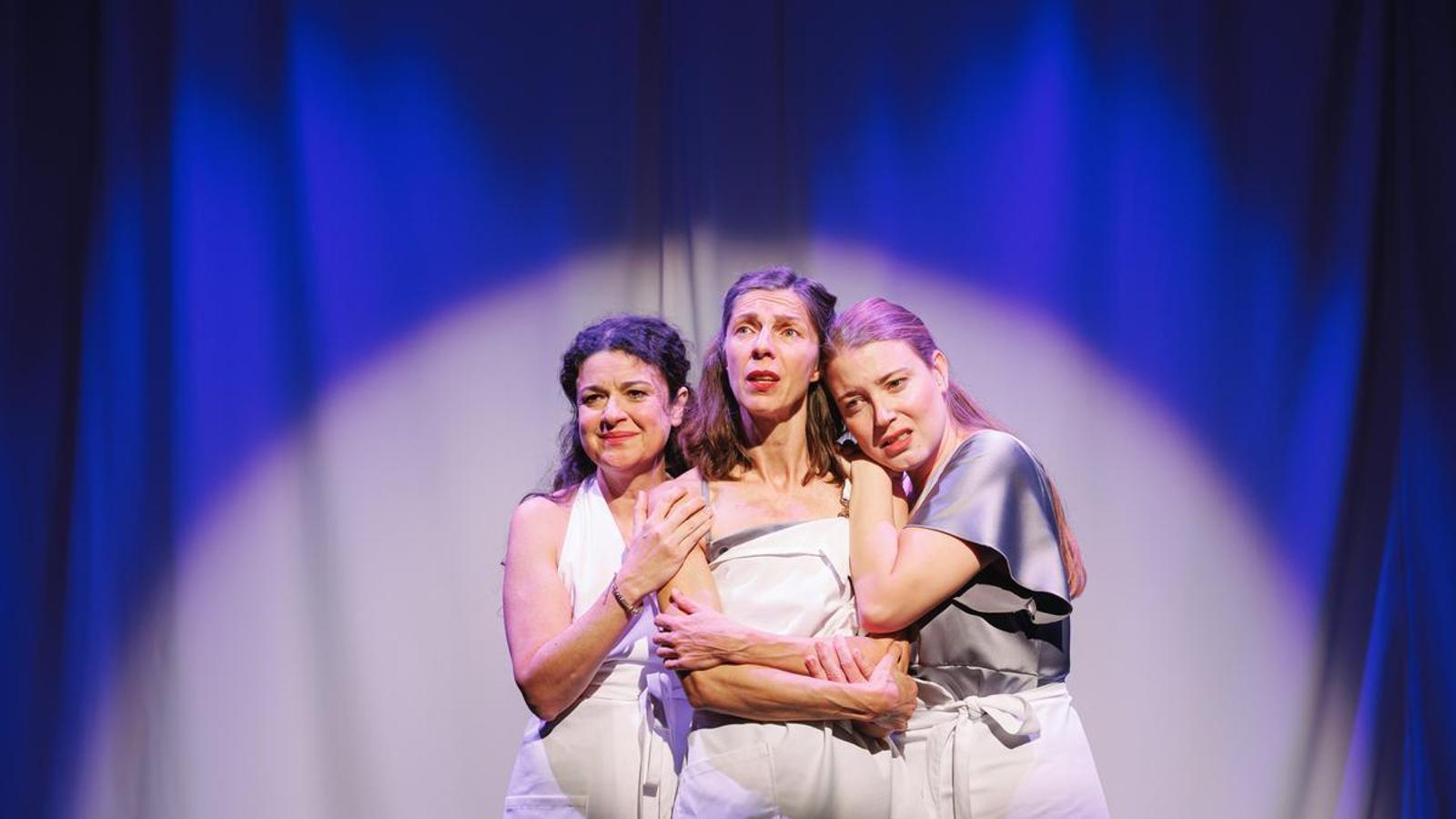
Forgive my body is, in some way, a work linked to the three previous ones by playwright and director Queralt Riera (Parets dels Vallès, 1978) due to the theme of violence. In Dona she spoke about the violence involved in prostitution, in Pruna about the violence of child sexual abuse, and in I porn, you porno about that which nests on women's bodies. Now, in Forgive my body, she speaks to us of man's violence over the female body and soul, that is to say, of the gender-based violence that has claimed 44 lives to date since the beginning of the year.
The show presents three imagined stories that are by no means foreign to what happens in many homes. Carmen has discovered in the psychologist's office that she has no self-love, that she didn't even know what it was; Mari Carmen suffers aggression from her husband but is unable to report him. As in so many cases, love prevails. And Carmela has a sexually aggressive and despotic partner.
Perhaps these stories are not very original, but the way of telling them is. Riera opts for the fragmentation of each of them, for the bareness of a stage space supported only by a curtain-screen, and for the incorporation of foreign elements that make the work more playful, though not always justified, such as the five songs featuring the fine voice of Àfrica Alonso. Everything is permeated by the tradition of the pig slaughter, metaphorically comparable to that of women.
Queralt Riera says she did not want to create a denunciation show, but there is something of that in the long address that positions the woman as a sow, no matter what she does. Certainly, this is a militant proposal to be applauded. It is a work tinged with poetic breath, like other texts by the playwright, and with a litany of three voices committed from the very title of the show. In the end, it is the woman's body that suffers the aggression.
The three actresses offer good performances with admirable dedication, although the direction—we imagine following current trends—clings to a restraint that nuances the characters' emotions. Thus, it avoids the great drama of the situations, which it adorns with a series of choreographic phrases that are not very well resolved. In any case, a recommendable performance.
