Sánchez appoints Carlos Cuerpo "transitional" Minister of Transport after Puente's resignation
The PP asks the Spanish president to resign after Puente's resignation
-
CAT -
CAST
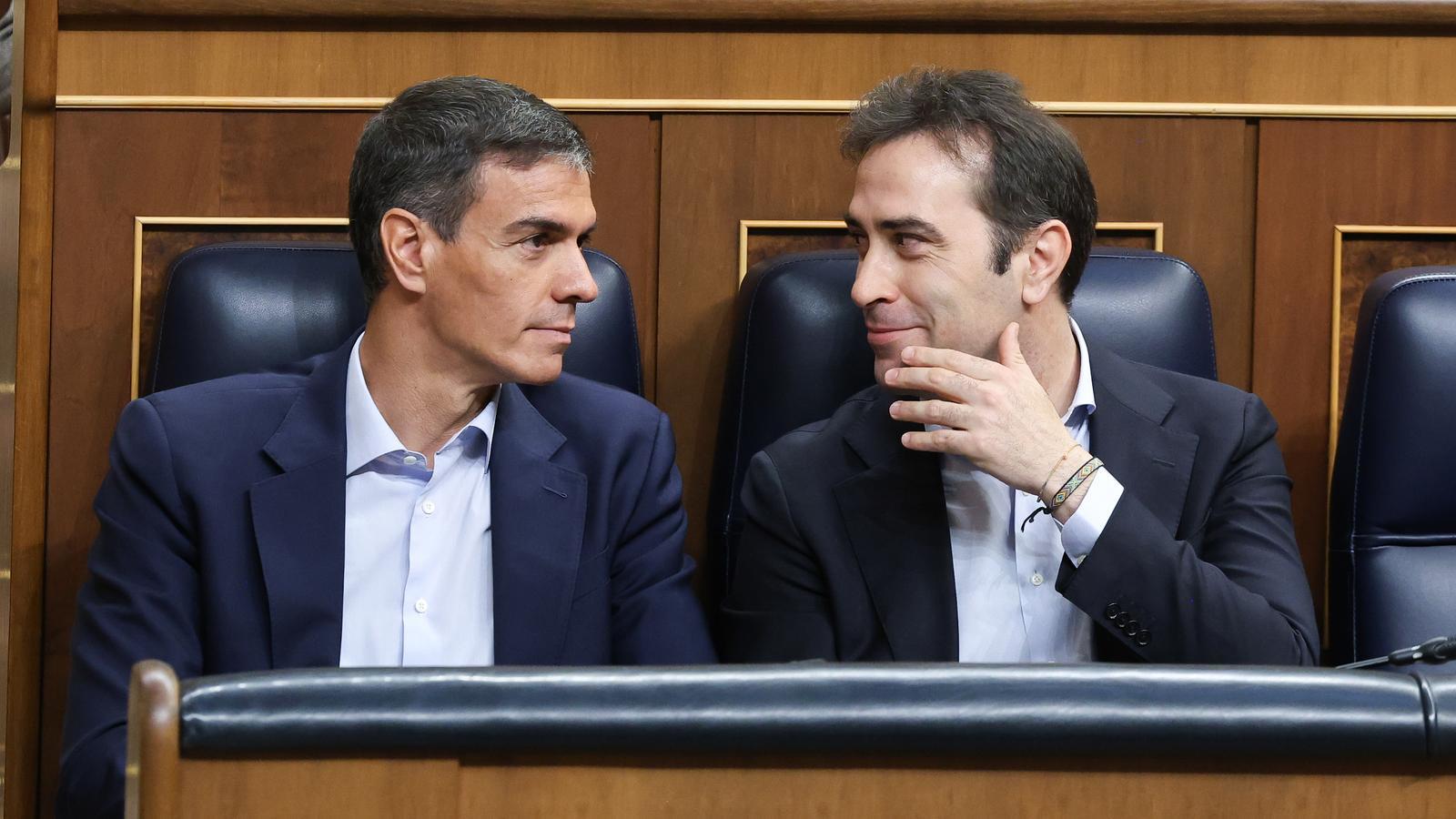
Madrid / BarcelonaThe surprise resignation this Tuesday of the Minister of Transport, Óscar Puente, a week after the Urda railway tragedy, has been the umpteenth jolt to the pre-campaign for the general elections in the State. The head of Transport announced his resignation this Tuesday evening after giving explanations in Congress for almost four hours, and this morning, the Spanish President, Pedro Sánchez, has already appointed his replacement. It will be the current First Vice President and Minister of Economy, Carlos Cuerpo, who will take over the Transport portfolio. “I accept [Óscar Puente's decision] with gratitude and respect,” said the President of the Spanish Government, Pedro Sánchez, in a brief institutional statement from Moncloa this Wednesday morning, in which he explained that it will be Cuerpo who will assume the powers of the Ministry of Transport “on a transitional basis”.
Cuerpo must from now on take on the management of the railway crisis. Felipe VI warned this Wednesday that it is up to governments to guarantee quality “infrastructure, education and training”, he said during one of the events of the XXX Ibero-American Summit.
In this context, the Minister of Economy, and now also of Transport, met with the president of Adif, Marco de la Peña, at the headquarters of the Ministry of Economy this Wednesday afternoon, shortly after his appointment was published in the Official State Gazette (BOE). Cuerpo is a much less political profile than Puente, despite holding the first vice-presidency. Furthermore, he uses a moderate discourse, without stridency, which contrasts with other ministers of the Spanish government and even unsettles the PP. Through the social network X, he thanked Sánchez for the trust placed in him to assume “an enormous responsibility”. “With the memory of the accident victims very much present,” he remarked, and valued the work of his predecessor.
Until this Tuesday, Puente had assured that he had Sánchez's full confidence. In fact, the Spanish president had asked him, according to the former minister's account, not to resign “for the sake of justice”. At Moncloa, they argued that in a moment of crisis like the current one, the best response was to remain at the helm of the administration, and not to opt for dismissals, but political and social pressure on the former minister had grown as the days passed and it was anticipated as a thorn in the side for the PSOE in the electoral campaign. Now, government sources interpret this as a gesture of “empathy” towards the victims and their families – Toledo Cathedral will host a funeral on November 10th in memory of all of them, which the Spanish royals will attend –. Puente informed Sánchez on Tuesday afternoon that he was stepping aside. He did so via a WhatsApp message, according to various sources, and a few minutes before revealing the decision at the end of his appearance in Congress.
Sánchez defends Puente's management
“Minister Puente has worked tirelessly to improve the country's life and the mobility of its citizens,” said Sánchez, who highlighted that his socialist and loyal lieutenant has “stepped up, provided explanations, and contributed solutions to a society that demanded and deserved them.” In Sánchez's view, Puente's step aside is not only a sign of respect for the victims, but also a demonstration that “not all public servants are the same.” “Our duty is to honor his gesture and continue working,” said Sánchez.
The socialists and Óscar Puente himself highlighted this Tuesday that, unlike the PP, the former minister's decision “dignified” the country and politics. “While some lecture, others give their all,” said Sánchez. Puente criticized the conservatives for asking him to resign when no political leader in their ranks has done so immediately after a crisis, he said. The most recent example is that of Carlos Mazón for his management of the DANA in the Valencian Community two years ago, which left 233 people dead. The former Valencian president resigned a year later—justifying it with “I can't go on anymore”—but since then, he has remained a deputy to avoid losing his immunity. On the left of the parliamentary arc, and in particular in the Broad Front, the space that brings together the minority partner, Sumar, they have also appreciated the gesture after openly calling for his resignation.
Spain asks the EU for help
Meanwhile, Spain has sent a request to the European Union Agency for Railways (ERA) for it to support local authorities in investigating the Urda accident, as explained this Wednesday by representatives of the European Commission, who confirm they have responded affirmatively.
During the same press conference, Commissioner Apostolos Tzitzikostas, responsible for Transport, described it as “very worrying” that there have been two train accidents of this magnitude in Spain in the same year. “We have been working for two years to support, train, and make the railway faster, safer, and simpler to use for the public. Therefore, two accidents in the same year is, in no case, what we would like to see. And, of course, even less so when these accidents are followed by tragedies with loss of human life,” he lamented.
The PP points to Sánchez
The PP, on the other hand, is not satisfied with Puente's departure and has quickly seen a new opportunity to wear down the Spanish president. “Mr. [Carlos] Mazón was president of the Generalitat and he left; Mr. [Pedro] Sánchez has not left,” stated Feijóo in an interview on Antena 3. In the opinion of the popular party, Puente was “forced to resign by the polls,” said the PP leader. “The news is that, otherwise, he wouldn't have done it yet,” insisted Feijóo. Vox leader Santiago Abascal also opined that “the important thing” is for Sánchez to leave, “the mafia boss who governs Spain,” although he has placed this goal at the polls on November 29th. In the PP, they saw the former Minister of Transport as a “firewall” to protect Pedro Sánchez in the face of the crisis caused by the train accident. A theory that those of Santiago Abascal had also joined.
The Government defends Puente
For his part, the president of the Generalitat, Salvador Illa, has come to the defense of Óscar Puente and has vindicated his 'sincerity' and the fact that he 'always shows his face.' The head of the Government responded in this way to the reproaches of the opposition. The president of the Junts group, Mònica Sales, has described the socialist management of the railway network as 'disastrous,' especially that of Minister Puente. 'The best thing he has done has been to resign,' said Sales, who reproached him for not coming to Catalonia after the fatal Rodalies accident in Gelida. On the other hand, the president of the Generalitat has admitted that 'there is a need' to 'restore confidence in the railway system,' although he has assured that it is a 'job for all [political parties].' In this sense, Illa has highlighted that the Generalitat is increasing investments in the railway network.
