Rufián, still
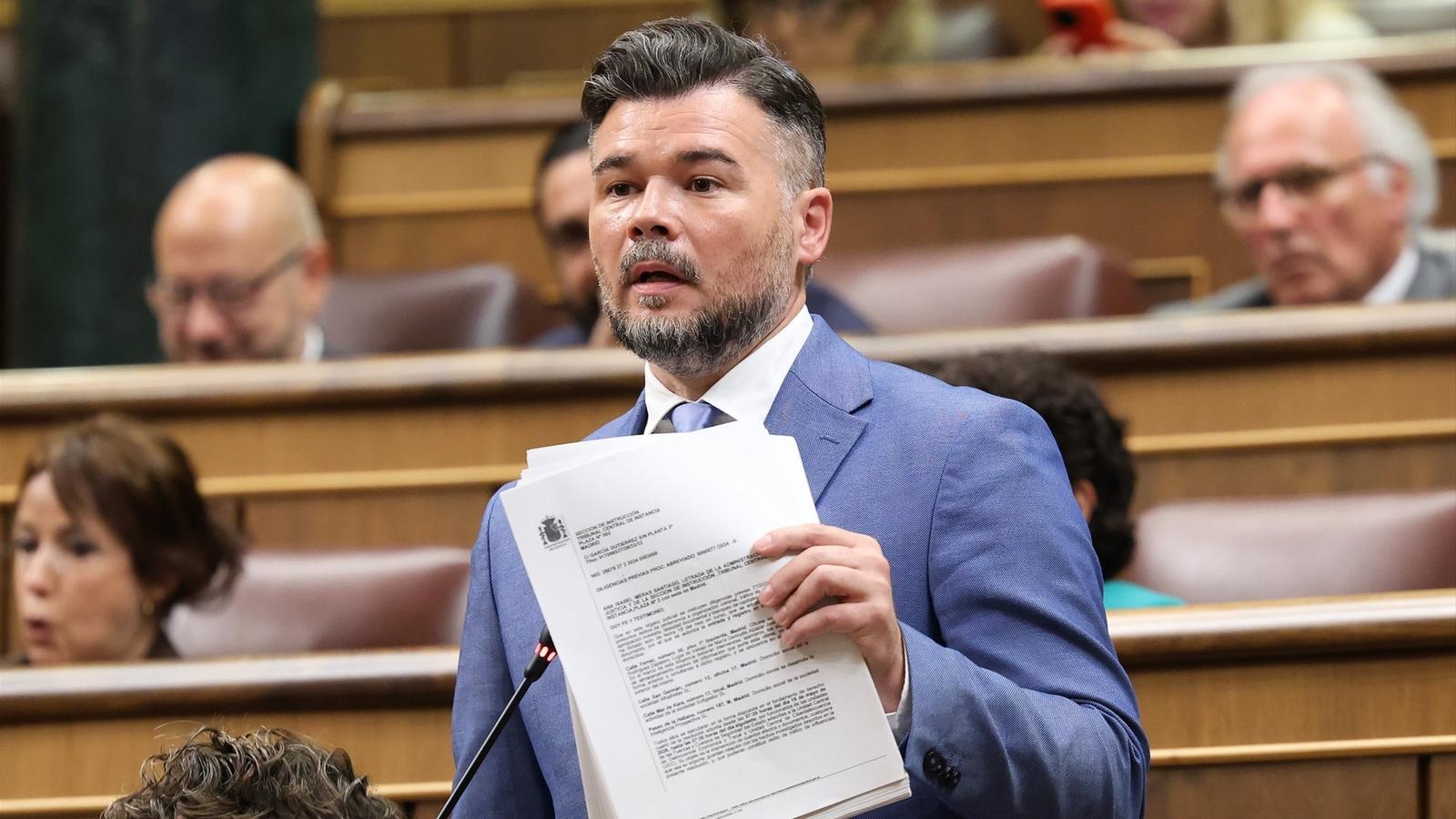

Without Rufián, ERC's electoral perimeter will be smaller; with him, their voters will not know exactly what they are voting for.It is now evident that Gabriel Rufián is not only a dissenting voice within ERC but also a leader with his own agenda and the ability to overshadow the party he belongs to. Therefore, for ERC, managing Rufián's weight (or absence) is a fundamental issue.The veteran republican party must measure its moves carefully. Having overcome a disastrous electoral cycle, it is weighed down by the failure of its institutional experiments (presidency of Aragonès and mayorships of Lleida, Tarragona, and other important cities). Oriol Junqueras is a son of the Process, which is both a halo and a stigma. And his political future is in the hands of the judges, which conditions everything. Faced with Junts' maximalism, ERC plays the card of pragmatism and conditioned support for the socialists. But this, which sells relatively well in Spain, is more difficult in Catalonia, due to the repeated non-compliance and management problems of the PSC. And despite everything, the polls are relatively favorable to him. Does the Rufián factor have anything to do with it? The one from Santa Coloma not only sweeps among Spanish left-wing voters, but also (at least in this newspaper's recent poll) is the best rated by Catalan voters, even beyond the pro-independence orbit. For Junqueras, Rufián widens the base. He cannot do without him, but he has serious problems controlling him. What to do? If Junqueras gives himself over to Rufián's speech (a populist, effective, but uncertain narrative) he will be buying electoral intention in exchange for assuming an uncertain and short-term bet. Instead of independence, Rufián proposes resistance: postponing the Catalan dispute to face PP, Vox and Junts (which he presents as a three-headed monster) with the unity of the alternative and plurinational left. There is no doubt that if ERC, Bildu, BNG, Compromís and Endavant Andalusia coordinated better in Madrid, they could install the debate on plurinationality (and self-determination) in the center of the Spanish ring, either by conditioning the PSOE or by erecting themselves as a containment wall for the Spanish right. But we don't know if that's what really motivates Rufián. And on the other hand, the only parties that buy into his narrative are not the sovereignists, but Sumar, Podem and Comuns. Those who are in low hours. Given Rufián's difficulties in converting his unitary calls into a realistic project, perhaps Junqueras has decided to remain silent and wait for reality to put him in his place. But as long as Rufián's future role is not clear, ERC's expectations will be doubtful. Without him, the party's electoral perimeter will be smaller; with him, ERC voters will not know exactly what they are voting for. Rufián does not live a party life and ignores his group mates; his fun is to offend Junts deputies and praise, somewhat forcedly, the colleagues from Sumar and even those from the PSOE. Catalan politics is very far from him; he never appears with Junqueras, he does not talk about independence (only passively: "I am fed up with Catalans being judged on whether they are independentists or not"). He has counter-programmed Junqueras' photo with Illa for the signing of the budgets. And he has not said a word, for example, about the conflicts of the PSC government with public education and healthcare. A notable exercise in restraint for a chatterbox like him. The great Catalanist parties have always had a double face (Macià and Companys, Pujol and Roca) but making these kinds of tandems work, with one foot in Madrid and another in Barcelona, is an art in itself, typical of solid parties with a well-crafted strategy and discourse. The management of contradictions is what characterizes large parties. ERC still has to prove it can do so successfully. And a new electoral cycle is approaching.
