Northern Ireland falls into the "modern pogrom" against immigrants
The far-right exploits an incident to erode the Peace Accords and turn newcomers into scapegoats of a "comfortably segregated" society

-
CAT -
CAST
LondonPope Leo XIV can say mass and warn Europe and the world that immigrants must be welcomed, whether they arrive in Arguineguín, Dover or Sicily, but his words do not count for far-right movements, such as some groups in Northern Ireland, which in recent years have staged episodes of xenophobic violence. Not because the radicals are Protestant and not Catholic, but because they exhibit "racist" attitudes, as defined by the British minister for the province, Hilary Benn, on Thursday.
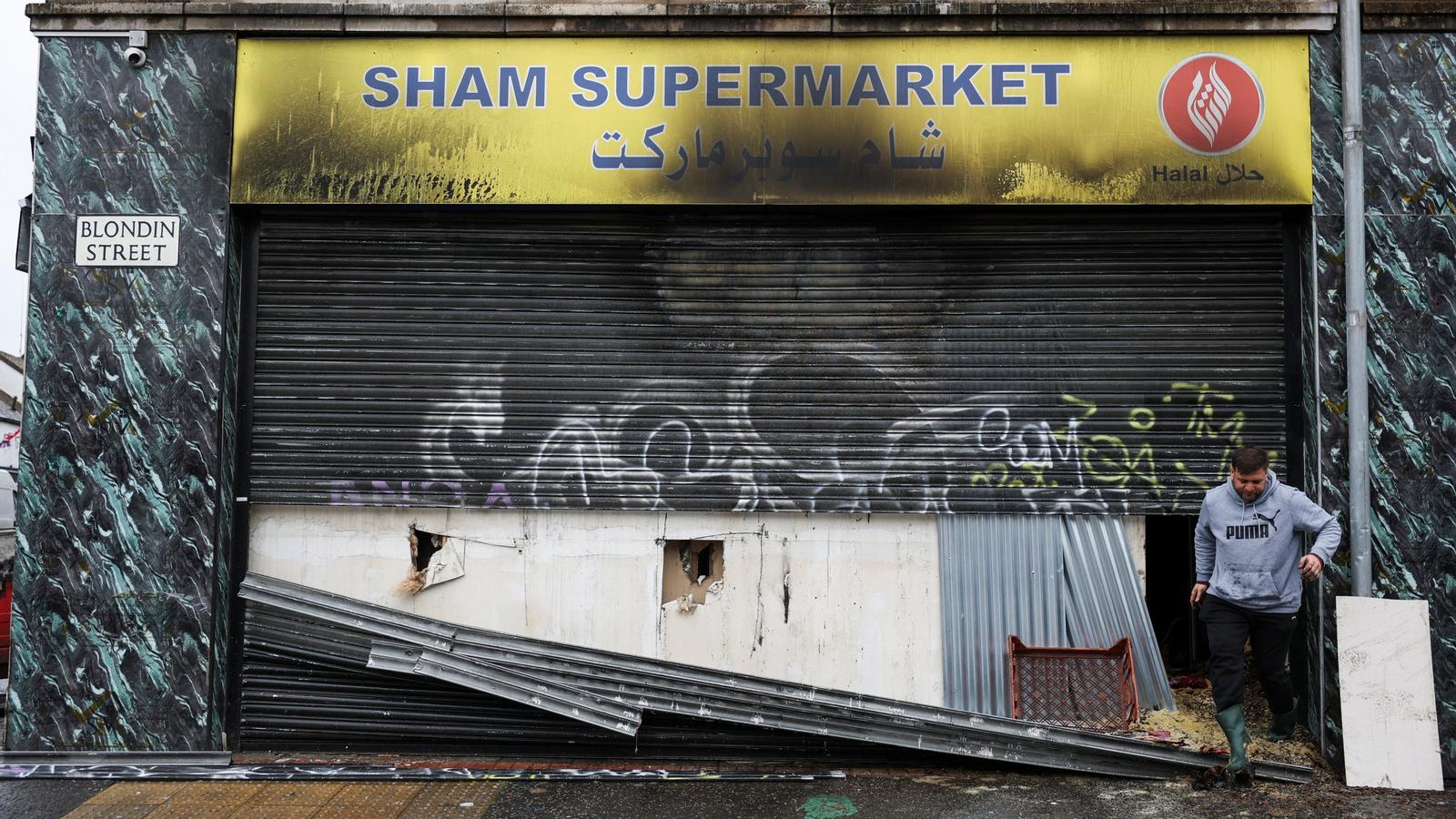
This week, hooded groups of young people – between 200 and 400, in some cases fewer – identifying with loyalist affiliation, have carried out what the newspaper The Times described on its front page as a "modern pogrom". It referred to indiscriminate attacks against immigrants simply for being immigrants, which ended with houses, vehicles and bins burned. Eight families lost their homes on Tuesday night. And at least fifteen more fled their homes on Wednesday after a list of addresses circulated online as targets for the mob, which included a hotel hosting refugees.
Minister Benn was very clear with the press: "If you burn someone's house and drive them out while shouting 'foreigners out!', what other words would you use to describe what has been happening?" Indeed, racism. The images – small children fleeing the fire – returned Belfast to the period of the Troubles, the sectarian violence between the two traditional communities, Protestant and Catholic, which has historically cost so much blood. Now the persecuted have been foreigners.
Brutal assault
The xenophobic violence that has erupted this week in Belfast and other towns in the province has been excused by the attempted beheading of Stephen Ogilvie, a 40-year-old resident of the north of the city. The perpetrator of the assault was Hadi Alodid, a 30-year-old Sudanese asylum seeker, legally established in the United Kingdom.
In Northern Ireland, 1.93 million people live. Of these, only 3.5% are part of ethnic minorities: that is, about 67,000 or so. According to Ben Brindle, from the Migration Observatory at the University of Oxford, "the available official data do not indicate that immigrants, considered as a whole, commit more serious crimes than British people".

Even so, Hadi Alodid's attack served to prompt the far-right figure Tommy Robinson, among others, to urge his followers to demonstrate against what he described as an "invader attack." His message on X was shared by the owner of the platform and billionaire Elon Musk, who called on citizens to protest "repeatedly and loudly" to change government policies on immigration.
the murder of young Henry Nowak in Southamptonnights of racist violence in Ballymena (45 kilometers north of Belfast) last year; the stabbing of three girls in Southport (2024) and the murder of young Henry Nowak in Southampton by a Sikh man in December 2025.
Patricia McKeown, general secretary of the Unison trade union in Northern Ireland, has also joined Professor Reilly's denunciation, speaking to the BBC, after explaining that nurses in hospitals in east Belfast were persecuted because of their skin color. "This is the least ethnically diverse part of these islands. We do not have an immigration problem. All of this is politically orchestrated by the far right, not just in Northern Ireland, but also in Great Britain, in Europe, and in the United States. It is a deliberate attempt to scapegoat an entire community. A community that is here to save our lives and care for our people.
The ghost of the Troubles
Since 1974, the demoscopy company IpsosSeptember last year to start the political year threatening with large-scale deportationsAt that time, propaganda from those who supported leaving the European Union produced posters with endless queues of Turkish migrants who were supposedly rushing to invade the United Kingdom if a break with Brussels was not made. The ad hoc poster proclaimed Nigel Farage's message. Since then, and even before, the brexiter
leader and an ultra has been setting the British political agenda. And he has placed the foreign population in his sights, along with other racist agitators. His electoral interests led Farage last September to begin the political year by threatening large-scale deportations if he comes to govern: a copy of the stances of Donald Trump or many other ultras in Europe.
The Ogilvie case has served as an excuse for the most radical sectors of British unionism and the far-right to question the Common Travel Area, the free movement agreement between the United Kingdom, Ireland, the Channel Islands, and the Isle of Man, in force since 1922.
According to the Irish Department of Foreign Affairs, up to 90% of the 18,500 asylum seekers registered in Ireland in 2024 would have arrived in the country after first entering the United Kingdom and then traveling to Ireland via Northern Ireland. For its part, the British Home Office reported this Friday that during the last year it has detected just over 900 offenders of immigration rules who would have taken advantage of this same open land border.
But a single aggressor having crossed the border from south to north from the republic has been enough to reopen a debate that touches the essence of the Good Friday Peace Accords. If an isolated incident becomes an argument to reintroduce border controls between the republic and Ulster, the ghosts of the Troubles could be unearthed in a society that still has them very present. Because as Professor Brendan Ciarán Browne, from Trinity College Dublin, wrote this week, "we continue to be, to a large extent, a 'comfortably segregated' society".
