Burnt Teslas and attacks on UN office: a demonstration against the G-7 in Geneva ends in violence
The leaders of the world's seven major economic powers meet this Monday in the French city of Évian
-
CAT -
CAST
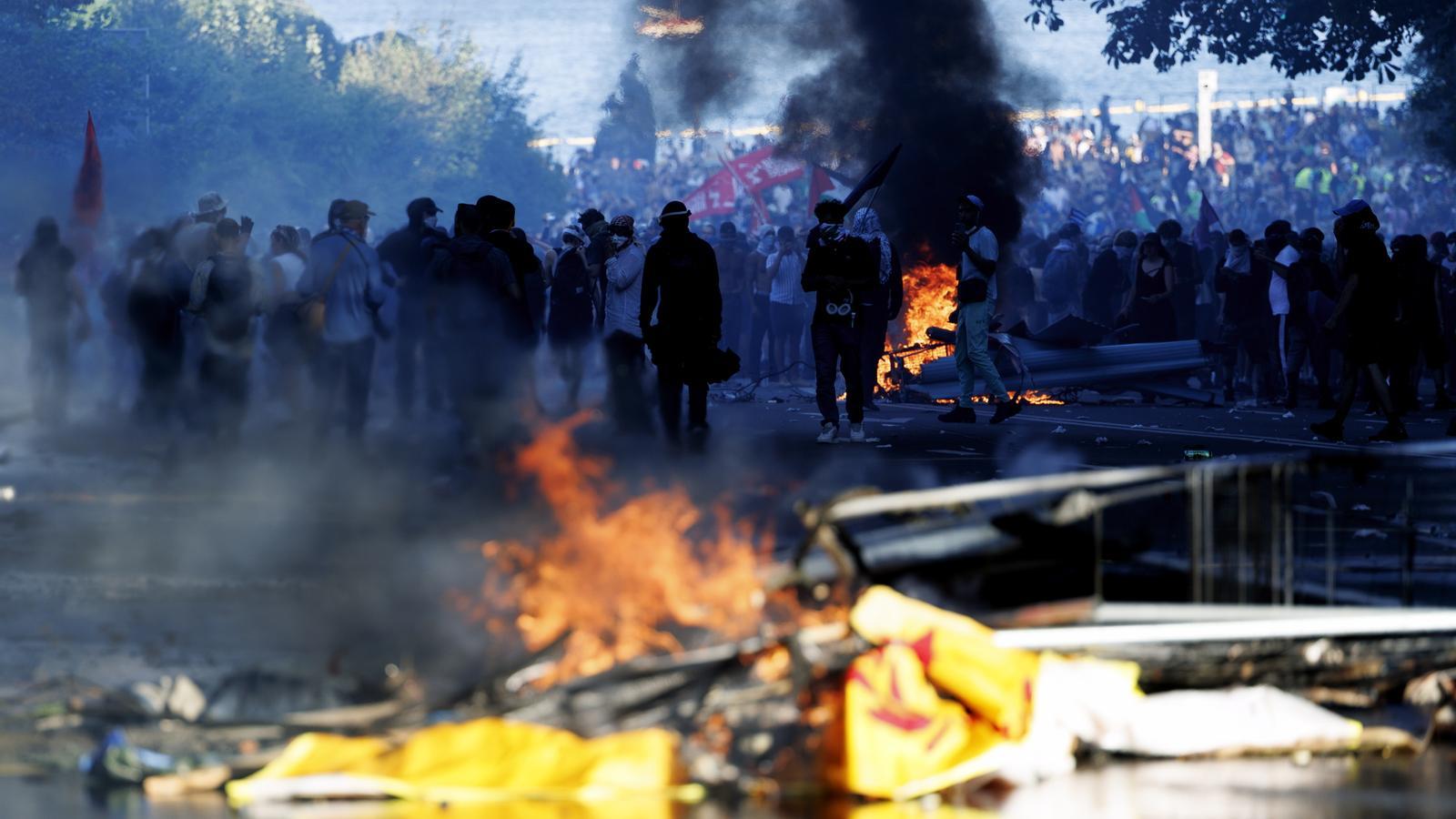
BarcelonaGeneva has become this Sunday afternoon the epicenter of anti-capitalism, with a demonstration against the G-7 meeting this week in the French city of Évian-les-Bains, which ended with riots and violent clashes with the police. Some 20,000 people participated in the protest, the only one authorized, according to police estimates, although organizers put the figure at 60,000 demonstrators.
The march began peacefully, but turned violent when a group of participants with their faces covered began to throw stones at the police, who responded with tear gas. According to the Reuters agency, the demonstrators set fire to a Tesla car and broke the windows of the headquarters of a United Nations agency.
According to the Efe agency, one of the businesses most affected by the acts of vandalism has been a Tesla dealership, one of the symbols of extreme capitalism, in the same week that its owner, Elon Musk, has become the first billionaire in history after the stock market launch of SpaceX, another of his companies.
Protests during G-7 summits are common, with proclamations against capitalism, globalization, inequality, and climate change. "We are very afraid of the policy of Trump and the other G-7 leaders, because they are waging war everywhere," declared Françoise Nyffeler, spokesperson for No to the G-7, the collective organizing the protest.

In Geneva there was already a violent march in 2003, the year in which the meeting – at that time of the G-8, still with Russia – was also held in Évian, on the French bank of Lake Geneva. At that time, the riots lasted for three nights. In this case, the French government denied authorization for the demonstration in its territory and the organizing collective asked the Swiss authorities to allow the protest to be held in Geneva, about 45 kilometers from Évian. Switzerland ended up accepting it, even though France has not agreed to contribute to the costs of the security operation.
The authorities have closed roads, prohibited unauthorized gatherings, and offered financial support to businesses that could be affected by possible disturbances. Only 7 of the 35 road border crossings have remained open.

Wars, at the centre of the summit
At the summit, which will begin this Monday and run until Wednesday, the leaders of the United States, France, the United Kingdom, Canada, Germany, Italy, Japan, and the European Union will attend. But there will also be other invited leaders, such as the President of Egypt, Abdelfatah al-Sisi. Donald Trump will also be there, and has said he plans to meet with the Egyptian leader and those of Qatar, the United Arab Emirates, and India.
One of the main topics on the table is the war in the Middle East, and Trump intended to arrive in France with the memorandum of understanding with Iran signed, plans that for the moment have been put on hold due to Israel's bombing of Beirut this Sunday.
The other major issue to be addressed is the war in Ukraine. The president, Volodymyr Zelenskyy, will also travel to Évian, where he hopes to hold a bilateral meeting with Trump, from whom he expects to receive a commitment to increase the military aid that Kyiv needs to continue defending itself from Russia. Zelenskyy has reported that this Sunday he spoke by phone with the American president to congratulate him on his 80th birthday and that they have committed to discussing in depth during the G-7 summit.
The Ukrainian leader – who has seen that the war against his country has been relegated to the background since the US and Israel launched the military operation against Iran at the end of February – has stressed that it is "very important" that the meeting in Évian concludes with "concrete decisions" aimed at increasing pressure on Russia, strengthening Ukraine's air defense and long-range capabilities, and increasing cooperation in drone matters.
