The difference between the high school grade and the PAU grade doubles in 10 years
Last year 1.2 points separated the results of the institute and those of the selectivity

-
CAT -
CAST
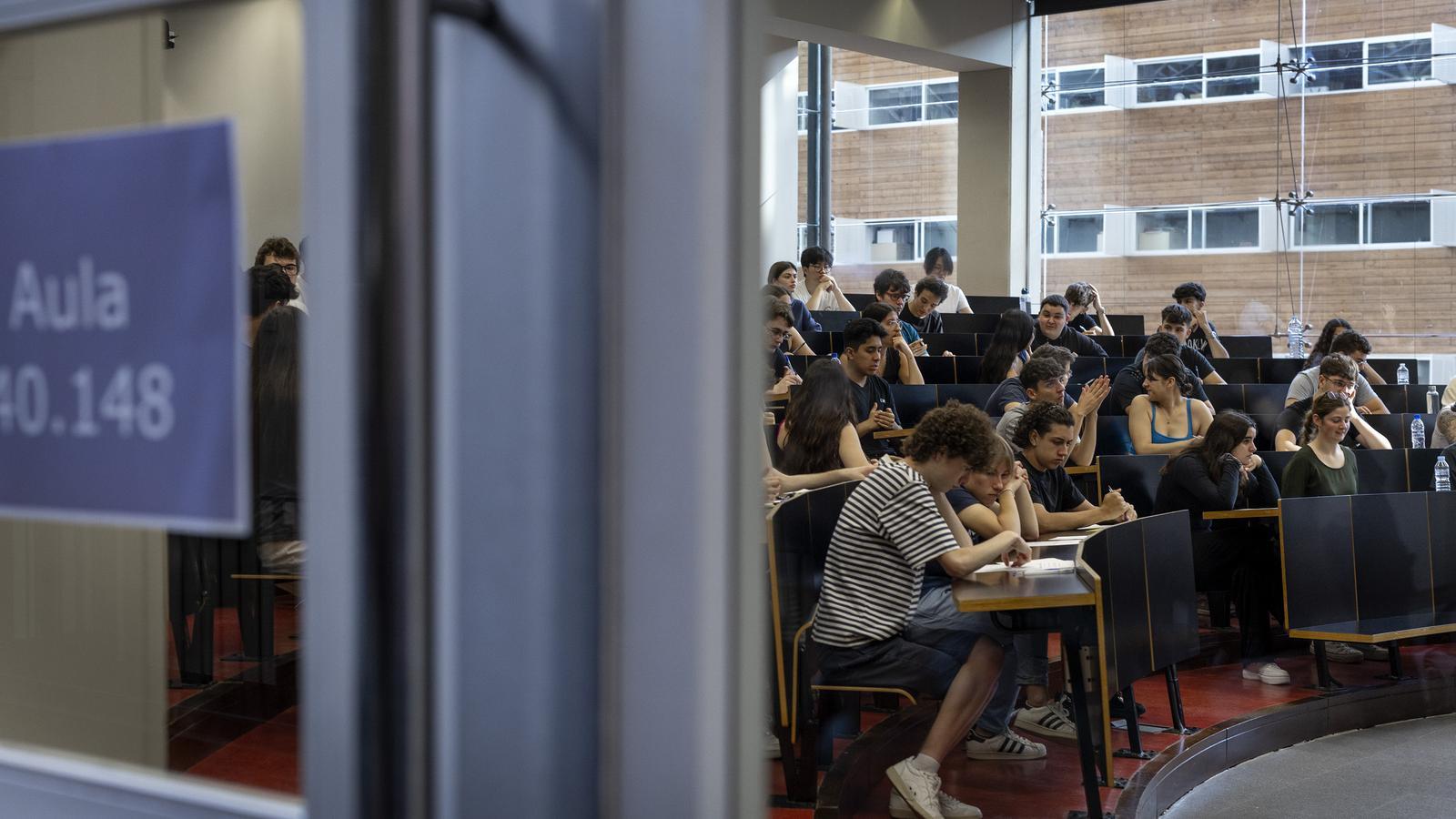
Barcelona"I have an average of 9 throughout high school and this has been the worst exam of my life," assured one of the students last week after leaving the exam – which some described as "terrible" – in mathematics of this year's PAU. Next to her, her teacher assured that this year's test "was affordable, but it asked things differently than how it had been done in class" and also said that nerves had to be taken into account. While waiting to see what happens with the grades of this exam, this scene can be an example of how the difference between the average high school grade and that of the general phase of the PAU is further away each year.
According to the data collected by the Department of Research and Universities, the difference between these two grades has doubled in a decade: in the 2014-2015 academic year, the difference between the average high school grade (7.3) and that of the general phase of the PAU (6.7) was 0.58 points, whereas last year this difference rose to 1.23 points, going from 7.67 in the high school average to a reduction to 6.4 in the PAU.
However, as indicated by the professor of economics and statistics at the University of Barcelona (UB), Ernest Pons, "behind this data there are many gray areas because in the end both the PAU grade and the baccalaureate depend on many things". The director of the Institut Antoni Martí i Franquès in Tarragona, Jordi Satorra, also agrees. Both agree in pointing out that one of the factors that can explain why PAU grades are slightly lower than baccalaureate grades is the fact that in recent years there have been changes in the structure of the selectivity exam questions to make it more competency-based, moving away from the way of teaching in the baccalaureate. "It's neither the same nor is it evaluated in the same way," says Pons.
On the other hand, Satorra also indicates that, until now, 10% of the baccalaureate grade depends on the Research Project, which is a very different way of evaluating than a one-day exam. "It is a type of evaluation that has a percentage of 10 that does not fit the exams you have in ordinary education," warns the also president of the directors' association Axia.
The UB professor, who insists that it's all hypotheses, also considers the option that part of the difference between the results is precisely that "the students who take the PAU and the students who do the baccalaureate are not the same": there are baccalaureate students who do not take the PAU, there are students who do vocational training and then take the PAU, and there are also older people who re-engage after years and retake the selectivity exam. Furthermore, Pons also points out that "an important element to consider is that, although the demographic curve would not justify it," every year a new record of PAU registrants is broken. Therefore, "diversity has been increasing".

Inflated notes?
'very specific studies such as medicinedifferences between the number of excellent grades registered in high school – especially in private centers – and those subsequently achieved in the PAU. In fact, the UB expert assures that this trend, in which the curve of excellent grades is observed to be wider in high school than in the selectivity exams, continues to be maintained today.
"It is true that 10s in high school are more frequent than would be expected and this is an anomaly, but I do not dare to link it to anything," explains Pons, who insists on saying that "there is no data to demonstrate inflation." "Beyond the ownership of the center, the student's situation must be taken into account. Not all are the same nor do they have the same support or level of pressure at home, and this also influences the results," he justifies.
Satorra does suggest that perhaps in some high schools there may be a tendency to "not want to harm the student" and a certain overprotection. Among the reasons, he points to the fact that there is a different yardstick between the selectivity exams of each autonomous community. For example, in Catalonia there is one more subject because Catalan and Spanish are taken in the PAU, and high school class hours must be divided between the two languages. "This harms students in the face of the single district [the formula that allows access to any university in the State, regardless of the community where one has studied]," he warns. And he admits: "All of this makes you think: why be so demanding if other students have more flexibility?". Despite this situation, Pons points out that there is no data showing a generalized problem of inequality due to the single district except for very specific studies such as medicine'studies like medicine.
Despite these differences between high school and the PAU, the system does offer high schools statistics to compare the results of their students in the selectivity exams with those of other centers and with the general average. However, Satorra details, these reports do not make a comparison between high school grades and those of the PAU. "You have to do that yourself as a director, cross-reference the data, and if you see that there are many differences, try to talk to the corresponding department to try to correct it for the following academic year," he concludes.
