France: young people who do not resign themselves
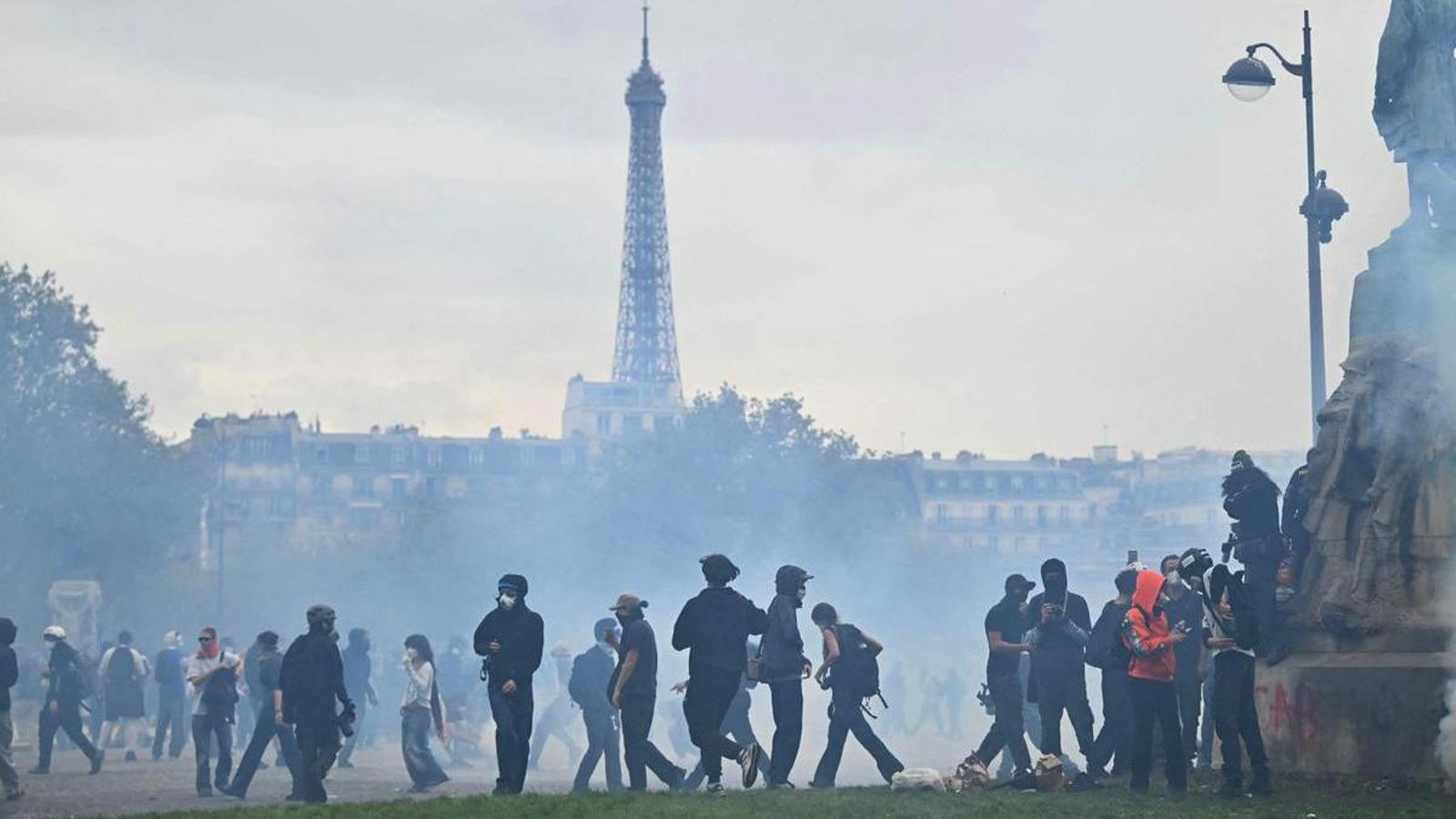

The outbreak of unrest in French secondary schools these last autumn weeks has taken the form of very concrete images. Outside, the late heatwave and storms; inside the classrooms, even though it was already the month of October, a stifling mugginess. One of the banners that could be seen in front of the Jean Perrin high school in Rezé said “35°, 35 par classe, mais le problème c’est nos téléphones”. The students have taken to the streets asking for very concrete, material, palpable things: fans, the repair of blinds, the urgent hiring of teachers to cover leaves of absence, and the reduction of class sizes. Among the hand-painted slogans that have spread across social media, there was one that synthesized with bitter irony the paradox of a generation: “You ask us to prepare for the future in classrooms that cannot withstand the present”.
In an op-ed published in Le Monde on October 7th, sociologist François Dubet expressed it with a headline as forceful as it is paradoxical: “There is no future outside of school, and school cannot guarantee any future.” In 1990, when I was a doctoral student at Paris 8 Saint Denis, I experienced firsthand the outbreak of the lycéens movement in the Parisian banlieue, which culminated in a large demonstration in Paris. A year later, in 1991, I was able to hear Dubet, who had just published Les lycéens, a study on the experience of secondary school students in France, where he already addressed the tension between the expectations that school generates and its real capacity to guarantee a future. Thirty-five years later, the mobilizations that shake the high schools and streets of France continue to pose the same question: what can a young person expect from school today?
It would seem that young adolescents find themselves caught in an institutional trap. On one hand, they are told repeatedly that without degrees they will be nobody in an uncertain labor market. On the other, they witness daily the inflation of these same degrees and the suffocating pressure of algorithmic admission platforms like Parcoursup, which transform youth into a hyper-calculated and competitive dossier. When the meritocratic promise fails—when school says that effort is everything, but the social inequalities of origin persist—, school failure is experienced as a personal humiliation and classroom work loses all emancipatory perspective. The analysis of this malaise must go beyond material conditions and point to the very meaning of studies. How can one ask young people to strive, compete, and accumulate degrees if the promise that this effort will open the doors to the future is increasingly uncertain?
The crisis has sharpened in France, in a system marked by enormous inequalities between centers and territories. Families and young people know that not all itineraries have the same prestige nor do they open the same doors. When the diploma ceases to be a guarantee and becomes the minimum necessary to not fall behind, when starting inequalities continue to determine future possibilities, the effort can lose meaning and fuel frustration.
We have also seen in Paris and other cities how some teachers formed protective chains around students, to protect them from possible police charges. One teacher expressed it with a question: “What do we do? Do we let them beat up the students?” The most alarming thing about what is happening in French high schools, if we compare it with the revolts of other times, is that this loss of meaning among the student body runs in parallel to the identity crisis of the teaching staff itself. Teachers no longer face only insufficient salaries or overcrowded classrooms, but the daily difficulty of finding a purpose in their work when knowledge has lost its sacred value and the institution that was supposed to contribute to building citizenship and opening horizons for the future is perceived as a place where the promised opportunities are no longer guaranteed.
In Catalonia, we are well aware of these tensions. Teachers' strikes and mobilizations have brought urgent demands regarding resources and working conditions in classrooms to the table. Now that a national debate on education is opening and the five major themes that will articulate it have been defined, we cannot limit ourselves to discussing with what resources we educate, but we must also address why we educate, what it means to be a teacher today, and what the purpose of school is. The question that Dubet poses is, deep down, political and social: what future do we promise young people and what role do we want the school to play in it?
Amid the unrest, there is, however, a reason for hope. The mobilizations do not just express anger: they also reveal that many young people have not resigned themselves. In France, students from socially advantaged high schools and prestigious institutions such as Sciences Po and the École Normale Supérieure have stood in solidarity with the demands of the banlieue high schools, aware that not everyone studies under the same conditions, and have demanded a more equitable distribution of resources. That young people with different backgrounds and opportunities mobilize for one another breaks the logic of individual competition and reminds us that education is a common good. Perhaps this is one of the most important lessons of this revolt: school cannot guarantee the future on its own, but it can certainly contribute to building it.
