Do you know what circulates at the speed of light on the slope of Collserola?
Seeing it with an extraordinary definition: this is the secret of the Alba synchrotron's success

-
CAT -
CAST
Today I visit the science place closest to my home. And despite that, I had never set foot there. It is located on Carrer de la Llum – yes, they have given it a tailor-made name – in Cerdanyola del Vallès, bordering Sant Cugat, where I have lived for many years.
To reach what is properly the synchrotron, I had to pass through four doors (counting the outer reception booth). They have not skimped on security measures, of course. There are also, of course, numerous safety measures for the workers. "This is a radiological place, not radioactive," says Montse Pont, a physicist and member of the management team. She wears a dosimeter (a device that measures radiation) around her neck; she has been working at the synchrotron since its inception.
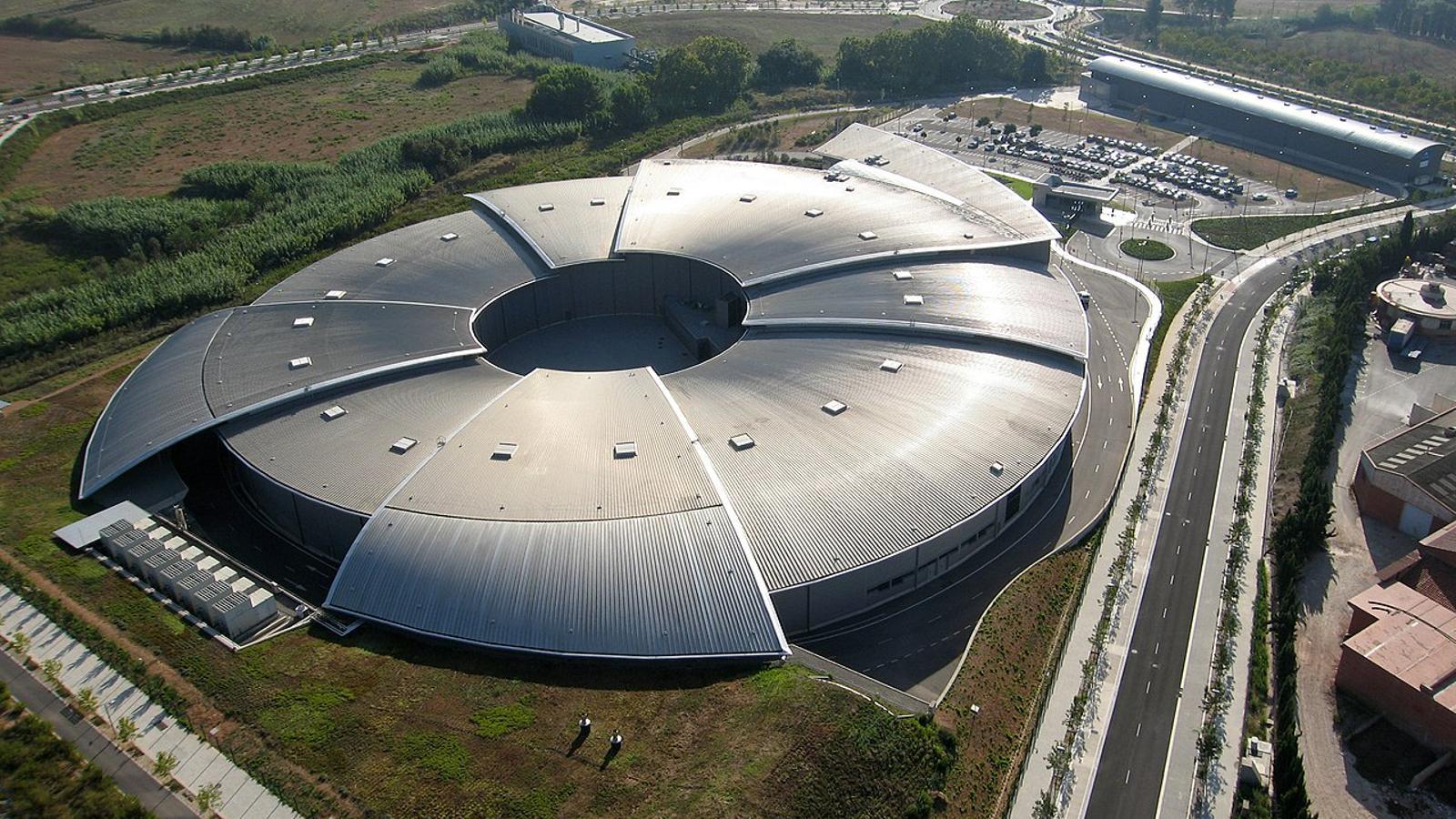
While doing a 360-degree tour of the synchrotron, one of the elements that surprises me the most are a few showers. "These showers... what are they for?" I ask Montse. "It's quite hot, but they're not for cooling down, no. They are emergency showers. They are for showering in case of contamination during the handling of chemicals or other dangerous materials. Each shower has two knobs, from which water comes out to wash your eyes, if necessary."The synchrotron is an electron accelerator that generates a tiny beam, 50 microns wide (the diameter of one of the hairs on our head), which circulates through a cylinder at high speed. Very powerful magnets guide the electrons through this cylinder. Other equipment, called radiofrequency cavities, accelerates the electrons.When magnets spin electrons, synchrotron light is generated. An extremely bright light, millions of times brighter than the Sun. It allows us to see everything with extraordinary definition, which is essential for investigating many things. It reduces experiment time and makes it possible to study fast phenomena, such as chemical reactions."The synchrotron is running seven days a week, non-stop, although it stops for some weeks a year (in summer, at Christmas...) for maintenance tasks," explains Montse, who is also the technical director of the Alba II project, which will transform Alba into a fourth-generation synchrotron, allowing experiments that are still impossible today."Every 20 minutes we put new electrons inside the accelerator, which go around a million times per second," says Montse. That is, more or less the speed of light. Montse knows the operation of the Alba synchrotron very well.The synchrotron is separated from the rest of the building. Both the electron accelerator complex and the laboratories (called beamlines) where synchrotron light is used are on top of a slab resting on compacted gravel, which is completely decoupled from the main building. "We are very close to the AP-7. We feared that the traffic in the area would produce vibrations," he says. The research carried out at Alba is extremely varied. Montse explains them when I sit for a while on a cardboard bench. They were acquired for an open day and are surprisingly robust. Here are some examples: research into new materials for batteries and electronic devices; analysis of drugs for diseases such as malaria, hepatitis C, cancer or Alzheimer's; design of catalysts; study for the conservation of Romanesque paintings. Other experiments will lay the groundwork for our near future in areas such as alternative energy sources or tissue imaging. Sodium batteries (much less polluting) are also being studied to replace lithium ones. We currently have a beamline in sight – that's what the laboratories are called – where a team is dedicated to protein crystallography. The pharmaceutical industry is a major client of Alba: they conduct 40% of the synchrotron's industrial experiments.(much less polluting) to replace lithium ones. We currently have a beamline in sight – that's what the laboratories are called – where a team is dedicated to protein crystallography. The pharmaceutical industry is a major client of Alba: they conduct 40% of the synchrotron's industrial experiments.I am accustomed to visiting large scientific facilities where the architecture and design are very well thought out. The Alba synchrotron building is no exception. If you fly over it, you will see that it has a very beautiful geometric shape – some see a snail shell in it. The building is completely covered, but in the large central space, where the synchrotron itself is located, natural light enters from below.4,000 researchers
The synchrotron began to take shape in 1992. It costs a fortune and takes a lot of effort to build a large-scale scientific facility like this from scratch. Experiments began in 2012. The Alba synchrotron is funded equally by the Spanish government (Ministry of Science, Innovation and Universities) and by the Generalitat de Catalunya (Department of Research and Universities). Currently, around 280 professionals work there. Every year, nearly 4,000 researchers from all over the world pass through its facilities.

