Juan Antonio Flecha: "Cyclist is who lives life with a bike, not only who does sport"
Cyclist
-
CAT -
CAST
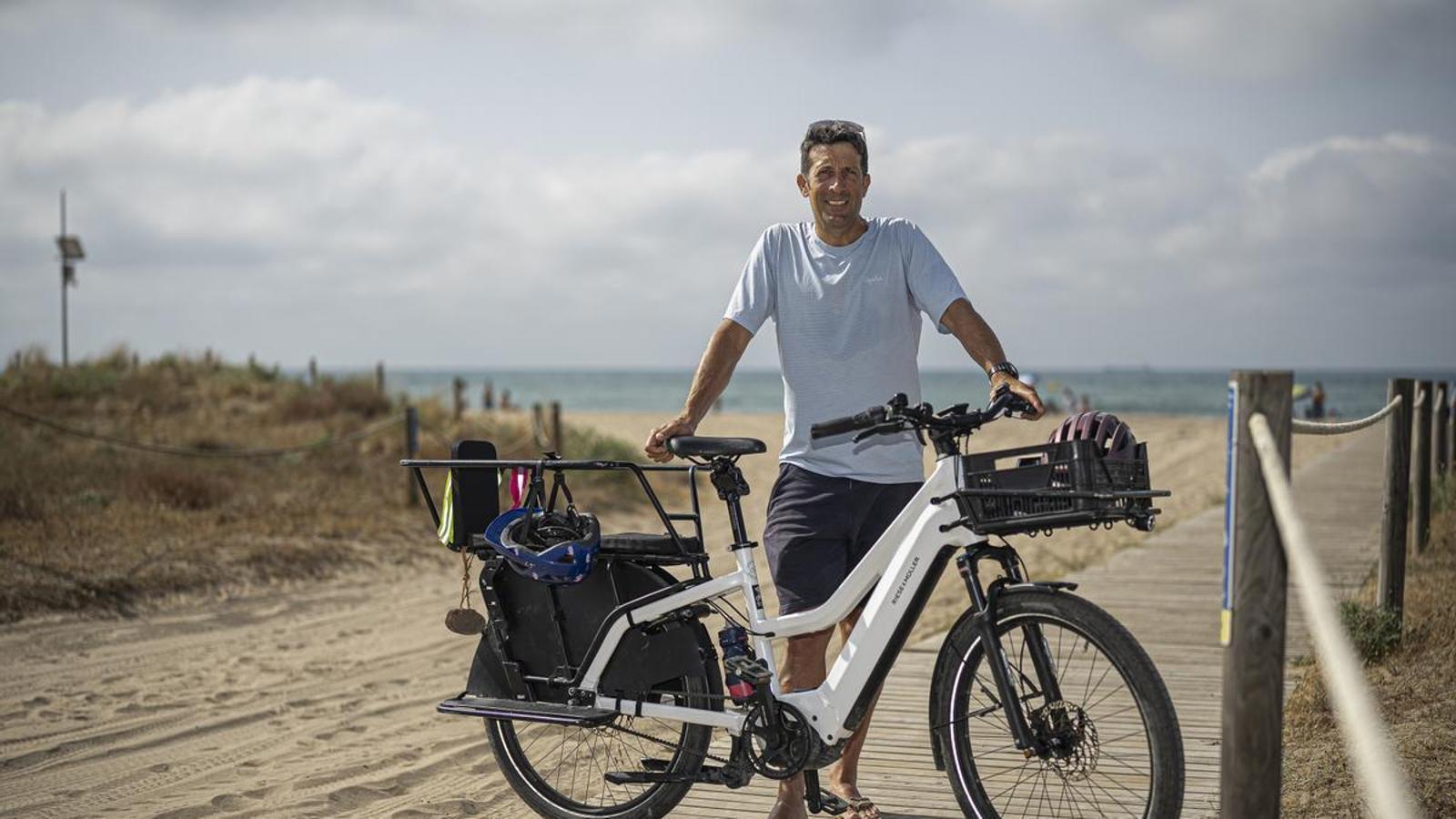
Gavà Mar / CastelldefelsWe arranged to meet at a quarter past nine in the morning in Castelldefels, but I arrive late after an hour of traffic jams on the AP-7 and the ronda de Dalt. The photographer, Pau de la Calle, calls me, a little startled: Juan Antonio Flecha (Junín, Argentina, 1977) has already passed, as his surname indicates, like an arrow, with his two daughters sitting on the back of the bicycle. I catch him just as he has dropped them off at school, in Gavà Mar. From there we will cycle to his house, where a podcast recording awaits him.
Flecha is one of the most unique cyclists of his generation. A specialist in the northern classics, those great one-day races that demand strength, technique, and an extraordinary ability to read the race, he stood on the podium of the Paris-Roubaix three times and won a stage of the Tour de France. But his prestige went far beyond his palmarès: he was one of those riders any sports director wanted to have on their team for his generosity and tactical intelligence. In 2013 he retired from professional sport, but not from cycling. Because if there's one thing he will make clear to me throughout the journey, it's that “a cyclist is someone who lives life with a bicycle, not just someone who does sports”.
And he always preaches by example when he can. When he has to go to Madrid to comment on a race, he arrives cycling to Sants station, disassembles the bicycle wheels, puts it in a special bag, and continues his journey by AVE. For him, combining the bicycle with public transport is the most natural way to get around. “It’s very comfortable. You can even go through security control with the bike. [...] The best thing is that, on the way back, leaving with half an hour’s notice, I always arrive at Atocha on time. Predicting the weather by bike is much more efficient than by taxi”.
Educating children
Today they go with sandals, without lycra and on a longtail electric cargo bike. In the back there is space for the two daughters to sit, protected by some bars. She also has another Dutch-style one, with a wooden box in the front, but these days she hopes to find an unusually sized tire to repair the rear wheel. When she started taking her daughters by bike to school, five years ago, few families were doing it yet. Now it is a much more common sight. She even donated a repair point at the center so that other families could fix minor breakdowns and lose their fear of taking the step.
“When I ask my daughters what they love most, they always tell me the bike,” she reflects. “On the way they see the sea, the birds, they talk and share time that wouldn't exist in the car – she adds–. We grew up with the idea that the only option was the car and my daughters are growing up differently.” In five years at school, they have taken the car a maximum of ten times to go to the educational center, about five kilometers away. Cycling with Flecha means paying attention to all intersections and the continuity of the preferred space for bicycles, because she argues that good infrastructure is key for more people to embrace cycling.

It cannot be understood that the bike lane that follows the coast of Gavà ends upon reaching the Maritime Promenade of Castelldefels. A sign announces it: bicycles prohibited. The lines of the bike lane that was erased ten years ago are still visible. “Now there are four lanes for cars, shared with bicycles, which must watch out for cars parking in a bay. One highway next to another highway – censorship –. It is a step backward in mobility. You cannot tell people they will be safe in a shared lane”.
The future of mobility
Faced with the difficulties within Castelldefels, Flecha gives as an example the reality of Bicivia 7, a metropolitan cycle axis that connects safely through the interior, segregated from cars, with Gavà, Viladecans, Sant Boi and Cornellà. “Both AMBici and Bicivia are changing the reality for many workers in Baix Llobregat, who can move by bicycle or scooter safely to their jobs,” he points out.
We end the conversation where we started: on the bike. Because, for Flecha, cycling does not end when a bib number is hung up. It begins precisely when the bicycle becomes part of all other moments of life.
- The bicycle is... It is everything. A tool to get around that makes my life easier, but also a toy.
- What has it taught you? It still has a lot to teach me!
- And for your daughters, what is it? It comes naturally to them. We go to school by bike every day. We have only gone by car a maximum of ten times in five years.
- Do you get around everywhere by bike? As much as I can. I go from Castelldefels to Sants station by bike and take the AVE to go to Madrid. The same when I take a flight at the airport.
More cycling conversations from the Let's Pedal and Chat series:
- Relationships:

- Heritage:
- Wine and senses:
- Social transformation:
- Life change:
