Isma Garcia: "I consider myself an archaeologist, but of cycling"
Restorer of centenarian bikes and creator of @ferrosambrodes

-
CAT -
CAST
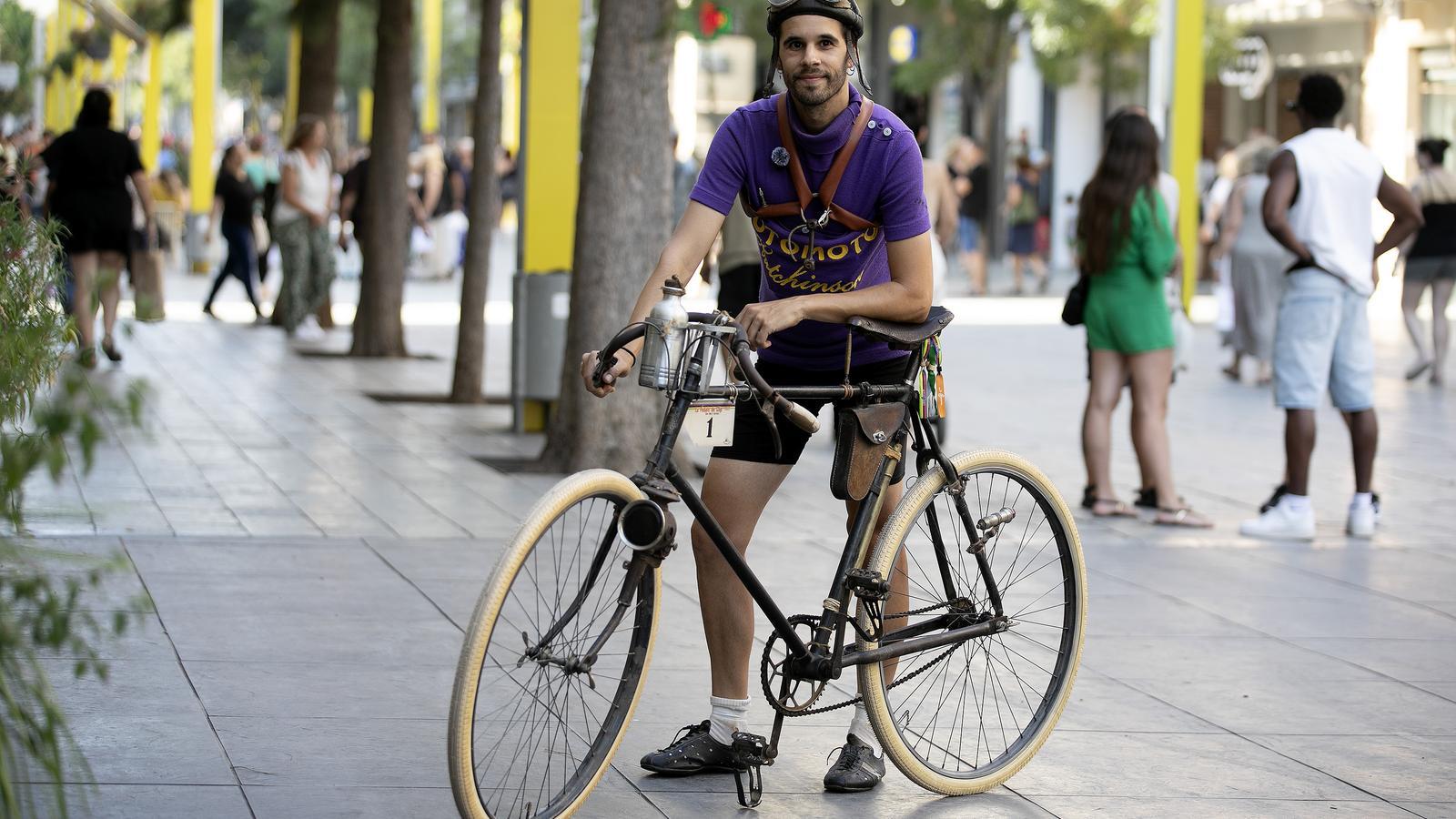
GranollersIt's impossible to cross paths with him and not look at him. Wool jersey, knitted shorts, 1950s cycling shoes, a flat cap instead of a helmet, vintage glasses and a spare camera on his chest. But what draws the most attention is the bicycle. “It's Dutch, from 1908, made of iron and little else. An uncomfortable racing bike in terms of position, without gears and with spoon brakes over the tires, with which I have ridden hundreds of kilometers”. Isma Garcia (Granollers, 1992) has been steeped in cycling since he was very young, growing up in a family linked to the almost centenary Granollers Cycling Club. But it wasn't until his twenties that he began on his own in a hobby with which he has ended up finding a large community on social networks: restoring century-old bicycles.
From the Instagram account Ferros amb Rodes, where he has almost 40,000 followers, he brings old bicycles to life, but also explains what he is most passionate about: the stories behind those who have pedaled them. And perseverance has paid off this year, coinciding with the Grand Départ of the Tour from Catalonia. We met in Les Franqueses del Vallès after frantic days inaugurating two exhibitions in Catalonia due to the passage of the French race. “I am dreaming,” he exclaims. Until September 27th, an exhibition can be visited at the Granollers museum which, through the evolution of bicycles over decades, explains the city's cycling past.
“Rare” bicycles
Today we will travel the route that he takes almost every day from his home to work, from Les Franqueses del Vallès, where he lives, to Granollers. “Every day I come this way and people already know me because I ride different strange bicycles,” he explains, laughing. He avoids saying how many bikes he has at home, but assures that there are many and they are mostly distributed among family and friends. “In the end, with this type of bike, when you go for a ride on a path like this, an old one, through the middle of the countryside, it's like transporting yourself to the past – he reflects –. It's like traveling in a time machine”.
Garcia looks at the surroundings with the glasses of the past. We imagine the streets of Granollers full of bicycles until the mid-20th century. “At first, the bicycle was a luxury, but very quickly it became an everyday thing, to the point that one had to pay a tax, the arbitris, to be able to cycle on some paths and roads”. It was the toll of the time, for practical purposes. But what also impresses him is seeing the impact that the Tour had in the fifties and sixties in the area. “It was very common for many young people to take their father's touring bike and turn the handlebars upside down, to make it more competitive”.
Of the centenary bikes, he is struck by the “authenticity” they had compared to today’s. Made in a family business, which often passed from fathers to sons, and designed above all to last a lifetime. He explains this as we take a walk around the Plaça de la Porxada in Granollers, from the 16th century, destroyed during the Civil War and later rebuilt. We are about to enter the Granollers Museum, where decade by decade from the 19th century we can understand how bicycles have evolved. “These bicycles are over a hundred years old and are still working without us having done practically anything to them – he relates with enthusiasm–. They have an aesthetic and a love put into the product that I find to be a very unique thing”.

For example, we see the first prosthetic seat already in the 1880s. How the chain was invented and was a true revolution to democratize the bicycle. Or a jewel of cycling from the thirties that already had it all: gear change, a puncture-proof ring and even a small tap with oil to lubricate the chain while pedaling. The lights, like the one Garcia is using, also have their charm: a candle with a spring protected by glass so as not to go out. “They said they were just to see you before you had the accident,” he says ironically.
The passage of the Tour de France has once again put Granollers on the cycling map. Garcia, however, hopes that the legacy will go far beyond photographs and closed roads. “The Tour happens in a day, but what really matters is what remains afterwards,” he argues. For him, the best way to honor the history of cycling is not just to preserve it in a museum, but also to see it every day on the streets: with more children and young people going to school, more people commuting to work, and more bicycles becoming part of everyday life. Because the best way to preserve this heritage is not only to restore it, but also to continue writing its history, pedal stroke by pedal stroke.
- Your first cycling memory? Going out with friends to ring doorbells, getting lost on trails and in forests, and customizing our bikes.
- What does pedaling mean to you? Beyond being a vehicle, the bike, for me, is a form of expression, an art.
- What has it taught you? That beyond balance, it's a tool for fun, adventure, and freedom.
- And professionally? It's giving me many opportunities. I started as a hobby, and social media has given me a community.
More conversations from the Pedalem i xerrem series:
- Relationships:

