Javier Gurruchaga: "With Camilo José Cela I shat myself a little, the truth"
Singer, actor, presenter

-
CAT -
CAST

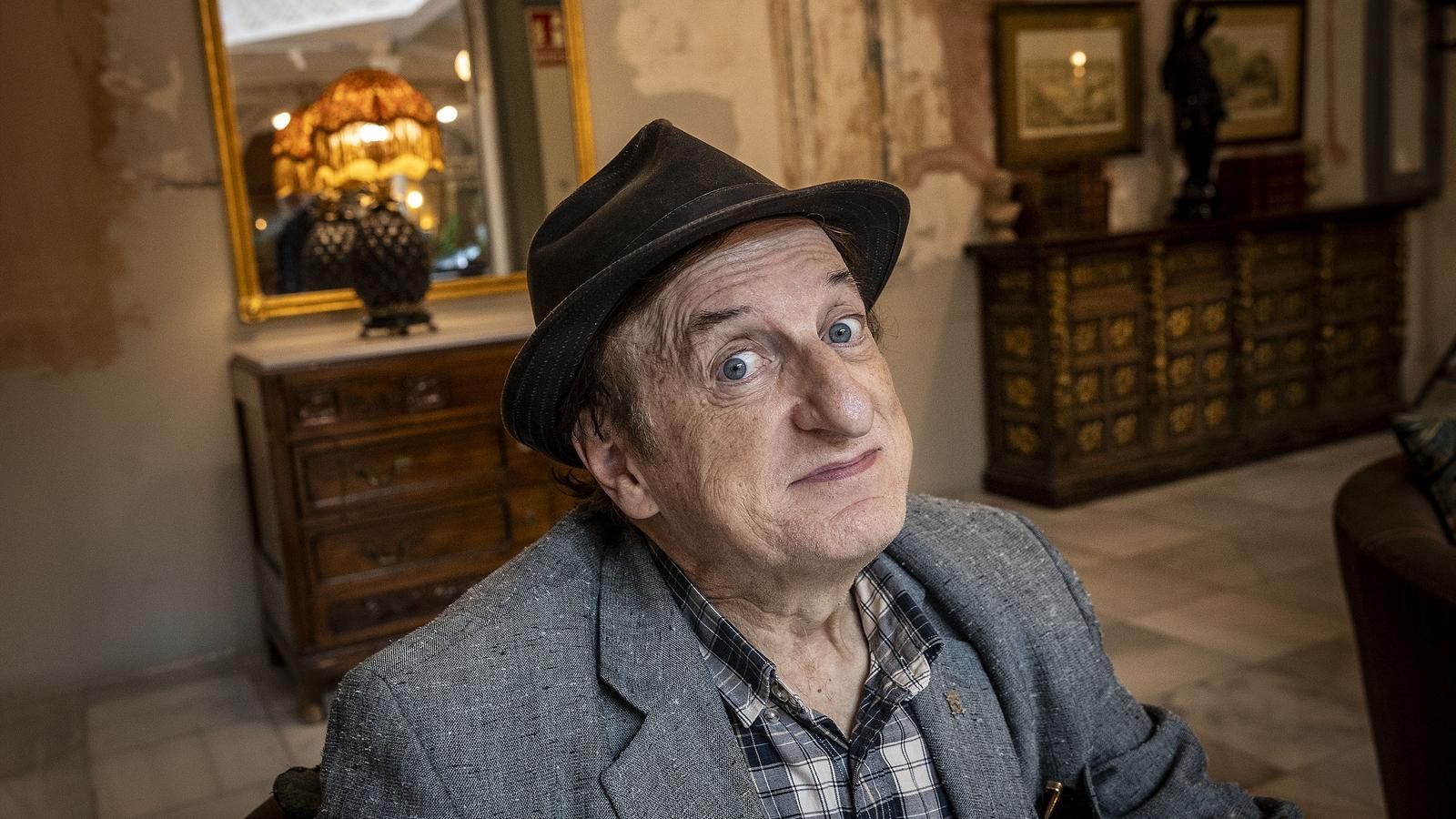
Since he contains multitudes, he doesn't know which photo he has on WhatsApp: he claims he changes it constantly and shows me several from the last few weeks. Javier Gurruchaga celebrates the half-century of his Orquesta Mondragón –named in honor of the town where the most famous psychiatric center in the Basque Country was located– with a concert at Razzmatazz on October 23rd. Despite the histrionics that accompany his public figure, in private he claims to be less eccentric than people think. In any case, he has left his mark on the world of entertainment, music, television, and cinema.
How does the son of a cook and a railway worker become an orchestra conductor?
— I had to pull my own chestnuts out of the fire from a very young age. At fourteen, I was already working as a bellboy at a bank and paying for my own studies, because my parents couldn't. We were very poor, that is the truth. And I wanted to study philosophy and letters, study music, solfège, saxophone... I kept going like that until at 18 years old it started with Mondragón and I was able to leave the bank.
What do you remember about this foundational moment?
— Well, a lot of excitement to do things, to entertain. I was a real clown. On a radio station, we did a very fun jam session in which we parodied the Elena Francis advice column. And that's how we started, 50 years ago.
Half a century that you will celebrate in Barcelona with a performance at Razzmatazz. Do you think the humor aspect has gone against how the band has been valued?
— I think humor helped! It can happen that, after many years of doing humor, this confuses things a bit. But mixing music, humor, and improvisation was the key to success from the beginning.
I do not know if the most purist critics were looking down on you.
— It is true that, later on, a part of the critics became a bit silly. But those are fixations of the second-wave critics. I am a musician and I like rock, blues, pop, but I also like theater, silent cinema, parody, and we have done a thousand tributes to all of that. Sometimes the lack of rigor of many of these critics makes me laugh, because I find them opportunistic. What is trending now? What is in fashion? There is a lot of nonsense.
You have mentioned the great classic genres of popular music. Do you listen to current music?
— I barely listen to the most recent one. It doesn't excite me, to be honest.
As you said, you are multifaceted. But I would say that there is an axis that weaves through all your work: the vindication of difference. Do you agree?
— Well, I don't know... I have always been in favor of what is irreverent, different, iconoclastic. In those years we were coming out of a dictatorship, so people wanted that, too: they were tired of censorship, and that helped us catch a good wave. We were a group that broke the mold and went against the grain.
What I wanted to ask you is if you feel different.
— I am not as eccentric as they say. They are little labels of characters that you create, but then one ends up having a more or less normal life. I like Chaplin, Buster Keaton, Lon Chaney, Todd Browning... and I put all of that into my songs, but that doesn't make me someone strange, does it?
La Mondragón made a ton of albums in the 80s and 90s, but in the last few decades production has slowed down a lot. Is it hard for you to release albums now?
— The thing is that few records are sold and it is more expensive... The release is spaced out, the moment is chosen very well. The market has changed a lot!
Who is going to an Orquesta Mondragón concert in 2026?
— There is a bit of everything. Those who are of our generation, but also the children and some of the grandchildren, even. It keeps renewing itself. It is always appreciated that this music reaches other generations, just as in its time music that came from very far away arrived, be it Sinatra, Presley, or the Beatles. We should not create closed compartments. We must be open to the past. We always ask for the newest, the newest! And many times the newest is a mess. Not everything, eh? I respect some individuals, who are there.
You were part of a legendary children's program: La bola de cristal. It was anarchist, critical of television, cinephile, imaginative... Were you aware that you were making history?
— There was Lolo Rico, the director of the program, and people like Alaska, Radio Futura... My part allowed me to pay a lot of homage to the cinema. That was where the breeding ground was created for what would later be the program Viaje con nosotros. But La bola de cristal did indeed show that children were not stupid, on the contrary. Nor were adults. We realized that we were making a television very different from the one that was made back then. And from the one that is made now, too.
From Travel with us I remember an unforgettable moment...
— Oh, quite a few, quite a few. There was a double for Felipe González, or, well, perhaps we should call it a third [the actor was 122 centimeters tall]. A Joglars sketch with the Moreneta, the interview with the guy from Martes y Trece playing Mick Jagger... They tried to get us censored, but Pilar Miró was true to her word. She kept it and broadcast all the agreed-upon programs.
In any case, I was referring to when Camilo José Cela explained that he was capable of absorbing a liter and a half of water rectally and challenged you to bring him a basin to prove it right there.
— I was a bit scared there, to tell you the truth. I had a bad time, because I thought he really wanted to do it.
Could a program like that be made today?
— There is too much censorship. If you step a little out of line, they tear you apart. These are more difficult times for lyricism.
Are you more afraid of censorship by politicians or by social networks?
— That of the human being, that of society. Now we are in a whole in which we censor ourselves a lot, and we ourselves think everything over more times.
Do you self-censor?
— Yes, yes. You go out into the street, you want to please the general public, and you hold yourself back a little.
But you have taken a stand. Against ETA, for example. Did doing so bring you problems?
— Yes, these more serious things create certain discomforts for you. But in 50 years many things happen, and I am not obsessed with this subject, precisely. I have limited myself to focusing on work, putting my heart into preparing new songs, doing more shows and more films. Of some I have very good memories and others, well, let's say they were for sustenance, just to get by. The rest are anecdotes.
Along with other celebrities you were a victim of the Arny case, in which a great media circus was set up over a network of child prostitution that in the end exonerated practically everyone. How long did it take for this wound to heal, once the judge archived the case?
— It is a subject that I do not usually touch on in interviews, I am sorry. No comment.
Let's return to the Orquesta, then. Before you were talking about how it had benefited from the young people's desire to overcome the stuffy atmosphere of Francoism. Some young people nowadays, rather, are reclaiming the figure of the dictator.
— I do not have this very sympathetic opinion that some young people have about Franco. One must inform oneself. And one must abandon ignorance a little and really find out about the things that happened. To have a more objective view. I disagree with it, of course.
You had an apartment in Barcelona for many years, specifically on the Rambla. When you walk there today, do you recognize it?
— Ah, no. My Rambla has nothing to do with this Rambla, which is constantly under construction and plastered over, so touristy. There is another type of public, another anxiety. It is not lived in, nor looked at, nor enjoyed the same way. Many ugly construction works and few newspaper kiosks. That is why when I come I take refuge in this hotel, the Oriente, because it is the same as always. And I filmed a sequence there, here, for Vicente Aranda. It was very good. I played a paralytic.
