Clara Molins: “To do television you have to have a somewhat well-furnished head”
Journalist. Presenter of 'Nervi'
-
CAT -
CAST
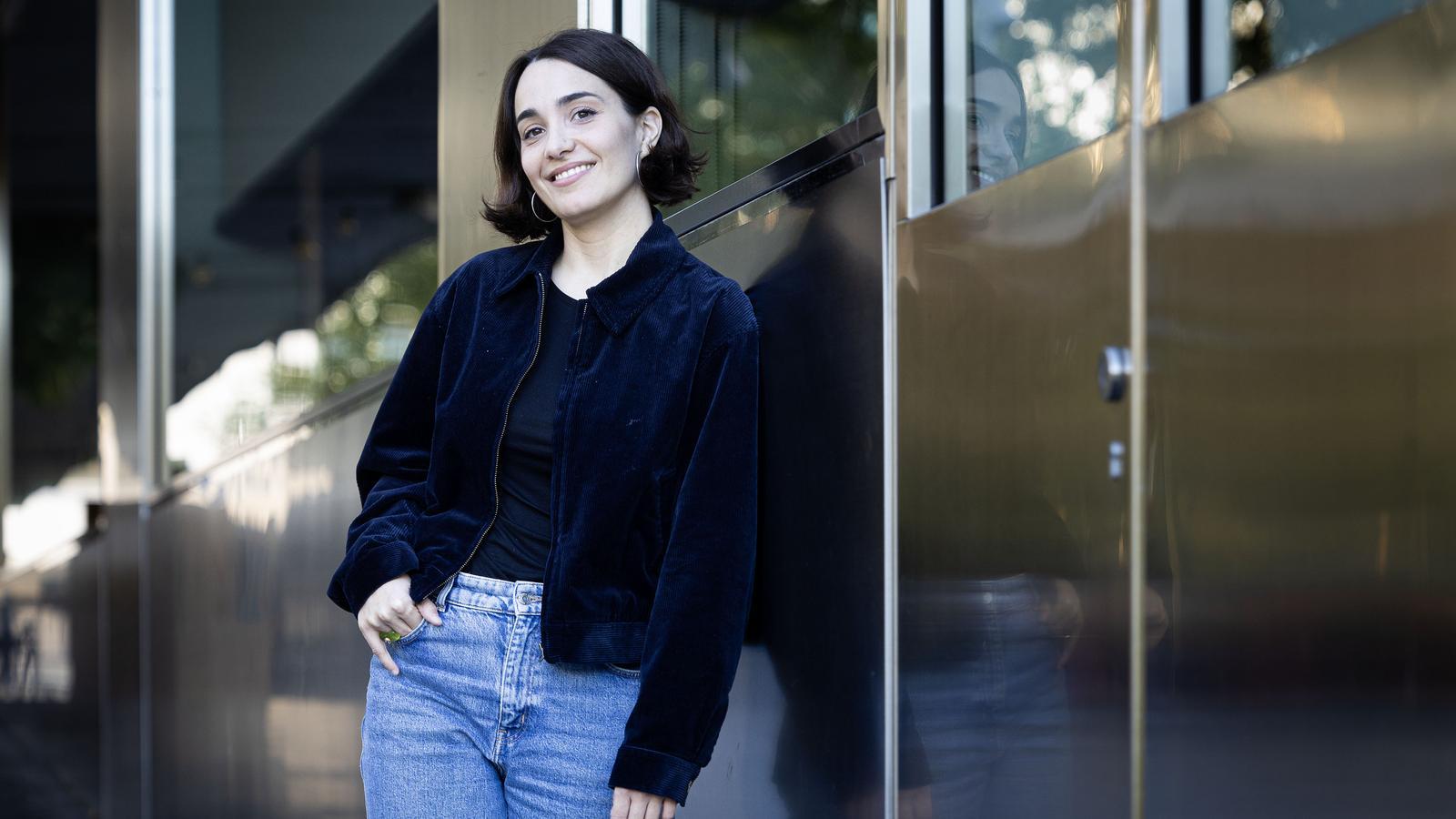
BarcelonaSince this season, Clara Molins (Sant Feliu de Llobregat, 1989) is the host of Nervi, the reference cultural program on 3Cat. The journalist has taken on this project after seven years as part of the team for Via lliure, the weekend show on RAC1 presented by Xavi Bundó, where she served as deputy director for three years. Molins also has a second facet as a singer and musician, as she is part of the band Rombo.
You have been at the helm of Nervi for two months now. How has the landing in television been after so much time in radio?
— It is very stimulating because I am learning a new way of doing journalism. Until recently, the most important thing was the voice, but now there is a new dimension which is the image and what you express, both bodily and with the scripts, which must be able to be translated visually. All this is something I had little experience with, even though for two years I was on television, first at 8TV as a news editor and then at the FAQS of TV3. I had always wanted to do cultural journalism, but I had never had the opportunity due to professional circumstances that you do not quite control.
How do you reach the program?
— A casting was held and I did it because they proposed that I do it. I was very happy in my job at Via lliure on RAC1, with a director whom I admire and consider my mentor, Xavi Bundó. Xavi Bundó. I was not planning on changing jobs, let alone from radio to TV. To me, radio is the best thing in the world. I thought that by trying it I had nothing to lose and that, besides, they wouldn't pick me for anything in the world. But they did pick me, and the idea of doing something new seduced me. At the radio, I was doing relative on-air work: I was mostly organizing, and now I felt like defending a script I had written myself, being able to conduct an interview that was my own.
The visual part of this new job implies that now not only do you listen to yourself but you also have to see yourself. Is it a strange process?
— It is very strange to see how you speak, move your hands... One of the things I really like about this program is that I can be myself; it is what is expected of me. In the moment of seeing yourself, you discover things about you that you were not aware of; some things you don't like at all and with others you are more in agreement. You have to come to terms with this part that wasn't there before. On the other hand, for me the whole sound aspect had always been very important because I really like doing and listening to the radio. And, of course, on TV, the entire treatment of the voice is not as relevant, because there is the whole image and the viewer has much more information. This is something that I miss, because sometimes I would like the voice to have more presence.
You were part of the FAQS team, which was always in the spotlight. Is the pressure you feel now different from the one you experienced with that program?
— There is a big difference, for me it has nothing to do with it. The FAQS was in the middle of the independence process and in the middle of repression, too. It was very sensitive, many people watched it, it had an exorbitant audience. Furthermore, it was a live program and with an audience. It was not easy to do anything on FAQS. In this sense, Nervi is much friendlier. It is recorded, it is done very late at night and it does not have this factor of dealing with absolutely controversial topics when there is a very large political division in the country.
You were mentioning the schedule for Nervi, which is quite late because it usually starts at 23:30, if not later. Is there a lack of a more determined commitment to culture on the part of 3Cat?
— I think the fact that a program like Nervi exists is already a commitment and a victory. It has recovered a bit of the spirit of the old cultural programs on TV3, such as Silenci, which were innovative, groundbreaking, and inspiring. This alone seems to me a commitment to celebrate. And before Nervi there was Marcians, and we also have Tot el temps del món, which is now presented by Andrea Gumes. Then there are the balancing acts that the television management has to perform to place a program like Nervi, which has an intellectual demand, even if there is an entertainment component. It is a space in which there is cultural conversation linked to social conversation. If I were the director of TV3, it would be very difficult for me to say where we fit this program or to know who the audience watching it is. I believe that now the interest is primarily in the platform and for the format to have a shelf life outside of a specific time slot. I understand, at certain hours it is also difficult for me because I am sleepy.

Each broadcast of Nervi has a thematic common thread and reflection around it. Do you go a bit against the grain of current cultural consumption, which is increasingly fast?
— We try and I hope we succeed! We try to look for new voices and people who expand our way of thinking about the world. We don't want to be obsessed with the audience or with the reel that will come after, nor be conditioned by this influencer gaze that is permeating everything. Our distinctive point is to give another perspective to the interviews or to the people who come to the program.
Could you have made this program ten years ago, for example?
— I couldn't have done it a decade ago because to do TV you have to have a fairly well-settled head. Some time ago I was younger, more inexperienced, and more immature. I don't want to belittle the Clara of the past, whom I respect a lot, but I feel that now I can do some things that I wouldn't have been able to before. I can also do it now thanks to the team at Nervi, which has taken great care of me and is a very favorable environment to be able to do something that later has repercussions.
Television has a higher degree of exposure than radio. Have you found that you receive more comments now?
— Before, people would make comments to me, but now people give their opinion on physical appearance, which is something you cannot change. Like it or not, that affects you. It is important that you are sufficiently armored so that a comment cannot make you waver. You achieve separation from external judgment when you are a little older. When you are young, you are much more fragile in that sense.
Do you think we are experiencing a regression regarding the judgment of others' bodies?
— I do not know how to diagnose exactly why it is happening, but I think it is also a regression of feminism. I have the feeling that those of us who are feminists are also a bit disoriented. There were things that were assumed and incorporated that now, suddenly, no longer seem so important. I do not know if it has to do with the far-right and that discourses end up being contaminated even if you are progressive or whatever you want to call it. There is a general state of opinion that causes things that were once shielded to no longer be so, such as the representation of women in the media.
You are part of a music band, Rombo. Does knowing the country's cultural fabric firsthand make you very clear about the problems within the culture?
— Wow! The fact of having done something cultural and artistic like music I think gives me a different perspective, which perhaps brings me closer to the people I interview. I delve into my own experiences as an artist to try and approach an interview with someone else who is also involved in this in some way. It is quite an experience that should also help me as a journalist.
Is it easy to combine both facets, journalist and musician?
— No. To do anything artistic you have to be accustomed to doing it, you have to have a space. It is not like going to an office to keep a schedule. You have to be in a kind of inspiring or creative bubble and believe in what you are doing. And when you are not in that mental state, creation feels very far away. Then, of course, you have to prioritize: either you work as a journalist...
Or you are a rock star.
— Yes, or you're a rock star. And, besides, I am a mother now and it's complicated, demanding and exhausting. Right now we have put the band aside because it wasn't sustainable. Rombo is an independent music band and we couldn't dedicate ourselves to it professionally in any way, nor was it the intention or the philosophy. You make music for many other reasons than to be successful, although being successful is also very good [laughs].
In an interview with L'altre barri on Catalunya Ràdio you said that motherhood has very boring moments. Do you stand by that opinion?
— Motherhood is exciting and wonderful and my son is the best in the world, the funniest, happiest, and smartest guy on the planet, but, gosh, there are phases where communication is complicated and a bit boring. It's just like that, and that's okay. And going to the park is a drag. And going down the slide 300 times isn't very cool.
The first years are so consuming that often the cultural life of parents disappears. In your case, this is a problem.
— For my current job, I can't afford that, I have to be connected. If I didn't have children, I would be everywhere and I wouldn't miss any party, but it's impossible. I have to prioritize a lot which exhibition, which movie, or which concert I go to see. I have a pact with my partner to try not to give up this part of our professional life. And I also think it's a way to lead by example: it's good for our son to see that his parents are people with cultural interests, beyond just being parents. Now that he's a little older, between babysitters and grandparents we balance things out. There are people who find it very good to shut themselves in the cave of motherhood and I respect that very much, but I need to do things that reach me and move me.
Your mother and your brother are painters. Were you somehow destined to be linked to culture?
— It is possible. My mother is an extraordinary painter and has painted large-format pictures all her life. But beyond that, at home they have transmitted to me a sensitivity for art and for looking at the world in another way, or in a non-obvious way. My mother always explained that when my brother and I were drawing and we made a mistake or made a stain, the stain was a beautiful thing or an opportunity to do something different. I believe that this is part of our education, which has been very wild and very unconventional.
Very free?
— Very free. My parents have never asked me if I had studied or how I was doing with my homework. As a child, I went out partying very early and I was also very responsible. They haven't monitored me or judged me for the things I did. I really appreciate it and I find it extraordinary, especially since I became a mother. It is impossible to have as open a mind as my mother.
