How does the technology behind train safety work?
Behind the alphabet soup of acronyms like ASFA, LZB and ERTMS there is a complex framework of systems that regulates and protects railway circulation in Catalonia and the rest of the State
-
CAT -
CAST
BarcelonaBroadly speaking, railway safety rests on three technical layers that are often confused: blocking, interlocking, and protection. After the accident in Urda, Toledo, it is worth explaining them.
Blocking divides the track into sections, called blocks, and in each block there can only be one train. Interlocking is the brain of each station: it prevents a signal from opening to green if the switches are not properly set or if the route conflicts with another, just as a traffic light at an urban intersection does not give way simultaneously to two crossing streets. Finally, the automatic train protection, ATP (Automatic Train Protection), is on-board equipment that monitors the driver and brakes the train if they skip a signal or exceed the permitted speed. Blocking decides which signals open; the ATP checks that someone respects them. The so-called ATO (Automatic Train Operation) does not protect but rather drives: it accelerates and brakes between stations like an automatic gearbox, but always supervised by an ATP.
AVE, Rodalies, FGC and the metro
On the Adif network, the state manager of the tracks, systems of different generations coexist. ASFA (Automatic Signal Announcement and Braking) is a Spanish system that acts as a backup throughout almost the entire network. Emitter beacons placed between the rails transmit to the train what the signal indicates; if the driver does not confirm that they have seen the warning, the emergency brake is activated. It only monitors specific points, because between one beacon and the next it does not look at anything.
In contrast, the LZB (Linienzugbeeinflussung) supervises continuously thanks to a cable laid between the rails that communicates the control center with the train via magnetic induction; today it is only found on the Madrid-Seville AVE (where it seems it failed on Wednesday) and on the C-5 in Madrid. The current European standard is called ERTMS (European Rail Traffic Management System) and has two levels in service: at level 1, beacons give a movement authorization each time the train passes over them; at level 2, the communication is continuous, via the GSM-R railway radio.
In Rodalies de Catalunya, no line yet operates with ERTMS in commercial service: they function mostly with the conventional system: lateral signals, automatic block signaling, interlockings (in the process of being renewed for electronic models), and ASFA as protection. The first line to adopt ERTMS will be the R1 between L'Hospitalet and Mataró, precisely the one that will be assumed by the brand-new joint company Generalitat/Renfe.
Ferrocarrils de la Generalitat (FGC) follows another path. On the Barcelona-Vallès line, an ATP using speed codes monitors the train's progress, and since December 2022, ATO has been operating there, with a driver in the cab. The Llobregat-Anoia line, less modern, has its own system, but FGC is preparing the transition to CBTC (Communications-Based Train Control), the same technology as the metro, based on radio. The AESF only supervises FGC trains when they circulate on the Adif network, but the Catalan railway safety agency provided for in the Catalan Railway Strategy does not yet exist.
In the Barcelona metro, lines L1, L2, L3, and L5 combine ATP and ATO with a driver. The L4 is the only one that is driven entirely manually, only with ATP. The L9, L10, and L11 lines run without a driver using the aforementioned CBTC. This system is closed and specific to each manufacturer, unlike ERTMS, which is interoperable and allows trains from different operators to circulate on the same network.
When the main system falls
The weak point is not the variety of systems, but the occasional breakdowns: when the main system fails, the train runs in the so-called degraded mode, with a less demanding backup system and more human intervention. On the Adif network, if the LZB fails, as it seems to have happened on Wednesday, the section shifts to lateral signaling block, with trackside signals and the ASFA as onboard protection. Even older is the telephone block, where the officials of two consecutive stations "grant" the track to each other by phone; it works (until recently, on our R3 line), but safety depends on people's discipline.
A delicate moment is the transition between sections with different systems. High-speed trains carry equipment to read ASFA, LZB, and ERTMS, and when moving from one to the other, the driver must acknowledge it and the level of protection may drop. The best-known case is that of Angrois: on July 24, 2013, an Alvia train derailed while traveling at 179 km/h on a curve limited to 80 km/h; 80 people died there. The final section was in an ASFA zone and the onboard ERTMS was disconnected. The Railway Accident Investigation Commission (CIAF) concluded that the ERTMS would not have limited the entry speed into the curve, because the limit the system was monitoring at that point was 200 km/h; the 80 km/h limit of the curve only appeared on a sign.
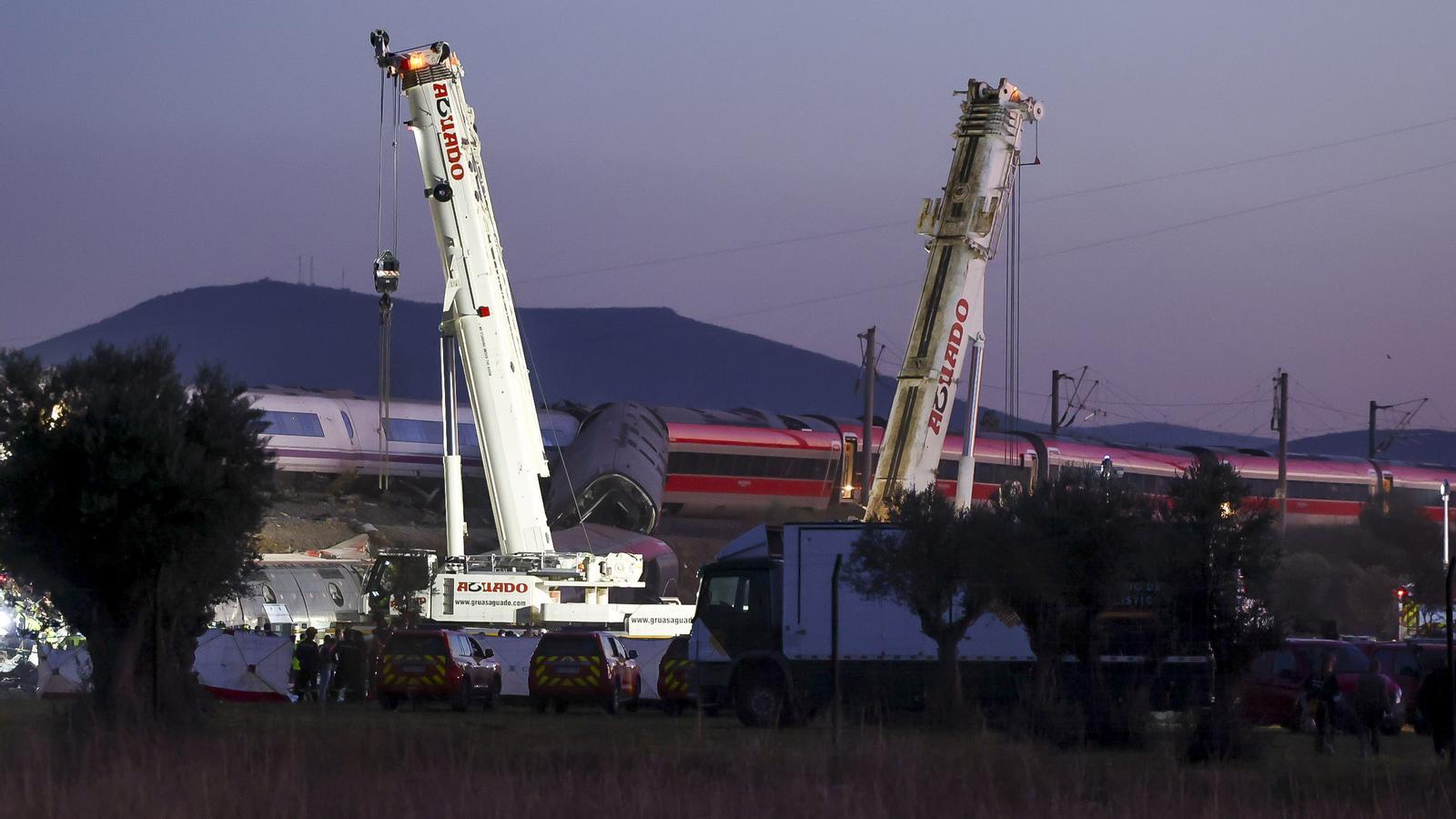
In the case of Toledo, the investigation has just begun. Around 8:30 a.m. on Wednesday, according to the ministry, the section's LZB control system went down due to a communication failure and the trains stopped. Adif switched to lateral signaling block with the ASFA as a backup system, but the Atocha control center authorized –in a decision that Minister Puente described as "inexplicable"– to resume traffic normally, even though the procedure limited the speed to 40 km/h. The Renfe AVE train rear-ended an Iryo train stopped on the same section: the provisional death toll is already around 70. The Independent Administrative Authority for the Technical Investigation of Accidents (AITAT), which has replaced the CIAF since July, considers it too early to put forward hypotheses.
On the other hand, an anecdote illustrates the physical vulnerability of these systems: as a spokesperson for Prysmian, a cable supplier company, explained to 3Cat, many of the most recent copper thefts on the railway network specifically affect signaling and control cables, which operate at low voltage and are easier to steal than the high-voltage catenary ones.
It should be noted that not all recent accidents have to do with protection systems, which do not detect a broken rail or the collapse of a wall. In Adamuz (Cordoba, on the same Madrid-Seville AVE line as last Wednesday's collision), on January 18, an Iryo train derailed and entered the adjacent track, where an Alvia train was circulating: 46 people died there. According to investigators, the rail broke before the Iryo passed. In Gelida, on January 20, a wall from the AP-7 collapsed onto the R4 track and killed a trainee train driver.
The regulations are coming at their own pace
The general calendar is set by Brussels: a European regulation requires ERTMS to be in place on the core network by 2030 and national systems such as ASFA to be withdrawn between 2040 and 2050. On the Madrid-Seville line, the scene of the last two major disasters, the level 2 ERTMS was awarded to Thales in September 2021 with a deadline that expired at the beginning of this year, but we are already in October and it is still not the primary system. When it arrives, it will already be too late.
