Instagram and LinkedIn, great pending subjects of digital Catalan
Accent Obert has mapped the presence of Catalan on the internet with 342 tools and web services: only 99 have a Catalan version, but there are some that are widely used and the traffic-weighted coverage reaches 42%

-
CAT -
CAST
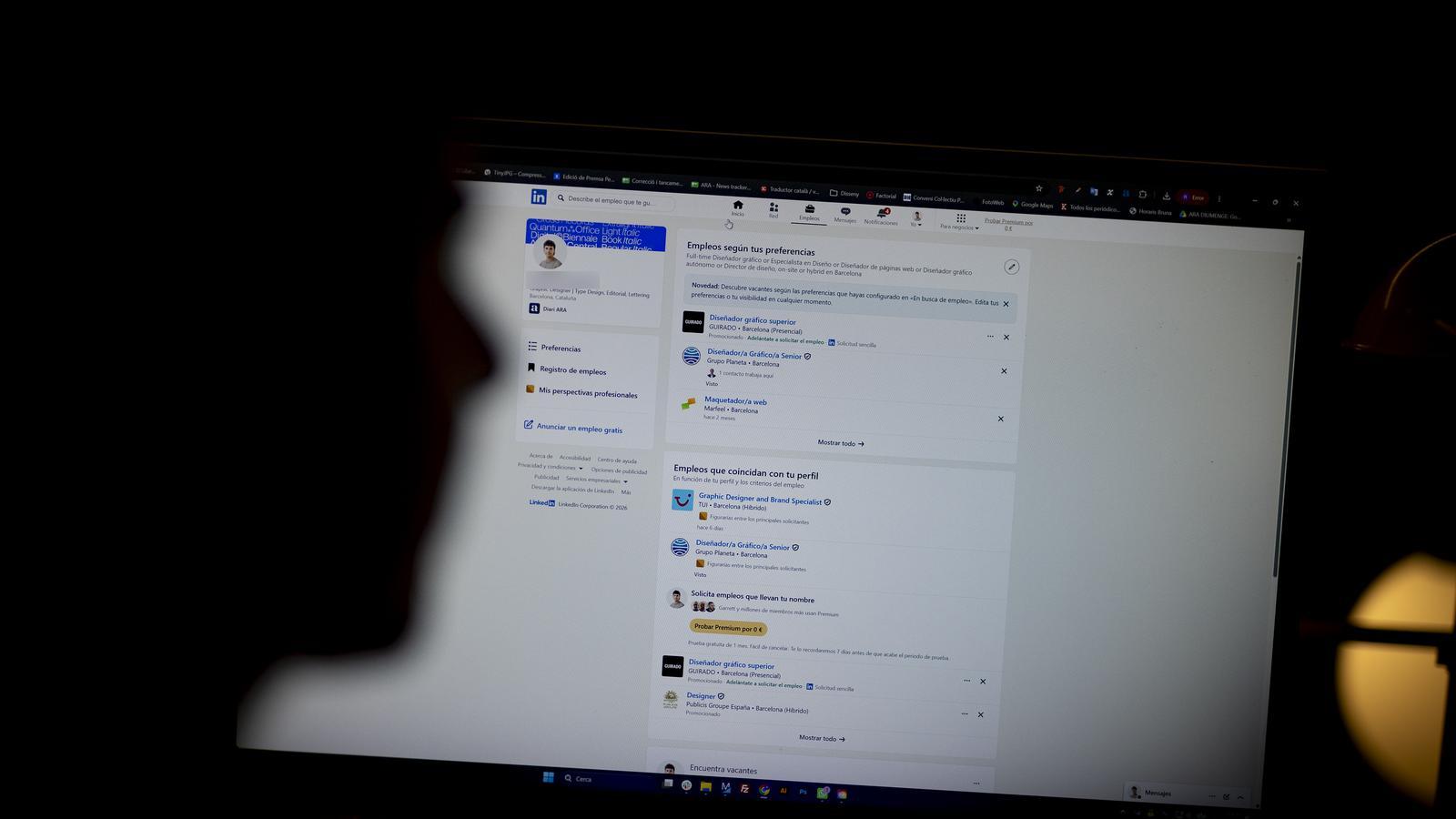
BarcelonaWe can rent an apartment, send an email, check a map, or listen to a podcast in Catalan with coverage close to 100%, because the most used tools in these cases already have an interface in our language. On the other hand, we cannot look for a job on LinkedIn, use Netflix in Catalan, learn languages from Catalan on Duolingo, or edit a video with CapCut: in these four use cases, the coverage is 0%.
The figures come from the Galaxy Report, published this Wednesday by Accent Obert (AO) based on the galàxia.cat directory, an open and free catalog of applications and web services available in Catalan that the organization has been promoting with Softcatalà since July 2025. The report published this Wednesday is not limited to inventorying what exists: it also identifies what is missing. Of the 70 use cases measured, 17 exceed 90% in Catalan, but 25 have none at all.
99 tools in Catalan out of 342
The AO study analyzes 342 web tools, distributed across 70 use cases (such as sending an email or looking for a job) grouped into 11 categories. Only 99 –less than a third– offer an interface in Catalan, but fortunately among these are Google, WhatsApp, Canva, and Microsoft Office, which is why the traffic-weighted coverage reaches 42%.
The categories, however, hide the contrasts. According to AO, 42% is the average of the 11 areas, and the calculation made for this report based on the report's tables shows that each category is, in turn, the simple average of its use cases. Digital communication marks 72.3%, but this figure mixes the 97.9% of email with the 2.7% of communities and discussion platforms, where only Substack has Catalan and Reddit, Twitch, Discord, and Quora are left out. It is worth saying that, calculated directly on the 70 use cases, the average is 42.25%, almost identical.
Among the most favorable cases, housing and real estate (Idealista, Fotocasa, and other portals) reach 100%, territorial viewers 99.4%, podcasts 99.2% (Spotify concentrates 96% of the traffic), office software 99%, and classroom dynamization, with Google Classroom or Padlet, 98.5%. Email, encyclopedias and dictionaries, flight search engines, and web browsers also exceed 96%.
Among the weakest cases, the 0% does not correspond to marginal tools, but to the leaders of each use case: LinkedIn concentrates 81.4% of the traffic of employment portals, Duolingo 61.5% of language learning, CapCut 60.3% of video editing, Netflix 57.3% of streaming platforms, and Trello 36.5% of task management. Reddit, with 66% of discussion communities, is also left out. In social networks, the 68.8% coverage is mainly due to Facebook (42% of traffic), while Instagram (24.7%) and LinkedIn (6.5%) do not have Catalan. Within the same category, the distances are large: Canva has Catalan and CapCut does not; ChatGPT and Gemini have it (the large language models reach 93.3%), but programming assistants like GitHub Copilot remain at 0%.
How it was measured
For each use case, the report analyzes the five most used tools (up to 342 in total), because a few services concentrate the majority of usage. They are web tools, accessible from the browser and mostly free or freemium. Hardware, downloadable software, operating systems, network infrastructure, and applications that only exist for mobile are excluded. There are some paid exceptions, like Netflix, which have been included because excluding them would have distorted the result of the use case.
Each tool goes through four successive filters: the multilingual strategy (single language, 2 to 5, or 6 or more), the number of European languages of a similar size to Catalan that it incorporates (such as Czech or Finnish), the presence or absence of Catalan and, if it exists, the degree, from superficial to the full or native version. This distinguishes significant gaps—tools that already translate the interface into comparable languages while leaving out Catalan—from those that have a technical explanation.
Weighting is decisive: each tool is weighted according to its monthly visits within the use case. In music streaming, Spotify accumulates 50% of the traffic and Deezer 1.4%; counted equally, each tool would be worth 20%. Since three of the five tools have full Catalan support and account for 88% of the traffic, the use case scores 88% and not the 60% of a simple count. The applications that are reviewed have been chosen based on two criteria: that they correspond to the use cases with the highest or lowest coverage, and that they have a relevant traffic weight within their case, according to the report.
The panorama is not complete. Leaving out mobile applications has a cost, because today they concentrate a good part of citizens' usage time; the report admits that this especially affects health, well-being, and sports, a sector dominated by mobile apps that only reaches 7.9%. As we have explained many times in this space, it is always preferable to access services via the web rather than with an application, both for privacy and neutrality, and in this sense, the authors' criteria should be applauded. Another limitation is that traffic data is global and not just from Catalan-speaking territories. Even so, it is the first diagnosis of this scope: according to the authors, until now there were no specific studies on digital tools in Catalan nor a global map of the ecosystem. Their conclusions provide valuable clues on how to continue advancing: combining the approach to hegemonic platforms –Instagram, LinkedIn: get ready!– with support for local developments that include our language.
Recommendations
The report proposes three complementary lines of action. The first is advocacy regarding leading platforms with high technical viability, measured with an index from 0 to 100 that is calculated based on the multilingual strategy and comparable languages they already incorporate. The report cross-references this with traffic volume to prioritize them and specifies that it does not measure the actual capacity for influence over the company. LinkedIn tops the list, followed by Reddit and CapCut, Netflix (paid service, outside of immediate priority), Instagram, Duolingo, Trello, WeTransfer, and Strava. Duolingo is, according to the report, the most relevant gap in qualitative terms: it is a platform that allows learning Catalan from other languages, but not other languages starting from Catalan.
The strategy has precedents. Twitter (June 2012), Spotify (October 2022), TikTok (April 2023), ChatGPT (May 2024), Copilot (September 2024), Gemini (November 2025), and Substack (March 2026) have added Catalan, and each incorporation of a leading platform suddenly reaches millions of users without making them change their habits.
The second line of action is the development of local projects of manageable scope and investment, such as task management or personal productivity, which could be promoted in a hackathon or challenge format. The report also recommends it for monolingual tools or those with a very limited multilingual strategy, where Catalan is unlikely: rather than pressuring the company, it is advisable to explore local alternatives or intermediate solutions. Other gaps, such as language learning or professional video editing, require much more investment and are medium- or long-term projects. The third is the periodic monitoring of the diagnosis, to record progress and detect new gaps.
(Note: Albert Cuesta collaborates with Accent Obert on several projects regarding digital Catalan, but has not intervened in the preparation of the Galàxia Report).
