Fine threat to 'Directa' for revealing the identity of undercover police officers
Four agents achieve that the Spanish Data Protection Agency estimates their claim

BarcelonaTo censor a dozen of its website articles and a fine of 7,000 euros. This is the claim of the Spanish Data Protection Agency, which has initiated proceedings against the publication Directa for a series of reports in which it revealed the identity of National Police agents infiltrated in social movements. Four members of the corps have appealed to this body and, after their claim was dismissed, a request for reconsideration has led to this proposed resolution.
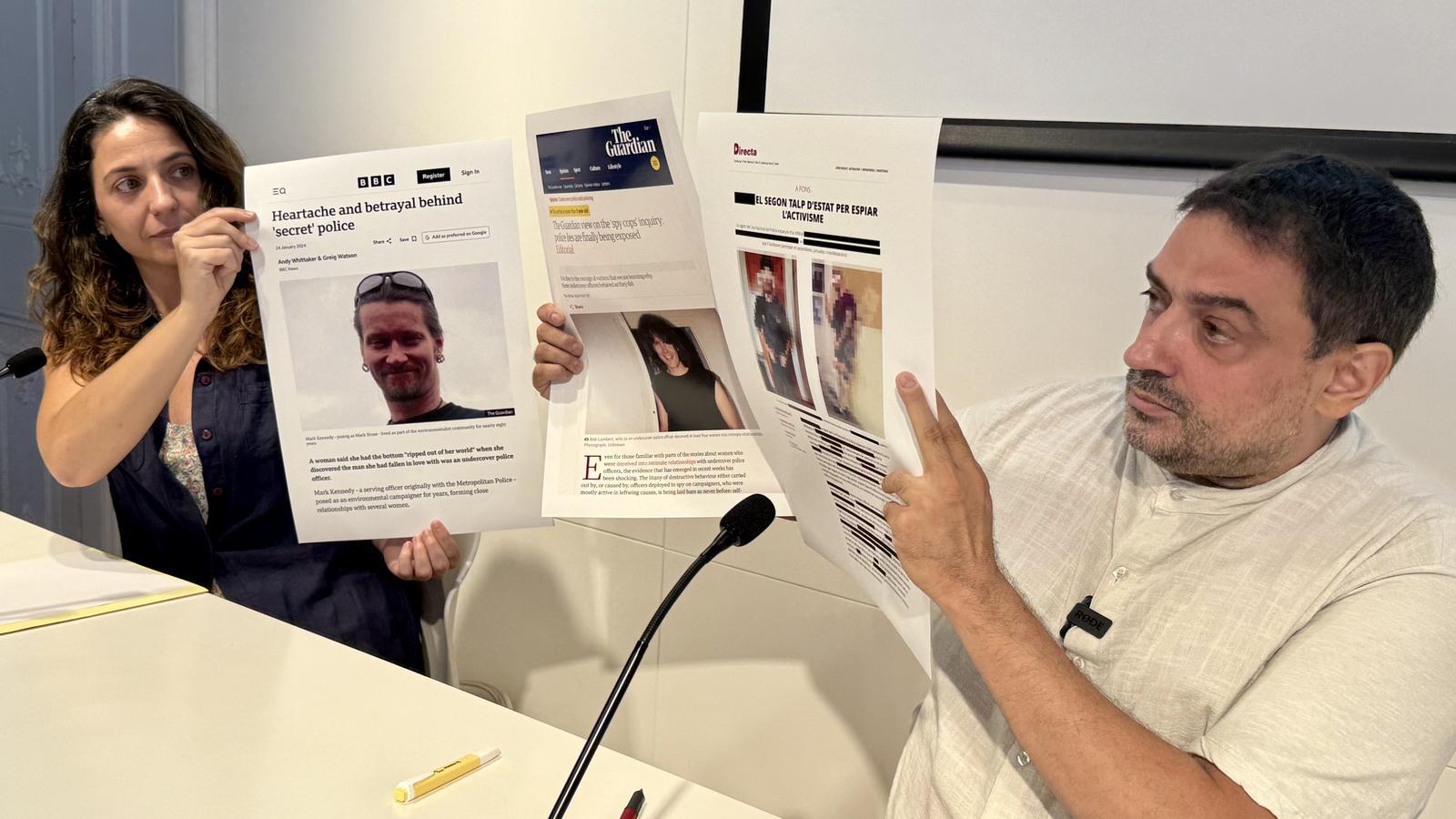
The College of Journalists hosted a press conference this Wednesday in which Jesús Rodríguez, a journalist for Directa, assessed the case accompanied by lawyer Sònia Olivella from Irídia and Elisabet Borreda, co-president of the Barnils group. "They give us three months to censor ten articles by deleting not only personal data, but also the fictitious ones they infiltrated with, and pixelating faces and tattoos," explained Rodríguez. The publication will present allegations within the three months it has available.
In the opinion of its defense, there is a fundamental fact: the six police officers who were exposed over three years were not agents acting under judicial cover to investigate a specific crime, but rather intelligence agents, a figure that has no specific legal cover in the State and which has been denounced by social movements. This difference in the status of the agents means, according to Olivella, that it makes no sense for the Spanish Data Protection Agency to prioritize their privacy over the right to information. "They are public servants and, therefore, precisely because they must be able to be scrutinized, the legal system specifies that they enjoy less privacy," he recalled.
The participants in the press conference contrasted the opacity of the Spanish State with the response of the United Kingdom when a similar infiltration case was discovered: a Truth Commission was established that has investigated from 1982 to the present day and the documentation collected by the police in a spurious manner has been handed over to those affected. The identity of the agents remains published in the country's media. In fact, the case of Directa could be a lever for new pressure actions through this channel: several media outlets and individuals have already received information requests from the Agency in relation to this case. TV3 dedicated a 30 minuts to these infiltrations, explaining details of the police officers involved in the operation.
Directa has presented a manifesto on its website and has launched a campaign to collect signatures and subscriptions to face the legal expenses of its defense. Borreda, from the Barnils group, framed this sanction proposal within the so-called Slapp, for its English acronym: judicial actions that do not seek victory in the courts, but rather to instill fear and wear down journalists. “Every hour lost defending oneself is an hour the journalist is not investigating,” he concluded.
