You have an André Ricard design at home and perhaps you do not know it
An exhibition at the DHub reviews six decades of the career of the pioneer of industrial design

-
CAT -
CAST
BarcelonaIf you want to build a private collection of objects designed by André Ricard (Barcelona, 1929), you don't need to spend a fortune: some can still be found in supermarkets. For example, the container for Norit delicate laundry detergent and the Orion anti-moth clips. Others, such as the Eivissa light switch and a Moulinex orange juicer with a transparent jug, are also part of many people's daily lives. The collection could continue with the Tong ice tongs and perfume bottles for the Puig house, with the famous Aigua de Lavanda at the forefront. And with a few other objects, such as the Compact tableware, the Copenhagen ashtray, and the Tatu lamp.
"The greatest reward for a designer is to see how one of their designs becomes timeless, and turns into a classic," says André Ricard in one of the quotes included in the major exhibition dedicated to him by the Disseny Hub Barcelona (Dhub) until March 14, André Ricard. Design in use. "The most perfect design is that in which the form itself fulfills the function: a spoon, a button, or a simple nail. In our consumer society, we have lost respect for these objects that surround us and help us," he says in another quote.
Of French family origin and with a contemporary vision, Ricard is considered one of the pioneers of industrial design in the State. He discovered design in the international context of the fifties, and from a young age, he felt drawn to everyday and essential objects. In the institutional field, he was one of the founders of the Industrial Design Association of the Foment de les Arts i del Disseny (ADI-FAD) and, subsequently, promoted its integration into the International Council of Societies of Industrial Design (Icsid). Currently, Ricard is 98 years old and continues to think about pending design problems: recently, he canceled his newspaper subscription due to the difficulty of turning the pages.
It seems that the curators have had a dual objective: to celebrate Ricard's six-decade career and, at the same time, for the public to realize that good design is what makes life easier. "Good design is what goes unnoticed; that is to say, if we do not realize that there is a person who has designed that object, it means it is perfectly designed –says Marina Povedano, the exhibition's curator together with Arnau Pascual–. In André's case, if an object is well designed, you will not wonder who made it". "In all of Ricard's designs, one same conception is recognized: that of design as a service, in which form is subordinate to function and well-resolved objects are integrated into the habits and affections of those who use them. This practice is complemented by a solid intellectual dimension", points out the designer Jordi Blasi in the book, which the Association for the Study of Furniture has published coinciding with the exhibition.

André Ricard. Design in Use is a co-production with La Fábrica that could be seen in Madrid during the last edition of the Madrid Design Festival, where it received some 30,000 visitors. In Barcelona, about 140 objects are included, twenty more than in Madrid, thanks to the Dhub collection. The organization is inspired by an exhibition that Ricard himself held in Switzerland in the mid-90s, so the objects are distributed according to the spaces of a supposed home. For example, in the bathroom there are the bottles of Denenes children's soap, also from Puig, whose caps are designed to keep the little ones entertained in the bathtub, as well as the cologne and perfume bottles. "If his great concern was that his designs be used, it seems a bit contradictory that he was making bottles for perfumes. But what he explains very well in his writings is that, since a perfume is invisible, the bottle speaks for the perfume, so when you see the bottle, you can understand if it is your style, if it fits you. And in that sense, it is indeed useful," recalls Povedano.
For Ricard, the commercial success of a design is important. "An idea that Ricard promoted a lot is the communication between the company and the designer. If the company does not communicate well to you what it needs and what it is looking for, the designer will always do it wrong. And he says it clearly: you must understand the commission and what problem the company has. In this sense, he explains what happened to him in the case of the Aigua de Lavanda bottle, which the company could not market, even though it was a success, because of the artisanal way in which it was made. If you understand this, the design you create will work. It's that easy. But you must have that prior conversation with the company," adds Povedano. Within this aspect of commercial success, the Aigua de Lavanda bottle was a great milestone: Puig could not market it because the artisanal production of the flask did not satisfy demand, and Ricard evoked the authenticity of a handmade product with a smoked glass bottle and a wooden cap with a wicker ribbon.
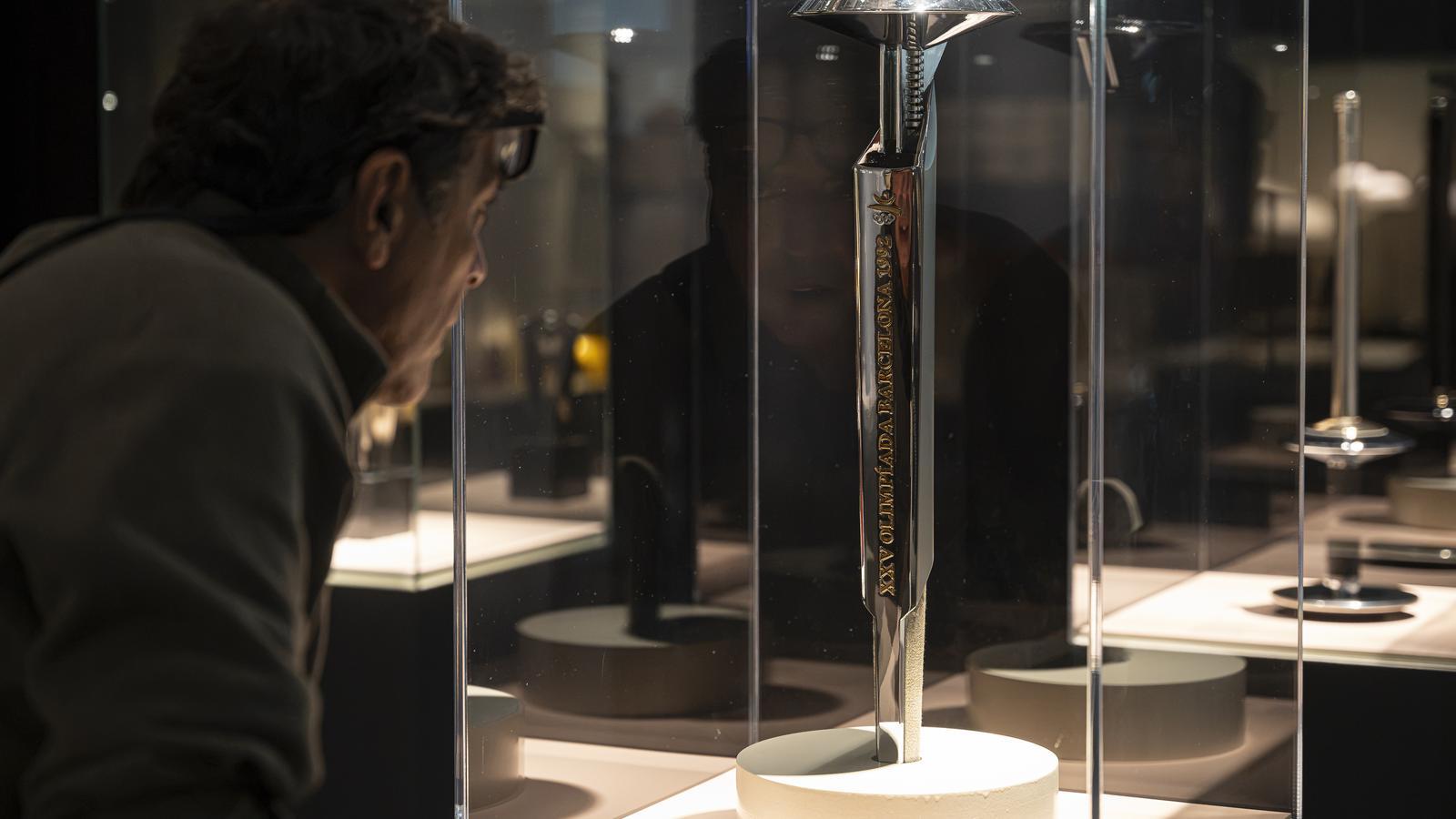
In Barcelona, the exhibition incorporates a new area featuring books written by Ricard and some lamps he made for the now-defunct brand Metalarte, unpublished until now. Further on, one can see the array of designs he created for the Barcelona Olympic Games, among which the Olympic torch and the wooden box that contained the bid dossier stand out. And, finally, Ricard himself takes the floor through Poldo Pomés' documentary André Ricard, the invisible design.
