Dancing 70 kilometers from the war: this is how Eurovision has been lived in Tel Aviv
The public screening of the festival gathers hundreds of people and turns the competition into a soft power apparatus
-
CAT -
CAST
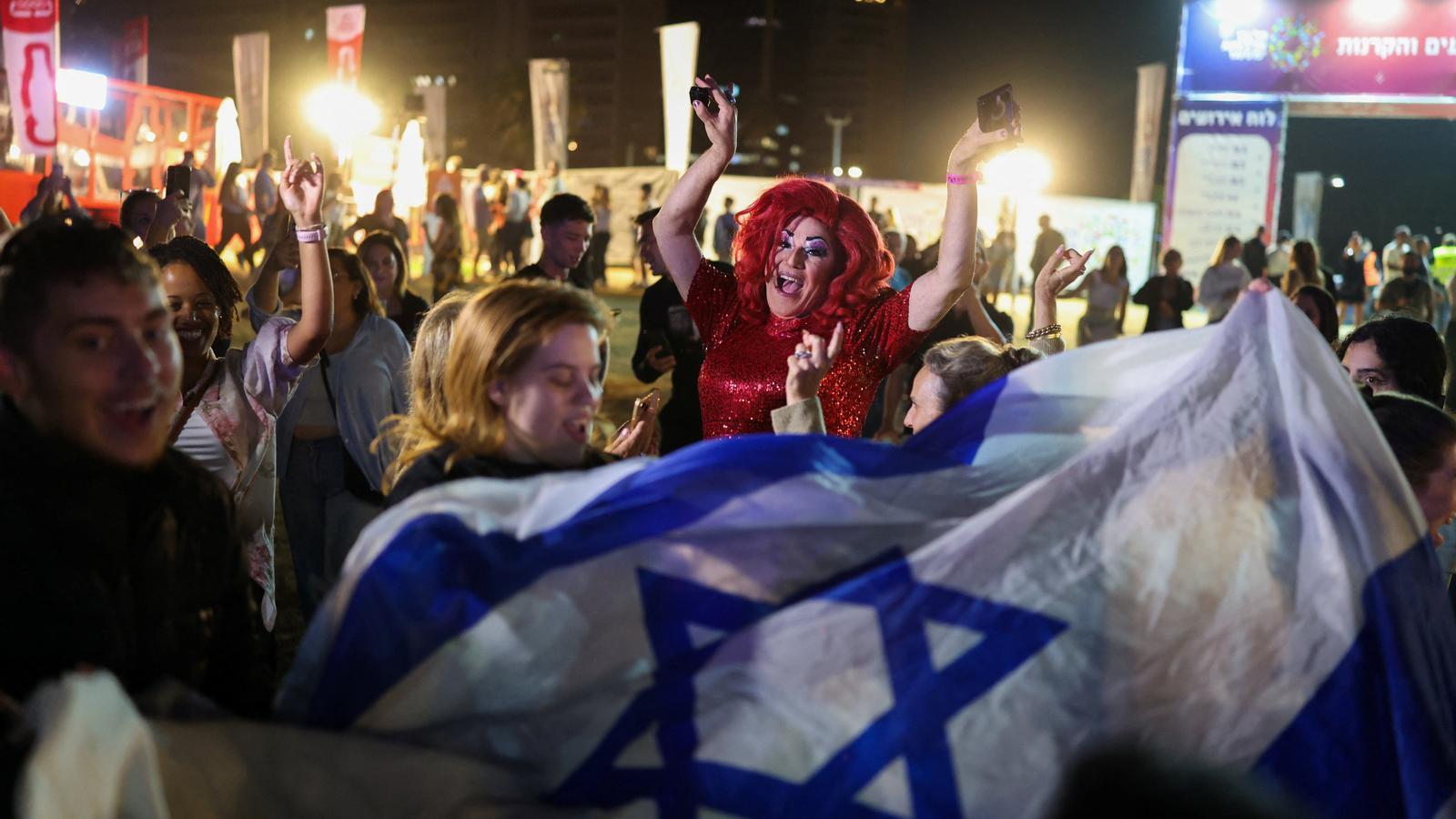
Tel AvivBy the sea, between giant screens, beers and groups of young people wrapped in the flag, the public viewing of the Eurovision festival seems, at first glance, a Mediterranean pop celebration. Four large screens, food trucks, contests, a vip area and merchandising have been set up outdoors in the space dubbed Tel-Aviv 360. But the musical euphoria coexists with another reality: Eurovision has become foreign policy, propaganda, national pride and a symbolic battle over Israel's international legitimacy.
On the promenade, hundreds of people followed the festival this Saturday amidst shouts,
selfies and songs. When Noam Bettan, Israel's representative this year in Vienna, appeared, the public erupted. Many of those watching the contest seated stood up. “It’s not just a song. It’s showing that we are still here,” said Atam, a young man wearing a headband with hearts and the flag. “In Europe they want us out of everything: Eurovision is one of the few places where we can still be,” he added.

The location of the viewing was not by chance. Tel Aviv's waterfront is a key part of the Israeli international narrative: modernity, tourism, and Mediterranean normality. It is the same waters that, less than 70 kilometers to the south, look towards Gaza, where the military offensive continues. To the north, the border with Lebanon remains active. And in recent days, Israel has been preparing for a possible resumption of attacks on Iran.
To Israel, virtually no one hides that Eurovision is a soft power tool. According to an investigation by the Almost a matter of state
In Israel, practically no one hides that Eurovision is a soft power tool. According to an investigation by the New York Times, the Israeli government has allocated more than 900,000 euros to digital campaigns, international promotion, and mobilization of televotes during the last editions. Some Israelis have admitted that, in recent years, the contest has almost become a matter of state. Ziona Patriot, the artistic name of the drag queen in charge of presenting the screening, summed it up like this: “I believe that politics and music should not be mixed, but I am a Zionist and this contest has become a demonstration that we will continue here. If there are countries that do not want to participate, I don't care. We will continue to participate”.
During the broadcast, the presumed absence of politics lasted little and at certain moments the country's situation was recalled. For example, when the Danish representative, Soren Torpegaard Lund, inaugurated the competition. Then, one of the presenters of the Israeli public television commented that he was "his friend", since the singer had shared on Instagram a photograph of a computer with a sticker that read “FCK HMS”.

In this context, Israeli participation has once again faced the controversy of televoting. Although there is no evidence that Israel has used bots or system manipulation, some eurofans have rushed to claim that the country's positive results are thanks to manipulation. “When various countries vote for each other, it's normal. When Israel receives support, it's manipulation –protested a young woman–. There are many pro-Israel people in the world. Why is it so hard to accept it?”
After the last edition, several European public televisions demanded access to the detailed voting data, but they did not succeed. Instead, the European Broadcasting Union ended up introducing new rules to limit massive promotional campaigns and reduced the maximum number of votes per user and payment method from 20 to 10. All of this was intended to reduce the noise around televoting, but the feeling of dispute has not disappeared.

When Bulgaria was proclaimed the winner, the promenade fell silent for a few seconds. “We’ll win next year”, said a group of young people as they left. In Israel, Eurovision has become a permanent battle for narrative: between the image of a country that wants to project normality and a world that increasingly looks at it through the filter of conflict.
