How geology has conditioned the history of humanity
From the fertility of the Nile to the energy of coal and oil, geologist Esther Lapaz vindicates the role of the Earth in the destiny of civilizations
-
CAT -
CAST
Our history can be explained through kings, wars, revolutions, and great inventions. But it can also be explained through the stones, sediments, volcanoes, and minerals that have conditioned human life throughout the centuries. Without all the resources that the Earth offers, many of the great civilizations would not have been possible. And without the geological processes that transform it, our history would have been very different. This is the perspective proposed by the geologist and popularizer Esther Lapaz, who invites us to retrace the past of humanity through geology in her new book Con los pies en la Tierra (Ediciones B, 2026).
Her journey begins with the first signs of human activity that we find on the planet: stone tools made during the Lower Paleolithic. "Hominids struck one stone against another to obtain fragments with sharp edges with the goal of breaking bones and cutting meat," explains Lapaz. A simple technology that allows for better utilization of available resources.

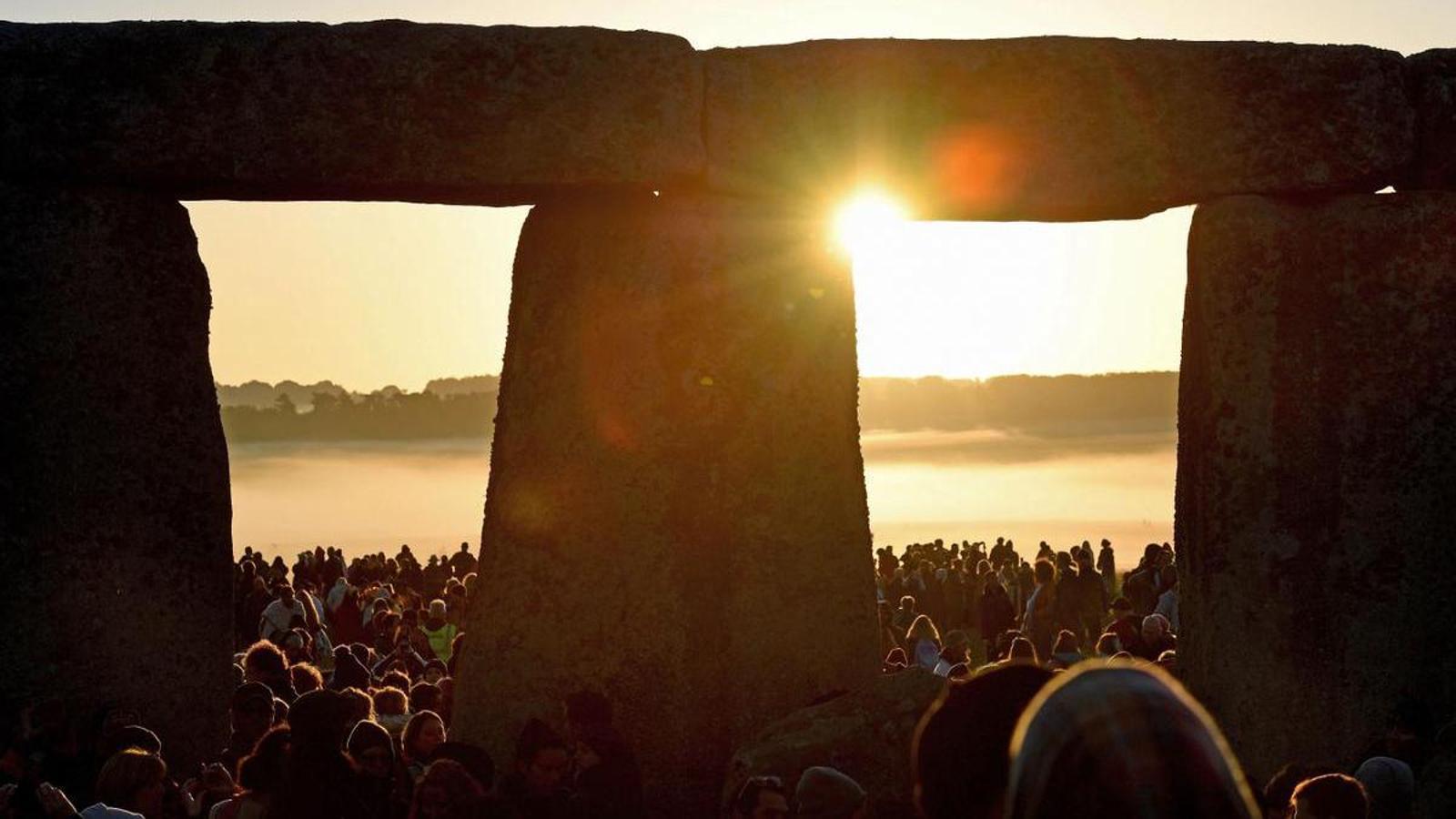
With the Neolithic, polished tools begin to have a greater presence, while human societies experience a decisive transformation: the transition from nomadism to sedentarism. In this context, megalithism also emerges, a cultural phenomenon that endowed the territory with meaning through stone monuments. The best-known cases would be Stonehenge, the Carnac stones, or the Antequera dolmens.
The relationship with Earth's materials becomes even more evident with the development of metallurgy. During the Bronze and Iron Ages, “humans learn to process mineral ores in furnaces to obtain metals with which to manufacture tools, weapons, jewelry, ornaments, and agricultural implements,” continues the geologist.
Creation of civilizations
One of the clearest examples of the influence of geology on human history is Ancient Egypt. When we think of this civilization, the pyramids, the pharaohs, and the great monuments come to mind. But before the monumental constructions, there is an essential material condition: the ability to produce food.

“Egypt sits on a large alluvial plain, that is to say, a terrain that has been formed by the accumulation of sediments transported by a river, the Nile,” explains Lapaz. These sediments provide nutrients and contribute to making the soils fertile, favorable conditions for the development of agriculture.
The consequences go far beyond food production. “When a society is capable of producing more food than it needs to subsist, it can generate surpluses,” points out the geologist. This allows not everyone to have to dedicate themselves to agriculture and for other trades to appear, such as artisans, merchants, or priests. In this way, the sediments contribute to creating the optimal conditions for the development of an increasingly complex society and, ultimately, of the Egyptian civilization.
Natural alterations
But our planet does not only offer the resources that allow societies to prosper. It can also radically transform the conditions in which we live. Volcanic eruptions are an example of this. Some have devastating local consequences, while others can alter the climate on a global scale.
The eruption of Mount Vesuvius in 79 AD buried cities such as Pompeii and Herculaneum and caused numerous deaths. It is one of the best-known episodes in the history of natural disasters, but it is not the only example of how geological processes can affect human societies.

In 1815, the eruption of Tambora, in Indonesia, had repercussions far beyond the volcano's surroundings. “The large amount of sulfur dioxide injected into the stratosphere formed aerosols that cooled the climate for years across the planet,” explains Lapaz.
History is also linked to the great environmental changes that have affected the planet for millennia. Lapaz reminds us that we are currently in an ice age, the Cenozoic, which began approximately 34 million years ago. “When we hear the word ice age we imagine sub-zero temperatures and kilometer-thick layers of ice covering the entire planet,” she explains. However, during an ice age there are glacial and interglacial periods: moments when large masses of ice expand and retreat, respectively. “Today we are in an interglacial period, the Holocene, which began about 11,700 years ago,” the geologist recalls.
Precisely the beginning of this favorable climatic period coincides with great transformations in human societies and with the expansion of agriculture and sedentary lifestyles during the Neolithic.
Stones that speak
Geology is also present in elements that we often observe without thinking about their origin. During the Middle Ages, transporting materials from one place to another was not an easy task. For this reason, when large buildings like cathedrals were erected, a good part of the rock blocks were extracted from quarries located near the construction site. In the book, Lapaz talks about the cathedrals of Santiago de Compostela, Florence, and Notre-Dame. “Each one is built with local rocks and they tell us a different geological story,” he notes.

Something similar happens with the pigments used for painting throughout history. Since prehistoric times, humans have turned to insects, plants, and minerals to obtain colors. “Ochres, formed by iron oxides and hydroxides, were already used to paint cave walls,” he explains. Over time, other minerals were incorporated, such as malachite, which was crushed to obtain a green pigment; cinnabar, a mercury mineral from which a red pigment was obtained and which, when heated, could release toxic mercury vapors; or lapis lazuli, coming from the mountains of present-day Afghanistan, which allowed for a highly prized intense blue. “Nowadays, pigments are synthetic, but I think it is important to be aware of where we come from,” remarks Lapaz.
Energy consumed
If there is a geological resource that has completely transformed contemporary civilization, it is fossil fuels. Coal and oil have been decisive for industrial and technological progress, but their origin reminds us that Earth time and human time cannot be compared.
“Mineral coal comes from plant remains buried in swampy areas, while oil is formed from the accumulation of algae and plankton on the seabed. In both cases, we are talking about organic matter subjected to geological processes for millions of years. The problem is that we have spent in a sigh, two centuries, the energy savings that the Earth has been accumulating for millions of years,” she laments. Therefore, the geologist believes that we must apply the same ingenuity that has allowed us to take advantage of coal and oil to find renewable and less harmful alternatives for the environment.
Land of other worlds
Geology, however, does not end on our planet. Astrogeology expands this perspective towards other bodies in the Solar System and allows us to study landscapes and processes that turn out to be very different from those of our own home. “Geologically speaking, the Solar System is a very diverse neighborhood,” explains Lapaz. Among the phenomena detected are cryovolcanism, or ice volcanoes, on satellites like Triton; seas and rivers of liquid ethane and methane on Titan, and possible underground oceans on moons like Europa, Ganymede, or Callisto. But all of that is another story. Perhaps one day we will be able to write it too.
