Al·lèrgiques al Pol·len: "We decided to take out all the shit and that, in a minute and a half, people could understand what is happening to us"
Musical group. Publishes the album 'I never wish it upon you'

-
CAT -
CAST
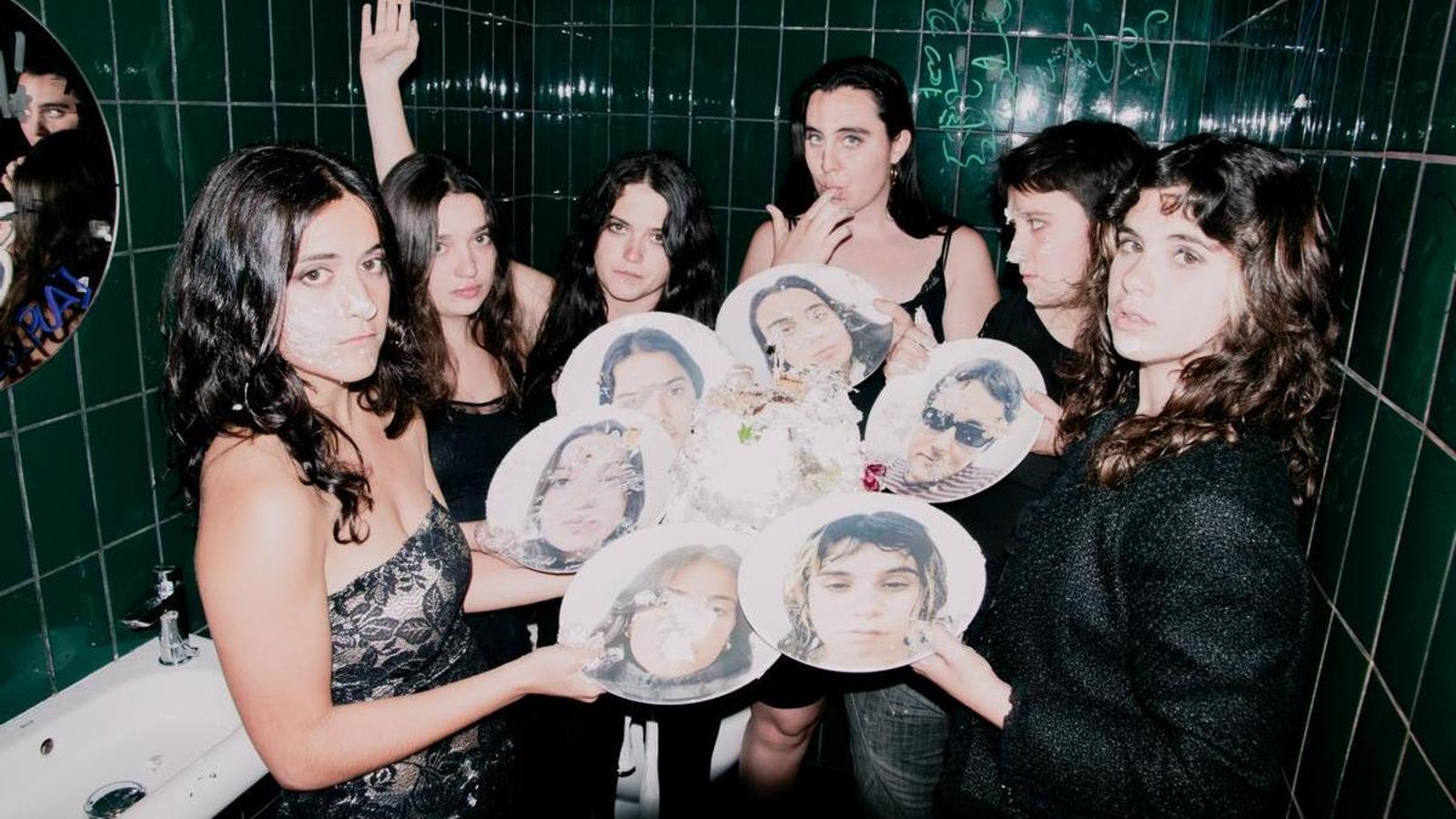
BarcelonaThe leap forward experienced in the album No t'ho desitjo mai (Montebello, 2026) is considerable and consolidates the commitment to indie rock of the Barcelona group Al·lèrgiques al Pol·len. Attentive to the international musical present, they propose a conceptual album that begins with the possibility of the end of a relationship, but which also travels the streets of Barcelona and the rooms of desire, and gives space to the rage against the stereotypes that have accompanied them. About all of this, and also about the complicity with bands like Remei de Ca la Fresca, La Ludwig Band and Dan Peralbo i el Comboi, speak Maria Riba and Joana Subirats, keyboardist and guitarist of the sextet completed by Berta Batiste (drums), Emma Dotres (guitar), Marina Rico (vocals) and Ona Salabert (bass).
Your music has changed quite a bit compared to six years ago, right?
— Maria Riba: Yes. We don't settle for anything, and we always have the spirit to try and evolve. Our musical influences have also changed throughout these years, and this makes us want to make what we are listening to without feeling pigeonholed into a style just because it's supposedly what we should be doing. We sent the album to Xantal [Rodríguez], from Remei de Ca la Fresca, and she told us: "I love it. I'm very surprised, because you had the radio-friendly sound and you moved away from it, which is something people don't usually do." In fact, many groups trade it for the radio-friendly sound, and we have done somewhat the opposite.
A bird has died, one of the tracks on the album, is the most Remei de Ca la Fresca song you have ever made.
— M.R.: Yes, exactly.
What do you like about Remei de Ca la Fresca? Xantal's defiant attitude on stage, the way she sings?
— Joana Subirats: We have always liked them a lot, because we have known them since the beginning. We became friends because we met at a contest in Gràcia, and ever since then we have been following each other closely. They inspire us a lot, both Remei de Ca la Fresca and many other groups like Power Burkas, La Ludwig Band, El Petit de Cal Eril, Dan Peralbo and el Comboi. We all feed back into each other, and we inspire one another.
The way you fit a conceptual theme while also talking about Barcelona reminds me of what Max Codinach did on the album Sempre i per instint by Gavina.mp3, in which you collaborated on the song Balcons, cavalls.
— J.S.: Max and I have composed together several times, we know each other very well and I think there are indeed certain similarities. In some way, surely he has also drawn inspiration from us at some point, because when he started we were by his side. And the collaboration we did also helped us see the path we wanted the album to take.
— M.R.: But Gavina.mp3 has not been an explicit reference. In other cases it has happened that we wanted to sound like we had specific references in mind. For example, for Un ocell ha mort, we played songs by Remei de Ca la Fresca for [Marina] Rico, the singer, so she could see how Xantal sings and be inspired by it. But with Max it is more a matter of friendship and personal closeness than an explicit reference. But yes, we love Max.
I never wish that on you is a concept album that apparently does not seem like one and that relates emotional and sentimental themes with life in the city.
— J.S.: It is true that it is our most conceptual album, both from a sonic point of view as well as aesthetic and in terms of lyrical content. It is an album very grounded in places. Before, you didn't know where our songs were taking place, they were more ethereal and metaphorical, and the ones on this album are more stitched to our city. It is also true that it is the first one we produce here; before we always left to produce outside...
— M.R.: In Vic, on the Costa Brava, in Madrid... This is all done in Barcelona, except for the drums, which are done on the Costa Brava [at the Ultramarinos studio of the brothers Santi and Víctor García in Sant Feliu de Guíxols].
In the song Diagonal you sing about a relationship that has ended and at the same time you draw a Barcelona between anger and disappointment.
— M.R.: It is a way of circling the red zones of the city after a breakup, but it is also a reconciliation with some places.
— J.S.: I think it is an album that loves Barcelona very much, or rather that demonstrates the proximity we have with our city. And that implies talking about what we like and also about the things we don't like, such as Mai més.
Do you like the work of Maria Jaume, who in her latest album celebrates her town and at the same time laments the dangers of tourist and urban predation?
— J.S.: All of this is closely related to the moment we are living in. In the end, we need culture to speak about things that are relatable. It also happens with the international groups we listen to, which are becoming more and more organic, like Geese and Westside Cowboy, which are bands that are very much from their own place.
— M.R.: On Instagram, Geese are Geese Band New York; they reclaim their home, with its good and bad things. We do it out of affection, except in Apocalipsis now, where we do complain a little about Barcelona or use a bit of irony by saying "Barna is not boring". If we didn't love the city, we wouldn't care if this happened.
Regarding the more organic sound you were commenting on, at a Mazoni concert in which Xantal Rodríguez, from Remei de Ca la Fresca, and Cala Vento participated, the return of guitar bands like yours was celebrated.
— J.S.: In Catalonia there was a moment of great effervescence for urban music, and sometimes it seems that here only one thing can exist in the foreground. And when all that has deflated, or when urban music has taken a backseat, those of us who were already there, in the background, have more visibility. I also believe that those of us between 20 and 30 years old are eager to be on stage in a different way.
— M.R.: When something is no longer in the foreground and something else arrives, people start listening to it and that makes there be more desire to do so.
The logic of referents.
— M.R.: Yes, exactly. That also gives us peace of mind, because we are not alone in making a type of music. When everyone else is making reggaeton or more urban or electronic music, it's scarier because you don't know if you will be liked. It is realizing that that was in the foreground not because it was what people liked the most, but because it was what was played the most so that people would listen to it. Now other things are being played, and La Ludwig Band, who are the group that is most successful in Catalonia, make music with guitars, are a full band, and have an incredible live show. Many people who had never heard them now find them on the radio, everywhere, and they like them because taste is also trained with references and with what is played on the radio. We are in that moment now, which is perfect for us.
In Diagonal, the song's protagonist says: "I no longer have to listen to that artist who sings terribly and whom you copy". It is a verse that explains the end of a relationship very well... As a group, have you ever felt forced to listen to things you didn't like simply because you believed it was what you had to do?
— J.S.: In the end, we want others to listen to what we like so that we can pull the thread our way a little bit.
— M.R.: The two of us, for example, had been listening to these references for a long time. The singer, Rico, likes pop a lot; we do too, but she really likes it. We kept sending her songs, and at first she was a bit reluctant, but now, from having listened to them so much, she loves them. After all, she is the singer, and she is also a songwriter, and she has to feel the songs very much as her own. It's like when you start making a film, you watch films you hadn't seen and you face art that other people have made that perhaps wouldn't come naturally to you, and in the end a world opens up for you. In music, when you scratch the surface of indie rock, a whole world from years and years ago opens up to you, full of references from all over the world. And then each person chooses their favorites and trains their ear, as happens with the audience.
Sofà ah ah is the song that best suits the singer's preferences, due to the pop-punk and the introduction with the acoustic guitar?
— J.S.: I wouldn't say that... It is one of my favorites, because we have been able to find a balance in it. One of the biggest changes on this record is how we have treated the voices, which has allowed us to find a sonic concept. For example, in Sofà ah ah, I love that you can't distinguish who is singing each stanza.
Sofà ah ah, with verses like "I have leftover macaroni and you have leftover trousers", is the clearest song about desire on the entire album.
— M.R.: And from the entire discography of Al·lèrgiques.
— J.S.: We had never made a song like this before. Honestly, we were embarrassed at times...
— M.R.: And we were all self-censoring.
You have a very powerful verse: "I only want to repeat it when you lift your face and look at me like that".
— J.S.: Yes. In the end, we shed our shame. There is an artistic demand when we compose, and if something does not please the three of us, we will not include it.
More than a linear story about a breakup, emotional grief, and overcoming, the album has a circular journey. The first song, Deixaré d'existir, and the last one, Dona'm un motiu, speak about almost the same thing, although with a different musical color, one more electric and the other more acoustic.
— M.R.: Yes, it is exactly a circle. Deixaré d'existir gives you an introduction: "If desire dies now, I will cease to exist, but as long as it doesn't...", and then there is a colon and the other songs begin. You might think it is an album about heartbreak, but in reality it traverses all the feelings you go through after a breakup. There is heartbreak, obviously, but also anger, apathy, desire for other people...
The euphoria of feeling desired once again...
— J.S.: There is no song addressed directly to the person with whom you supposedly broke up. And the last song resembles the first one harmonically as well and functions as the album's prologue because it speaks of the moment before breaking up with someone.
— M.R.: As the last attempt not to leave it, but everyone knows we will leave it because we just listened to the whole album before.
There is a song that stands out from the conceptual tone of the album. PPP, which explains critically how you feel in the musical ecosystem. You speak bluntly about journalists, producers, and programmers. Are these things you had repressed until you found the vehicle to explain them, or is it a diversion?
— M.R.: More than suppressed, it is something we talk about a lot among ourselves. In the summers, many radio stations call us to do generic interviews that focus on only one thing: we are a group of girls. It happens to us every summer, and we decided to make a song about it.
— J.S.: There came a point where we felt secure enough to explain how we feel. We were being unpleasant, but we weren't explaining to our audience why. We decided to get all the shit out and that, in a minute and a half, people could understand what is happening to us.
But in the current media context, for a musical group, the general press must be quite irrelevant, right?
— J.S.: I think it is important. The people close to the project already understand us, they already know who we are and what we are like. The most complicated part, where you find all these things, is in general public opinion. Al·lèrgiques al Pol·len is a name that is known among people who listen to music in Catalan because we collaborated with Oques Grasses; and regarding the vision they have of us, the general press does indeed play a very important role, and often we are reduced to that of a group of young girls.
As if a group of young girls were a musical genre.
— J.S.: Yes. On the other hand, with our colleagues, the Ludwigs and such, we see how they are interviewed and the way they are asked questions and with what admiration, and then how they do it to us, and it's like, "damn, what a piece of shit".
Regarding the press, for you, to stay up to date with a band like Geese, you don't need to follow the press.
— M.R.: We use Instagram, even though we aren't very skilled at social media. We don't like it; it's something very volatile. We are all defenders of the traditional press, whether written, digital, radio, or television. The press is a very important sector and has done a lot of good for culture. Besides, Instagram could crash at any moment and goodbye to all the content. In the end, we put effort into Instagram because it also appeals to a young audience... Well, not so young anymore. The other day I saw a study that said the generation that spends the most time looking at Instagram is the one between 50 and 65 years old, that of our parents.
— J.S.: What is other people watching, TikTok?
— M.R.: They don't spend that much time there. The ones who spend the most time on Instagram are these people. When I have lunch with my mother, she is looking at Instagram. "Mom, put the phone away!". Or I arrive home and I see her on the sofa looking at the phone and I think: "Wow, she is like a teenager".
In PPP you also talk about producers and promoters. Have you ever had the feeling that you were being hired to meet a quota?
— J.S.: Sometimes yes.
— M.R.: Yes, it is like a kind of positive discrimination: we are being hired because of our gender, but we are being hired. So, it benefits us. But many times we see that we do not fit into a festival and that we are there because we are six girls and it works well for their quota. We are a group that works very well for the quota because we are six.
"Good thing men will always save us", you sing with irony.
— M.R.: Exactly.
In an interview with ARA in 2024 you commented that, aside from the group, you all had other jobs, because if you didn't have them you would have to live under a bridge. Has this work situation changed?
— J.S.: The situation has improved, but we cannot dedicate ourselves solely to Al·lèrgiques al Pol·len.
— M.R.: Life is very expensive. If life were cheaper, maybe yes. Right now, no. There is also another thing. Beyond the economic issue, there is a matter of interests and passions. Ona is a nurse by vocation, she loves it, and she is also a musician by vocation; she has these two worlds. It works very well for us, because if we get hurt...
— J.S.: She is our nurse.
— M.R.: We have two teachers, which is also a very vocational job. Al·lèrgiques allows us to combine it, something that perhaps doesn't happen in other groups. It is also true that there are six of us and we can share the work very well.
Returning to No t'ho desitjo mai. Despite being a more cohesive album, there is enough harmonic variety.
— J.S.: It is a rigorous, well-thought-out album. There are many things we have already done, and now we wanted to look for different ones that still made sense. And harmonically, we have taken more risks. There are also very simple harmonies, but which, together with the voice and guitar melodies, allow you to look for different sound textures.
Since you make short songs, you don't give much space to repetitions or unnecessary filler.
— J.S.: This issue of duration led us to certain discussions, because I wanted to make longer tracks, but at the same time we said: "Well, we have to do what is best for the song".
This gives you some leeway for the concerts you will start on February 13th at Razzmatazz, right?
— J.S.: Yes, the point now is to take them live and give them a twist. We are already doing it.
— M.R.: Look, for now, in four songs we are already doing two intro loops that we don't do on the album.
