Who is and what thinks the new archbishop of Barcelona?
The Catalanist link is not the only one that characterizes Archbishop Vilà, the great bet of Leo XIII for Catalonia

-
CAT -
CAST
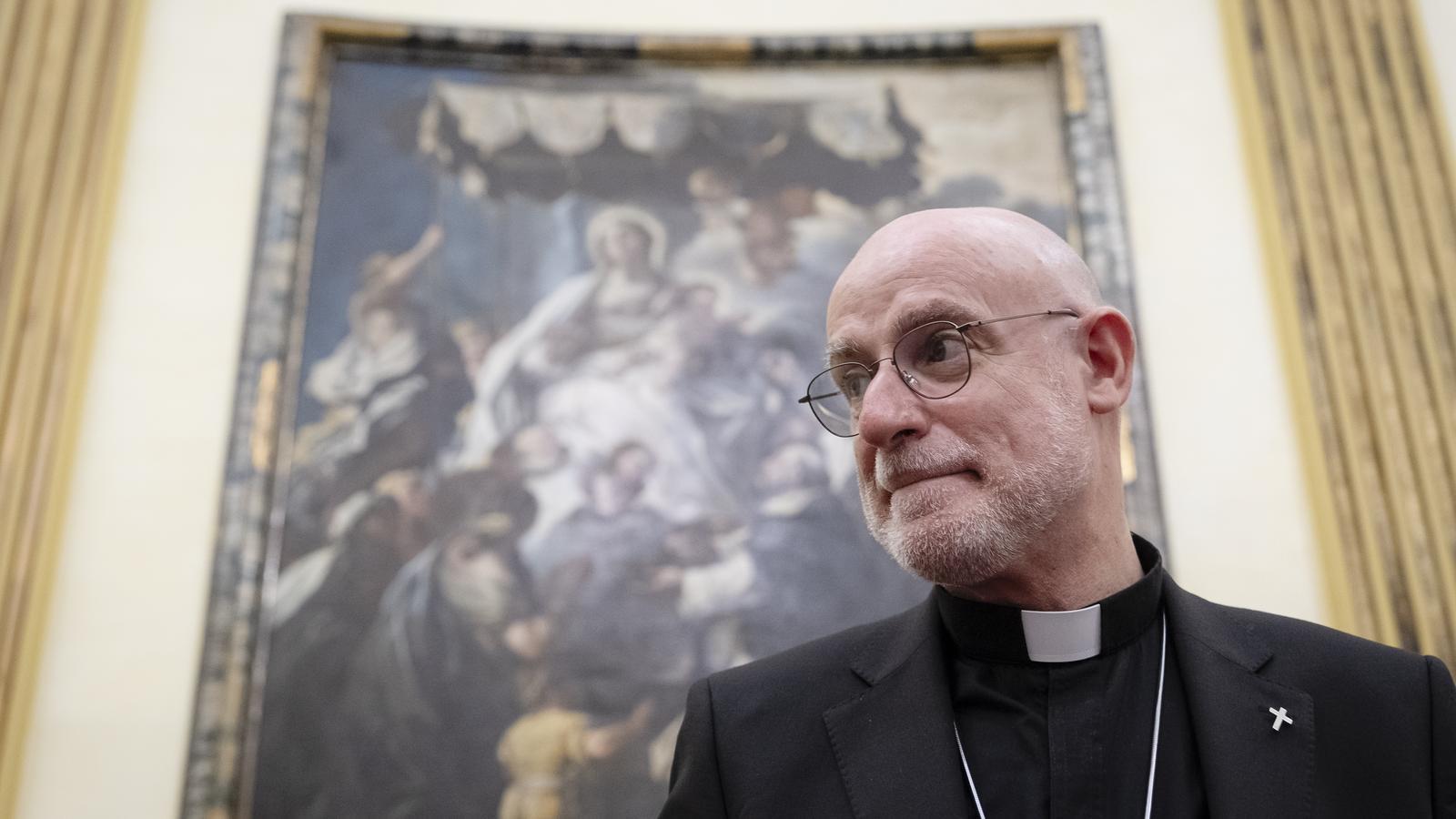
BarcelonaIntellectual capacity, a Catalanist and social idiosyncrasy, demonstrated leadership in a monastic community and a bishopric, direct liaison and fluid relationships with key institutions –the Royal Household, the Spanish government, the Generalitat, and the city's local executive–, skill in the art of high politics during critical moments, and a commitment to a Church focused on social causes. Friar Octavi Vilà i Mayo (Tarragona, 1961) meets a series of requirements that made him suitable in the eyes of Pope Francis to have been appointed this Wednesday to a position as relevant as that of Archbishop of Barcelona, the most important see in the Principality in terms of population, even though historically and by hierarchy it is Tarragona that holds the primacy in the Catalan Church. He is a man marked by a late vocation who has stood out through the discretion of work done and who currently leaves a void in the diocese of Girona, where he has served as bishop for the last two years. Who is he and what does he think?
Within the Church, he is a highly recognized person. At the end of February 2024, he caused surprise when Pope Francis appointed him Bishop of Girona, even more so considering he had come from being Abbot of Poblet. But he immediately made a great impression among the Girona faithful, whose esteem he has earned, according to various ecclesiastical sources. This Tarragona native already started on the right foot in Girona and now does the same in Barcelona, accompanied by the praise of Catholic Catalanist personalities and entities, but also by Archbishop Joan Josep Omella himself, who various consulted sources point out gave his approval. In fact, they have had a relationship for many years, even before Omella became Archbishop of Barcelona, due to his spiritual bond with the Abbey of Poblet, also through a priest very close to him like Josep Alegre, from the Franja like him, who also arrived at the monastery as abbot.
Even the mayor of Girona, the CUP member Lluc Salellas, has spoken wonders of him following his appointment in Barcelona: "You have done a very positive job as bishop [...]. You have been a very approachable, empathetic, and understanding person with everything that was happening in the region and you have understood the sense and vitality of Girona. It is a loss for the Christian community of the city, but good news for the country, because few people could do better as archbishop: you know the country and share the values of Catalan identity," he said. But his link with former president Carles Puigdemont still appears everywhere, criticized by Spanish nationalism; when he was appointed bishop of Girona, Puigdemont said that it had "filled him with joy" and that it was an "intelligent and sensitive" choice.
The extreme right has already harshly attacked the supposed "good friendship" that unites him with former president Carles Puigdemont, a terminology that the radical right uses by drawing on newspaper archives and which they take advantage of to frame the move as a conquest for Catalan independence after eleven years of a profile distant from this ideology. The campaigns against him, therefore, did not take long: for weeks, radical groups have been attacking him in ecclesiastical forums before the appointment took place, which they have not been able to prevent. The fact is that Puigdemont has a strong bond with Poblet since he was little, when he was a guest there some summers. When he was president of the Generalitat, he had contact with Vilà, who was the abbot at the time. It must be taken into account that Vilà supported the right to decide during the 'Procés' and rowed in favor of dialogue, provided that "the will" of the Catalan people was respected. Like the rest of the Church, he welcomed the measures to end the repression, even more so considering that he visited the prisoners. He is also a firm defender of the Catalan language and has defended the Church as an institution that can be key for "linguistic integration" and has opposed "extremisms" regarding the propagation of hatred towards immigration, which makes him a forceful person regarding the radical right.
His good manners and diplomatic skill, so admired by the Holy See, do not prevent him from raising his voice in the face of what he considers injustices. Before the Pope's visit to Catalonia, he championed the use of Catalan, for example, and during the visit, he aroused admiration that was decisive for the decision to appoint him bishop.
Harmonies
When it transpired multiple weeks ago that Vilà was the big bet, numerous voices within the Church were already pointing out to ARA that it was "magnificent news" and that "there was no one better than him." With a profile very similar to the pro-Catalan Joan Planellas, Archbishop of Tarragona, it is striking that the day after his appointment, they are both celebrating a mass together at the Sagrat Cor in Girona. The rapport between them is deep, just as it is one he has cultivated with other Catalan bishops such as those of Lleida, Sant Feliu, or Omella himself, who has highlighted it publicly.
One of the things that has been remarked upon most internally is Vilà's ability to unite, taking into account the difficulties that Barcelona presents. Numerous ecclesiastical sources point out that the Church suffers from multiple divisions in this diocese, which is why the choice was especially thorny: a rift between conservatism and ecclesiastical progressivism, between Catalan nationalism and Spanish nationalism, division by social class, and also regarding the spiritualist or more social and welfare-oriented approach. A monk has come to resolve the great "mess." From a political point of view, it has also been solved with diplomacy, with someone pro-Catalan but flexible and well-connected.
Spiritual, he entered the monastery in 2005, at over forty years old, and became abbot in 2015. His bond, however, had begun between 2000 and 2005 as secretary of the Brotherhood of Poblet, promoted by Abbot Alegre. He was also secretary of the board of trustees of Poblet; secretary and vice-president of the Bibliographic Archive of Santes Creus between 1998 and 2005, and a member of the board of trustees of the Montserrat Tarradellas i Macià Archive between 2000 and 2005.
Graduated in geography and history in 1984 and with a diploma in librarianship and documentation, he worked at the Tarragona Newspaper Library between 1983 and 2005. He is also one of the voices most committed to the fight against sexual abuse, intends to promote the role of women in the institution, as well as that of the laity, and believes in synodality.
